The
mythology of Daksha Yagya remains central to the origin and the
substanance of the Shakta form of worship and particularly to the
establishment of the Shakti Peethas across the sub-continent. It is
believed that when a distraught Mahadeva performed the Rudra Tandava with
the corpse of his wife Sati on his shoulders, her body disintegrated
and fell across the Indian subcontinent. Each area in which a part of
her body fell, became a Shakti Peetha where the Devi was consecrated in
some form. The number of Shakti Peethas in India are often a topic of
contention, but there is no ambiguity about the 18 Maha Shakti Peethas
where the divine mother is worshipped in her various forms. Adi
Shankaracharya in his Ashta Dasa Shakti Peetha Strotam laid
down the names of the 18 Maha Shakti Peethas spread across multiple
states of India and Sri Lanka. Each of these deities including the Ma
Biraja in Odisha, Ma Kamarupa in Gauhati, Ma Jwalamukhi in Himachal
Pradesh and Ma Shankari Devi in Sri Lanka are still worshipped in their
respective temples and devotees throng their abode through the course of
the year.
It is that
time of the year when we are remembering Shakti, the divine mother, the
Sri Mata and celebrating the divinity embedded in the female form all
across the country. The 18 Maha Shakti Peethas along with the numerous
Devi temples spread across the length and breadth of the country are
resplendent in the glory of the Adi Shakti that resides there. But, in
the midst of all this, there is one Maha Shakti Peetha, a temple central
to the Shakta tradition, the temple where the Devi resided as the
Goddess of knowledge and learning that remains far away from the
celebrations. The temple lies abandoned, the Vigraha of
the Devi destroyed and the stories of the temple as the centre of
learning and education gradually being pushed into the pages of history.
And while we celebrate, it is important to relive and remember the
enormity of what we have lost and resolve to regain the lost Goddess.
Namaste Sharda Devi, Kashmira Puravasini,
Twamaham Prarthate Nityam, Vidya Danancha Dehime
One of the
18 Maha Shakti Peethas lies at the base of the Shamshabari range at the
confluence of the rivers Madhumati and Kishanganga. Nestled at the base
of the beautiful mountain range in her homeland of Kashmir, was the
Goddess of Knowledge, Devi Sharda. The belief that the right hand of
Devi Sati, the hand symbolic of writing and learning fell in this holy
land also made it the abode of the Goddess Saraswati in the form of
Sharda. It is said that Kashmir at a point was known as Sharda Desha and
the temple was a hub of learning and erudition. The small village of
Sharda did not just have the temple of the Devi but was also home to one
of the largest universities in Central Asia. The Sharda script which is
native to Kashmir is named after this form of Shakti.
Kashmir is
known as one of the oldest Shaiva Kshetras but there is a strong Shakta
tradition in the state which is often ignored. And this Shakta tradition
owes its origin to the presence of Devi Sharda. The earliest mention of
the shrine can be traced to the Nilamata Purana which particularly
elaborates on the various tirthas and peethas of Kashmir. The Sharada
Mahatmya tells us the story of Muni Shandilya worshipping Sharada Devi.
Kalhana’s Rajatarangini also has a detailed description of the Goddess
and the shrine at the confluence of the two rivers. One of the most
vivid accounts of the temple has been provided by Aurel Stein who has
translated Kalhan’s Rajatargini in a chapter titled, ‘The shrine of
Sharda’.
But today,
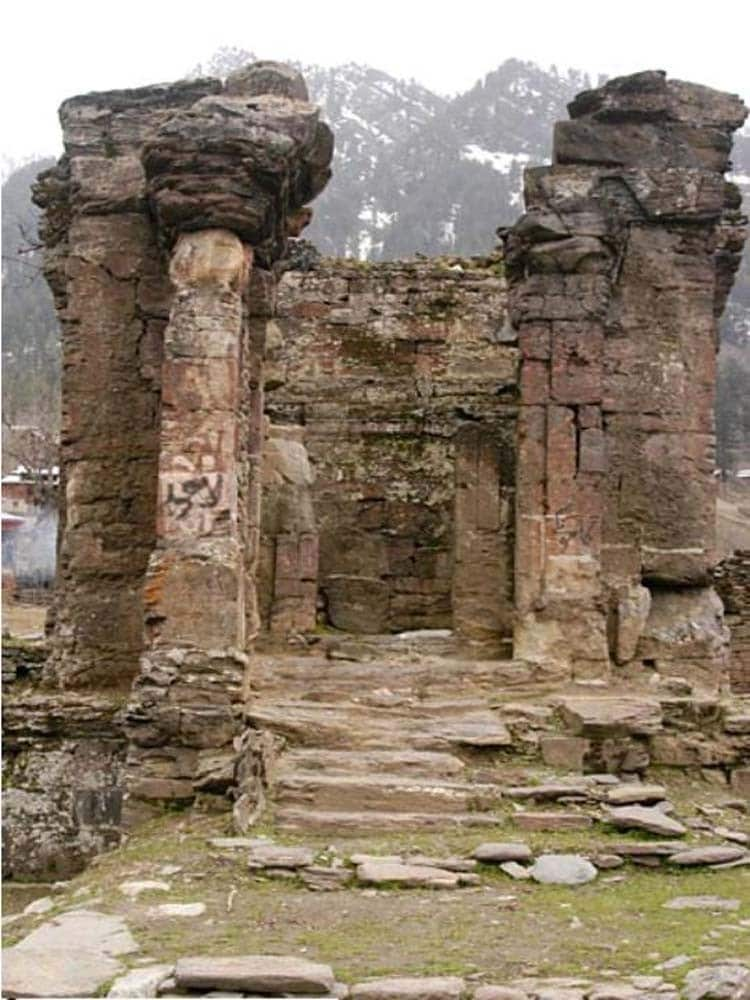
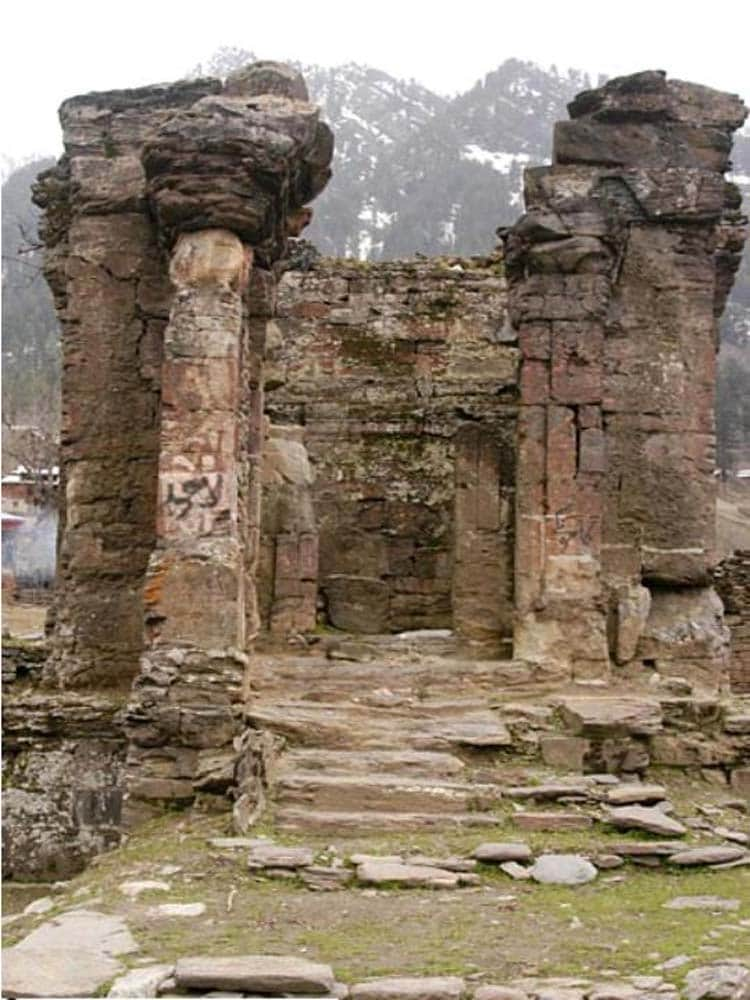
the abode of Devi Sharda lies desecrated and abandoned in Pakistan
Occupied Kashmir. After the mass migration of Kashmiri Hindus from PoK,
the temple was completely cut off from the devotees and gradually
started falling into disrepair. The temple lies unattended since
decades, the deity or Vigraha of the Goddess is long gone and the
earthquake of 2005 has even made the structure absolutely vulnerable.
There are even instances of theft which have come to light with one of
the Kundas from the temple being located at the Abbas Institute of
Medical Sciences, Muzaffarabad. Unlike the other big Shakti Peeth in
Hinglaj, Balochistan, Hindus of Pakistan have almost completely stopped
visiting the shrine of Devi Sharda. Once the seat of learning and
education, the tiny village of Shardi, has almost become a footnote in
the tumultuous history of Kashmir. The one thing that keeps the allure
and the longing of the shrine alive are the stories and oral traditions
that pass down generations in Kashmiri Hindu households.
But, even
oral traditions are dwindling with time. The last devotees who visited
this Maha Shakti Peeth did so before independence and the collective
memory of the shrine is at a risk of getting lost. One of the last
documented accounts of the temple is by nonagenarian Shambhunath Thusu.
It is unclear whether he has seen the temple but he has provided a
thorough description of the Vigraha. The Vigraha is a naturally
occurring stone plinth about six feet long and seven feet wide. Another
old timer account of the temple also provides a similar account and
states that there was an entrance of the Western side of the temple and a
Shiva Lingam outside the sanctum sanctorum. Another account came from
Justice S.N Katju who visited the temple in 1935. He added that “the
steps leading to temple were twisted like an earthquake had battered
them”. The details are sparse now and the images available make it
difficult to imagine the temple in its days of glory.
Brigadier
Ratan Kaul in his paper ‘Abode of Goddess Sharda at Shardi’ discusses
the elaborate preparations for the Sharda Peeth Yatra which used to
happen regularly before 1947. He has drawn from the accounts of Pandit
Bhawani Kaul and Pandit Harjoo Fehrist who had undertaken multiple
pilgrimages to Shardi in the late 1800s and whose accounts survived as
oral traditions in Kashmiri Hindu households. The pilgrimage used to
take 9-10 days on foot from Sri Nagar and pilgrims used to keep joining
the group as they passed through major halting locations.
One of the
most recent accounts of the visit to the Sharda Peeth is provided by A.R
Nazki in the book ‘Cultural Heritage of Kashmiri Pandits’. Nazki
visited the Peeth from Muzaffarabad in PoK in the year 2007 and in the
chapter titled ‘In search of Roots’, he describes the treacherous yet
tranquil terrain to Shardi made even more inaccessible after the
earthquake of 2005. Mr. Nazki describes the state of ruin of the temple
and details out all that has been able to bear the neglect of decades.
He writes of the faint inscriptions in the Sharda script on the entry
pillar of the temple and remnants of quarters where the Pujaris must
have lived in the days gone by. Only the left half of the archway stands
and the door and the roof of the temple are no longer there. The
university which used to thrive at Sharda has no remains and apparently
there used to be a pond with healing water in the compound which has
since dried up. Nazki writes, “The building presented a picture of ruin
and is a victim of neglect, its academic and instructional importance
appear to be only a dream”.
The
cultural sociologist, Ann Swidler in her famous article, ‘Culture in
Action: Symbols and Strategies’ talked about a tool kit of habits and
styles which people use to strategize their actions. Religious beliefs
and practises are a major part of that tool kit which determine our
actions, behaviors and decisions. Hence, our religious practises define
us on a daily basis and alienation from that has a profound impact on
the way we imagine ourselves. The cultural moorings of a community
cannot be understood without understanding the way in which they have
developed with the help of their religious beliefs and practises. This
is just one of the ways of assessing what being cut off from essential
religious beliefs and practises is like.
The
enormity of the loss of losing the Temple of Devi Sharda needs to be put
into perspective especially because it has been nearly 7 decades since
the temple has fallen into disrepair and abandonment. Our temples are
the link to our heritage, our shared history and our identity. When I
started reading and learning about the temple, I could only go back to
what I know and relate easily to. How would it feel to be a practising
Hindu in Odisha and not have the temple in Puri to visit or to see it
desecrated? Or to be a Sikh residing in India and never being able to
visit Nankana Sahib and seeing it in disarray? How would it feel to be
cut off from a physical manifestation of your identity and culture and
see it in ruins out of your reach? How would it feel to celebrate Basant
Panchami with the Goddess of Knowledge being uprooted from her home for
decades? How would it feel to celebrate nine days of Shakti. knowing
that we have been alienated from drawing our strength from our roots?
Whether you measure this in religious or cultural terms or just in terms
of collective identity, this is a loss beyond measure.
I met Dr.
Sushma Jatoo, a Sanskrit scholar working with the IGNCA and asked her
about the extent of the desecration of the temple. She refused to use
the word desecration but admitted that the Vigraha of the Goddess is no
longer present in the temple and the shrine remains unattended.
Sometimes, semantics is the only way of keeping memory alive and the
importance of Devi Sharda in the everyday lives of Kashmiri Hindus could
be gauaged from Dr. Jatoo’s reluctance to use the word ‘desecration’.
Desecration implies profaning or polluting something beyond repair and
probably to the Kashmiri Hindus like Dr. Jatoo, there is no way that the
temple of their beloved Goddess can be profaned. In the face of all
that the Hindus of Kashmir have borne, even language is a form of
resisting complete erasure.
Therefore,
Hindus and Kashmiri Hindus in particular wait for the recovery of the
temple. And that would begin by ending the alienation of the temple and
beginning to revive the temple again. But, the Neelum valley is one of
the most disturbed areas in the current political atmosphere and the
government of Pakistan is against issuing visas to any Indian citizens
to visit the area. It is against these odds that a group called the
‘Save Sharda Committee’ comprising of Kashmiri Pandits have started a
campaign to revive the pilgrimage to Sharda Peeth. The demand is along
the lines of the pilgrimage to Nankana Sahib in Pakistan which allows
the Sikh community staying in India to remain rooted to their identity
and culture. Together with another group called the All Pandits Migrants
Coordination Committee (APMCC), the activists have already met the
ex-CM Mehbooba Mufti and are planning to petition to the Prime Minister.
They have also reached out to the MoS PMO and MP from J&K Mr.
Jitendra Singh, the Minorities Affairs Minister Mr. Muqhtar Abbas Naqvi
and the Shankaracharya of Shringeri Mutt with their demands.
Our deities
live with us. Not just their legends. Our temples sustain our
communities. They don’t just turn into museums or relics. The Goddess of
Kashmir is lost. Much like the Hindus in her home are. Look closely and
you will see that abandoned home, those lost days of glory, that
struggle to stay alive through collective memory. Look closely and you
will hear the stories and the chants but you will not be able to
experience them. That is what being uprooted and lost feels like.
The Goddess needs to get her home back.
Much like her devotees in her homeland in Kashmir need their homes back.
(The
only efforts being made in this regard are the efforts of the Save
Sharda Committee led by Mr. Ravindar Pandita and APMCC to begin the
Sharda Peeth pilgrimage. In the current political situation, it is a
tall task, but we can do our bit to ensure that the activists do not
walk alone with their demands. )
Bibliography
Ahmad, Q.
J., & Samad, A. (2015). Sarda Temple and the stone temples of
Kashmir in perspective: A review note. Pakistan Heritage.
Ashraf, M. (2007). The Shrine of Sarada. Greater Kashmir.
Godbole, S. (n.d.). The Sharda temple of Kashmir. Retrieved from Kashmir.
Kaul, B. R. (n.d.). Abode of Goddess Sharda at Shardi.
Nazki, A.
R. (2009). In search of roots. In S. S. Toshkhani, & K. Warikoo,
Cultural Heritage of Kashmiri Pandits. Pentagon Press.
Rehman, F.
u., Fida Gardazi, S. M., Iqbal, A., & Aziz, A. (2017). Peace and
Economy beyond faith: A case study of Sharda temple. Pakistan Vision .
Singh, D.
(2015). Reinventing Agency, Sacred Geography and Community Formation:
The Case of Displaced Kashmiri Pandits in India. The Changing World
Religion Map.
As part of
their daily worship, Kashmiri Hindus utter the phrase" "Namastey Sharada
Devi Kashmir Pur Vasini Tvam Ham Prartheye Nityam Vidya Danam Che De hi
mey" (Salutations to you, O Sharada, O Goddess, O one who resides in
Kashmir. I pray to you daily, please give me the charity of knowledge).
It is only when the All Parties Migrants Coordination Committee (APMCC)
organized a recent seminar and press brief on Sharda Peeth and expressed
its desire to request the State Government and the Government of India
to demand opening of the shrine to religious tourism that I decided to
deeply educate myself on the issue. Anything one touches in Jammu &
Kashmir brings an element of fascination because hidden far into the
nooks and crevices of its mountain ranges are amazing theories, stories
and facts.
All these
years I used to fly over the Shamshabari Range, visiting Tithwal and
Keran without an iota of an idea of the existence of a near derelict
shrine at the western base of the Range near the confluence of the
Rivers Kishanganga (known as Neelum in PoK) and Madhumati. The exact
location to most will hardly gel except to hard core army men who have
had the privilege to serve in this sub sector. Here is how you get
there. From Muzaffarabad a road goes to the Neelum Valley and is aligned
at the north edge of the river. Between Athmuqam and Dudniyal lies the
confluence of the two rivers and there exists this ancient temple of
Goddess Ma Saraswati (also known as Sharda). It is said that Kashmir was
once known as Sharda Desh and was the center of learning of Vedic
works, scriptures and commentaries. Although there are different
accounts recorded it is evident that a very bustling intellectual
community existed in and around the area where the shrine is located.
‘Sharda Peetham’ (Centre for Advanced studies) was the nerve center of
learning and it was the Sharda script which was in use. The shrine did
not have a deity but a very large plinth/slab and outside there was a
Shivling (symbolic idol of Lord Shiva). Sharda Temple had the main
girdle of 22 feet diameter. It had an entrance door on the west. The
other entrances had arches over them, and these arches were 20 feet in
height. The main entrance had footsteps. On both sides of the porch,
there were two square shaped pillars, 16 feet high and 2'6" x 2'6" in
sectional size carved out of a solid stone block. The construction
inside the temple was very plain and unadorned. The temple is situated
on a hillock, on the right bank of river Madhumati. An annual fair used
to be conducted here. All the information here is courtesy Mr Bamzai, a
Kashmiri Pandit scholar who was one of the last to visit the shrine
before the partition 1947.

Although
the shrine and the Peeth were suppressed during the Muslim rule it was
Sultan Zainul Abedin, also known as Budshah, in whose rule it received
royal support. Thereafter in 1846 Maharaja Gulab Singh undertook the
repairs, maintenance and sustenance of the shrine through the placement
of a priest. After 1947 it is known that Hindus from Pakistan visited
the shrine which was also being maintained by the Pakistan Archeological
Department. The 8th Oct 2005 earthquake which affected Pakistan
Occupied Kashmir very adversely also had its impact on the Sharda
shrine. The status after the earthquake was not known until now when Ms
Rukhsana Khan a Pakistani researcher has undertaken to unravel more
details. It is learnt that the University of Muzaffarabad has instituted
study of the shrine and the Sharda culture.
The one
obstacle to the further revival of the Sharda site is the permission
which is denied to Kashmiri Hindus to visit it. There is an apparent
reason for this. The Neelum Valley is one of the most sensitive sub
sectors in the vicinity of the Line of Control (LoC). From Kel in the
North via Athmuqam and Dudniyal to Tithwal (our side) the valley is
under the complete domination of the Indian fortified positions along
the LoC. There is a cartographic bulge on the eastern side called the
Bugina Bulge which is a swathe of territory hugging the slopes of the
Shamashabari. This is the sub sector of the Pakistan side which is used
for launch pads to infiltrate terrorists into the Kupwara sector of
Kashmir. Strategically it is also very important because the foothold
that the Pakistan Army has in Bugina Bulge is tenuous; it can be rolled
aside at will by the Indian Army if the latter wishes to alter the
alignment of the LoC. The Neelum Valley Road running at the valley floor
is already dominated by the Indian Army and this domination will be
completely reinforced should Bugina Bulge fall into Indian hands. It
will impose a heavy penalty on the logistics maintenance of some of the
areas north of Shamashabari held by Pakistan.
It is for
these reasons that Pakistan is extremely wary of giving access to any
visiting Indian media people or others to the Neelum Valley.
APMCC, led
by two very passionate gentlemen, Mr Vinod Pandit and Mr Ravinder
Pandita, has been instrumental in making serious attempts at reviving
ancient Kashmiri culture. One of the methodologies that they have been
employing is the revival of some ancient yatras to important shrines
which are tucked away in the lap of nature. Among these are the yatras
to Gangabal and to Konsarnag. The State Government has been hesitant for
various reasons especially due to security concerns. There is a
political element to it which is also sensitive because there have been
demands about limiting the foot fall of the most revered Hindu yatra to
Shri Amarnathji shrine.
In the same
spirit of openness in issuing visas for visits to Ajmer Sharif for
Pakistani devotees or for Nankana Saheb in Pakistan for Sikh devotees;
also in the spirit of the proposed enhancement of religious tourism to
important shrines the Kashmiri Hindu community has been vociferously
demanding permission to visit the Sharda site. The need for revival of
an annual mela (pilgrim fair) at the shrine has been projected. However,
the Pakistani authorities are unlikely to relent for two reasons.
Firstly, Neelum Valley is strategically too important a location unless
there is a convincing change of strategic climate between India and
Pakistan. Secondly, unless the State Government itself promotes some of
the yatras the revival proposal for Sharda yatra will hardly sound
convincing.
The
Kashmiri Hindu community justifiably feels that with its almost
negligible presence in Kashmir its rich heritage in terms of shrines and
yatras would get completely diluted. It is making a brave effort
towards the retention of its unique culture. The Sharda Peeth Yatra may
as yet be a shrine too far but definitely the opening up of ancient
yatras within Kashmir to a degree beyond than just symbolism would be a
very positive step towards the integration of cultures.
It is to be
appreciated that Muzaffarabad University and research scholars like Ms
Rukhsana Khan have displayed much enthusiasm towards the Sharda site. If
nothing else Government of Pakistan must be prevailed upon to carry out
more extensive repairs of the shrine and the fort complex near it.
However, physical repairs and maintenance can never match the emotions
of devotees. An escorted delegation of just a few representatives of the
Kashmiri Hindu community traveling via Keran (Kupwara) would pose
little security risk for the Pakistan Army and would actually add to
good will.
APMCC needs
support and its campaign needs to be given some weight because only
with such things will the reciprocal reintegration of Kashmiri society
begin.




View comments