Burzahom site contains elevan megalithic
structures. Out of these structures five structure still stand tall
while as rest others have fallen. These structures are dated back to the
neolithic age. Many items of historical importance, like bone and stone
tools, have been found here. This site also has number of dwelling and
burial pits, which confirms the human activity in Kashmir is ages old.
Archaeological excavations have revealed four phases of cultural
significance between 3000BC to 1000BC which tell the tales of Neolithic,
Megalithic and Post-Megalithic era. The site is on an ancient
Pleistocene lake bed.
Burzahom means Birch, a tree species. The roofing material of the
excavated housing area confirmed the existence of the tree even in the
pre-historic Neolithic times. The first excavation of this site was done
in 1936 carried out by Yale-Cambridge expidition. Later another
detailed investigation was done between 1960 and 1971. Skeletal remains
of the Neolithic people found at Burzahom are similar to those found in
Harappa of Indus valley civilization.
Burzahom site has been named as the Northern Neolithic Culture in
view of its distinctive structural features with profusion of tools made
of bones and stones and tools representing the ritualistic practices.
This site has now been nominated as the UNESCO World Heritage Site.
Some historians state that Vedic Aryan culture extended till Kashmir,
but as per the archeological facts and ancient remains, Aryans in
Kashmir theory still is a question mark.
The initial excavations in Burzahom are both, vertical as well as
horizontal. The site is full of pits - circular or oval shaped dug in
karewa soil formation - which were inferred as dwelling units. Some deep
pits have ladder access. Some shallow pits close to housing pits
contained bones of animals and also tools made of bones and stones.
Carbon dating establishes that this site is dated before 2.357BC.
There are also sites found during the second excavations shows the
burial culture of both humans and animals.
Deep oval shaped pits were located with skeletons of humans
positioned along with the bones of animals, were considered to be the
burial sites. The site is maintained in the form that has been
excavated, representing the natural setting of the Neolithic people. The
exposed pits and the layout are well protected
Burzahom : Ancient Kashmir and its Dogs Generated by IJG JPEG Library
The most Ancient remains of human settlement discovered in Kashmir
are at a place called Burzahom near Srinagar. It is a settlement from
the Neolithic Period and transits to the ancient period ranging from
8000 BC to around 1000 BC. It was discovered in 1935 and the excavations
were done over a period of time and the excavations have been in three
stages, NP III corresponding to the later period, NP II to the middle
period and NP I to the earliest period. The Site is currently on Unesco
World Heritage Watch List and it might get the status of a World
Heritage Site in the future maybe.
As per the UNESCO “The Neolithic Site of Burzahom in the district of
Srinagar, India brings to light transitions in human habitation patterns
from Neolithic Period to Megalithic period to the early Historic. From
transition in architecture to development in tool-making techniques to
introduction and diffusion of lentil in North-Western India, the site of
Burzahom is a unique comprehensive storyteller of life between 3000 BC
to 1000 BC.
Archaeologist have excavated subterranean dwellings as well as burial
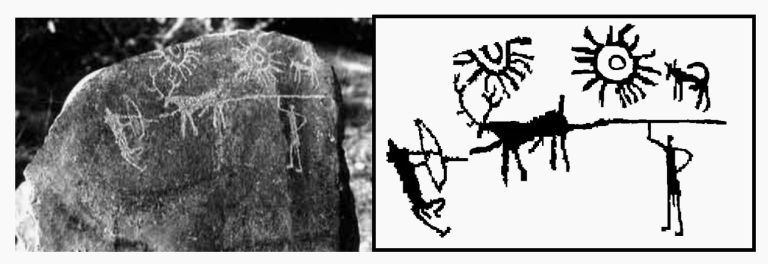
pits at Burzahom. One of the most famous Work of art discovered at the
site is a scene painted on a stone which shows the Burzahomese on a
hunt. There are two hunters and a Deer and along with them is their best
friend, yes you guessed it right, a Dog. And also interestingly the
scene depicts two suns. As per the scientists the this is the first
instance of a supernova being recorded in ancient times. Which of course
makes this indeed a very interesting find.
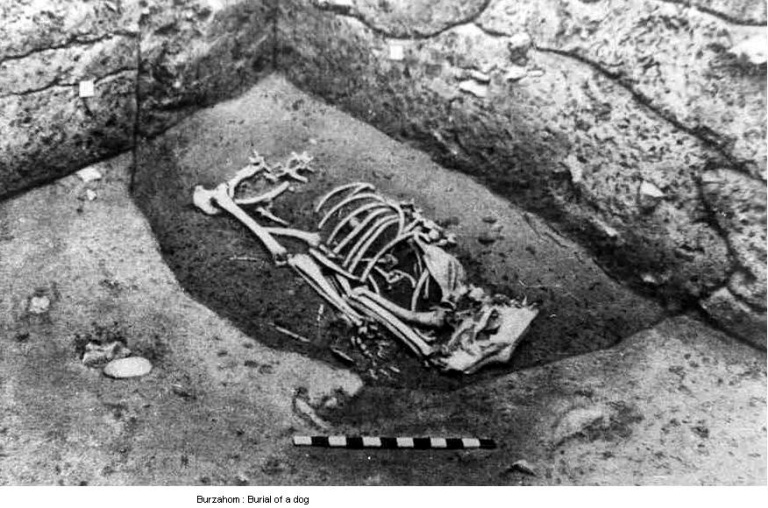
Dogs it seems held a special status in the Burzahom culture. Dogs,
Wolves and Ibex seemed to hold a special significance as burial pits
containing their skeletons have been found. More interestingly a couple
of burial pits have been discovered where the Dog is buried right next
to the master within the compounds of the dwelling units. There is even
an instance of Dogs buried in two layers one above another. Unlike in NP
I where no burial remains have been found, in NP II culture many such
burial pits have been found. This points out to the growth of a belief
system and a transition to the ancient age from the Neolithic period.
Interestingly this Dog burial culture is similar to the Shilka
culture, for whom the Dog was almost a cult animal, around the Shilka
River which is a tributary to the Amur River in Siberia bordering
Mongolia as well as other such cultures of the Gilyaks, Ulchis and
Goldis where till recent history Dogs were sacrificed and buried with
their owners. Probably to serve them in the their afterlife as well. It
surely sounds cruel in today’s time and age and actually it is but in
that time and age it made sense to those people to send a dead man’s
best friend along with him to the next world. where animals were
sacrificed as well and buried along with the person.
The pottery found at the site seemingly has a great similarity to
similar remains found in the Swat Valley in Pakistan. And as mentioned
earlier the burials practices and the type of tools found have been
inferred as having close resemblance to those found in North Chinese
Neolithic cultures which borders Siberia as well as Mongolia.
This practice is not seen anywhere in India. This again points out to
the fact that Kashmir was the place where Central Asia met the Indian
subcontinent. UNESCO also states that ‘ The results of excavations have
provided dynamics of interchange of ideas between Central Asian and
Southwest Asia through the Valley of Kashmir which acted as a bridge
between higher Himalayas and beyond on one hand, and the Gangetic Plains
and Peninsular India on the other hand during the third millenium BC.
The interaction of local and foreign influences are demonstrated by the
art, architecture, customs and rituals as also possibly by the language
as demonstrated by some graffiti marks on pottery and others”
Historian M K Kaw in his book “Kashmir and its People : Studies in
the Evolution of Kashmiri Society” writes ” It is also clear that the
Dog had a special place for the Burzahomese right from the day he
settled in the Valley. This is further substantiated with the finding of
a burial in period NP II where the Dog is buried with the owner in the
house floor, preferably the compound. He has depicted him in the
engraving on the stone slab already stated earlier. The Dog guarded his
herd and helped him in pursuing the hunt on which his sustenance
depended ”
As of today the Dog is thriving. Thriving too much according to some
people. And Srinagar is full of feral Dogs. Of all the cities I have
been to I have never seen such a great number of Dogs in any other city.
Another fact that I think is responsible is that people in Kashmir
consume a great deal of meat. And of course a lot of this gets wasted
and consumed by these Dogs and hence due to the availability of meat
they thrive. Some people also put the blame on the political situation
but I would rather not go there.
But of course that doesn’t change facts about the importance of the
Dog in the Burzahom Culture. And the fact that we have been friends for a
very long time.
I am using 4 pics to highlight the Story as it is an important one
which needs to be told and people made aware ( If you think you have a
story which needs to be told with multiple pics please contact the
Admins.)
Main pic from February 2018. Srinagar, Kashmir
The is the last piece of 2nd set of my Kashmir travelogue. 3rd set to start soon.
First dig. Burzahom 1935
Many a discoveries in Kashmir were purely accidental. Among the many is the discovery of Burzahom.
In 1932, Helmut de Terra arrived in Kashmir valley on a geological study
tour. On a clear spring day, he undertook an excursion on the river
Jhelum. Travelling along the river bank, at one place, he noticed a
strange object emerging from the river bank. On close inspection he
realized it was a stone knife made of volcanic rock and fashioned like
old Paleolithic Levallois blades. It was the first such discovery in the
valley, in fact, first sign of Stone Age man ever found in the
Himalayan region.
De Terra was to return to Kashmir many times
looking for more signs. In 1935 , De Terra with T. T. Paterson as part
of Yale-Cambridge University Expedition, finally arrived on the curious
stone mounds atop Yanderhom Karewa about 10 Kms north-east of Srinagar,
just above the marshy flood-plain of the river Jhelum. To the
discoverers it was obvious that the stones were menhirs. In subsequent did, stone axes, pestles and bone tool were found.
The flood plain is now where people live. While the stones still stand, next to a cricket field.
Road to Burzahom
The burial pits discovered in 1960s
Burial
pit. Burzahom. 1962 . From 1960 to 1971 extensive digging was carried
out by T.N. Khazanchi to discover the cultural remains of a
civilization.
The
people who live around the area believe the pits to be dwellings of
Jinns and consider the place to be haunted. Some people come and tie
threads on the steel mesh, making wishes.




Thank u
ReplyDeleteThank u
ReplyDeleteThank u
ReplyDeleteWhat is the differentiating factor between the dwelling pits and the megalithic structures in terms of time. Could these be dating to same time?
ReplyDeleteVery Nice Article and original thinking
ReplyDelete