
|
|
Birth of National Conference in Kashmir
Dr Satish Ganjoo* |
 he Valley of Kashmir had been ceded by the Sikhs to the British in lieu
of indemnity imposed on the Lahore Durbar. The British made it over to
Maharaja Gulab Singh on March 16, 1846, for a sum of seventy-five lakhs
of rupees. In this way, the territory and people of Kashmir were
virtually sold to Gulab Singh by the British. Thus began the Dogra rule
in Kashmir. The creation of the Jammu and Kashmir State in 1846, through
the Treaty of Amritsar, was a master-stroke of British diplomacy in
Asia. No doubt, Kashmir never became a part of the British India domain,
but the British authorities allowed only minimum operational freedom to
the Dogra rulers. In fact, the British created a buffer State of Jammu
and Kashmir under the title of a “Sovereign State”’ to keep Russia at a
distance from British India and to counter the Czarist Russian “menance”
in Central Asia.
he Valley of Kashmir had been ceded by the Sikhs to the British in lieu
of indemnity imposed on the Lahore Durbar. The British made it over to
Maharaja Gulab Singh on March 16, 1846, for a sum of seventy-five lakhs
of rupees. In this way, the territory and people of Kashmir were
virtually sold to Gulab Singh by the British. Thus began the Dogra rule
in Kashmir. The creation of the Jammu and Kashmir State in 1846, through
the Treaty of Amritsar, was a master-stroke of British diplomacy in
Asia. No doubt, Kashmir never became a part of the British India domain,
but the British authorities allowed only minimum operational freedom to
the Dogra rulers. In fact, the British created a buffer State of Jammu
and Kashmir under the title of a “Sovereign State”’ to keep Russia at a
distance from British India and to counter the Czarist Russian “menance”
in Central Asia.In the middle of the 19th century, the growing menace of Russian expansion in Central Asia posed a direct threat to the security of British domain in India. So there was need to create a buffer between the two rivals in Asia. Kashmir, like Afghanistan, served the purpose. Installation of a British Commissioner in Ladakh in 1847-48 was a prelude to the forceful perpetuation of British imperialist policy in Kashmir. The British managed their Kashmir policy with extraordinary caution and subtle diplomacy. History of Kashmir in the second half of the 19th century should be studied in the backdrop of Anglo-Russian rivalry in Central Asia. Any move on the central Asian chessboard had its direct impact on Kashmir. The policies of the British in Kashmir were designed to fit in the scheme of their “frontier policy” in Central Asia. In 1885, the first British Resident was appointed in Kashmir. With this started the active British intervention in Jammu and Kashmir State. Creation of Gilgit Agency, subjugation of Chitral, establishment of a Council and finally partial deposition of Maharaja Partap Singh in 1889 was the completion of British imperialist strange-hold over Kashmir. This was managed by the British through their successive residents in Kashmir. State Peoples’ Movement in Kashmir against the autocratic rule of the Dogras started in the first quarter of 20th century. The people of Kashmir, who were humiliated by the sale of their motherland in 1846, were inspired by the national liberation movements in Russia, India and Afghanistan in the beginning of the 20th century. Like other oppressed people of the region, the people of Kashmir believed that their liberation will sound the death-knell of imperialism, colonialism and autocratic rule. With this purpose, some prominent Muslims of the Valley including Sad-ud-Din Shawl, Maqbool Pandit, Noor Shah Naqshbandi,Hasan Shah Naqshbandi, Maulvi Ahmad Ullah Hamadani, Sayyid Husain Jajali and others, sent a memorandum to the Viceroy of India in 1926,demanding the: 1. Proprietory rights of land; 2. Representation of Muslims in Government Services; 3. Education facilities; 4. Prohibition of beggar (forced labour); 5. Release of mosques and other religious places from State control. The viceroy forwarded the memorandum to Hari Singh, the Dogra ruler of Kashmir. Disturbed by this activities, Hari Singh decided to punish all those who submitted the memorandum. Sad-ud-Din Shawl and Noor Shah were expelled from the State; and, the Jagir of Hasan Shah was withdrawn. Other signatories of the memorandum apologized in writing. The Muslims of Kashmir were perturbed by the actions of Hari Singh and revolted against his orders. The Maharaja of Kashmir was compelled to withdraw the externment orders of Sad-ud-Din Shawl. This was the first conscious effort by the people of Kashmir against the autocratic rule. Shaikh Mohammed Abdullah, Mohammad Rajab, Qazi Saif-ud-Din Qari and Ghulam Ahmad Mukhtar returned from Aligarh on April 12, 1930, after completing their studies. It was during their stay at Aligarh that they developed political consciousness through their contacts with the leaders of Indian National Movement. This emboldened them to contribute articles in the newspapers of Lahore regarding the atrocities of an autocratic rule in Kashmir. No serious political party existed in Kashmir up to this time. It was in 1923 that Hargopal Kaul founded the Sanatan Dharm Sabha, with its headquarters at Rughnath Mandir, Srinagar. But the sole objective of this Sabha was to help Kashmiri Pandits in rehabilitating themselves after they received education at institutions outside the State. In 1924, many educated Kashmiri Pandits joined the Sabha, and they succeeded in developing contacts between the Kashmiri Pandits living in the State and those who had settled in other parts of India. Subsequently the Sabha started its move towards politics. The Muslim students, who had returned from Aligarh formed a small group with the objective of looking to the interests of the Muslim of Kashmir. Mohammad Rajab and Maulvi Bashir Ahmad opened a secret “Reading Room” at Syed Ali Akbar, Srinagar. The “Reading Room” worked as springboard for political discussion and anti-government propaganda. A Committee was constituted to collect funds for the perpetuation of this Reading Room. After sometime, a room was taken in the Zainakadal locality and the “Reading Room” was shifted there, but only to be re-shifted to the residence of Mufti Jalal-ud-Din at Fatehkadal. Election of the office-bearers of the “Reading Room” was held later on and Mohammad Rajab and Shaikh Mohammad Abdullah were elected as President and Secretary respectively. The following members were also nominated: 1. Mufti Jalal-ud-Din; 2. Hakim Ali; 3. Master Ghulam Rasul; 4. Ahmad Shah Fazli; 5. Hakim Ghulam Murtaza. In this way “Reading Room Party” came into existence. Regular meetings were now being organized in the Reading Room. The Party also managed to obtain statistics regarding Muslims in government service, and published them in the newspapers of Lahore - Inqilab, Mazloom Kashmir, etc. Later on these figures were also submitted to the Glancy Commission. Ghulam Ahmad Ashai was forcibly retired from State service for his “anti-government” activities. He joined the “Reading Room Party” and renamed it as “Muslim Youngmens’ Association”. After sometime the elections of the Association were held in which Ghulam Ahmad Ashai was elected as President and Shaikh Mohammad Abdullah as Secretary. The other members were: 1. Ali Mohammad Shah; 2. Hakim Ali; 3. Hakim Mohammad Safdar; 4. Mohammad Rajab; 5. Hakim Ghulam Murtaza; 6. Pirzada Ghulam Rasool; 7. Ahmad Shah Fazli; 8. Pirzada Ghulam Ahmad; 9. Ghulam Mohammad Khan; 10. Ghulam Hasan Khan; and, 11. Ahsan Ullah. Moulvi Mohammad Yusuf Shah and Moulvi Ahmadullah Hamadani also joined the Association subsequently. It was Moulvi Mohammad Yusuf Shah who selected the Shaikh as leader of the Association and introduced him to the public. Shaikh Mohammad Abdullah then started delivering his public speeches and demanded the government service for the educated Muslim youth, freedom of press and platform, release of religious places to Muslims and lifting of ban on religious ceremonies. After serving in Islamia High School for some time, Shaikh Mohammad Abdullah was appointed as teacher in Government High School, Srinagar. In Jammu, a Muslim Party – Youngmens’ Association was already working as a substitute under the guidance of Qazi Gauhar Rahman, Allah Rakha Sagar, Ghulam Haidar Ghori, Moulvi Ghulam Haidar Shah and others. On April 19, 1931, when the Idd was being celebrated, the local police at Jammu prohibited Imam Hai to deliver a speech at Idgah after the prayers. This injured the sentiments of Muslims in Kashmir and they protested against it. After a few days, it was reported that one police head-constable, Lobha Ram, desecrated the Holy Quran in Police Lines, Jammu. A deputation from Jammu came to Srinagar to protest against the alleged desecration. The Muslims of Kashmir were irritated any they threatened to revolt against the Dogra ruler. To defuse the situation, the transfer orders of Shaikh Mohammad Abdullah from Srinagar were issued. However, these orders were put in abeyance when the Shaikh approached the then Director of Education, Mr. Wakefield. But the orders were again issued by the State government and Shaikh Abdullah resigned from the service. This brought him into active politics and started a new era in his life.  Shaikh
Mohammad Abdullah announced his resignation from the government service
in a public speech at Khanqah-e Mualla, Srinagar. Moulana Zafar Ali
Khan, Editor ‘Zamindar’ (Lahore), was also present in this meeting.
Seeing the nerve and guts of the Shaikh, he called him Sher-i-Kashmir
(Lion of Kashmir) - the title which afterwards became his identity.
Shaikh
Mohammad Abdullah announced his resignation from the government service
in a public speech at Khanqah-e Mualla, Srinagar. Moulana Zafar Ali
Khan, Editor ‘Zamindar’ (Lahore), was also present in this meeting.
Seeing the nerve and guts of the Shaikh, he called him Sher-i-Kashmir
(Lion of Kashmir) - the title which afterwards became his identity.In 1928, a Kashmir Pandit girls, Durga Devi, was murdered and her body was recovered from a drain at Karan Nagar locality in Srinagar. Some cases of cow slaughter were also reported. This naturally perturbed the Pandit community of Kashmir and they compared all these developments with the brutal aristocracies perpetrated against them in Afghan period. These incidents built up communal tension and a resultant stir in the Kashmir Pandit community. On the other hand, the Holy Quran Movement, inspired by some religious-minded people, gained momentum in Jammu. Anti-government posters were issued in the city and smuggled into the Valley of Kashmir by Abdul Majid Qureshi. One person namely Mohammad Ismail of Fatehkadal, was detained for circulating these posters. This was the first political arrest in Kashmir. By the time the ‘Majlis-i-Ahrar’ and ‘Anjuman-i-Ahamadiyya’ of Punjab also developed interest in the Muslim unrest of Jammu and Kashmir State. The State government, sensing the vast involvement of and inspiration for the Muslim cause from outside the State, proposed to meet a Muslim deputation and resolve the grievances through a dialogue. A public meeting was held on June 25, 1931, at Khanqah-e Mualla in which Mirwaiz Yusuf Shah, Moulvi Abdur Rahim, Abdul Qadir Khan and Shaikh Mohammad Abdullah delivered their speeches and took an oath to serve the Muslim cause in Kashmir. Syed Waliullah Shah Zain’ul Abidin and Choudhry Bashir Ahmad, who were deputed to Kashmir by the Jamait-i-Ahmadiyya Hind to guide and supervise the Muslim activities, also attended these public meetings. It was in one of these meetings that the following members of delegation were nominated to meet the State authorities and discuss their problems: 1. Mirwaiz Yusuf Shah; 2. Mirwaiz Ahmadullah Hamadani; 3. Ghulam Ahmad Ashai; 4. Shaikh Mohammad Abdullah; 5. Said-ud-Din Shawl; 6. Munshi Shahabuddin; 7. Agha Sayyid Hussain; 8. Choudhry Ghulam Abbas of Jammu; 9. Mistri Mohammad Yaqub of Jammu; 10.Sardar Gauhar Rehman of Jammu; and 11.Shaikh Abdul Majid of Jammu. Abdul Qadir Khan, who had delivered a highly anti-government speech at Khanqah-e Mualla, was arrested and prosecuted by the State authorities. A special court to try this first political case was established in Central Jail, Srinagar. A meeting was held on july 10, 1931, at Jamia Masjid, Srinagar, to protest again against the desecration of the Holy Quran by Lobha Ram. Ghulam Nabi Gilkar, Shaikh Mohammad Abdullah and Moulvi Abdul Rahim were among the prominent speakers. This stimulated the provocation among the Muslims. The first hearing of the case against Abdul Qadir Khan was held at Central Jail on July13, 1931. Muslims collected outside the jail and demonstrated in favour of Khan. Police arrested the five demonstrators, which made the mob furious and they tried to set the jail building on fire. Army was called in, and unwittingly, it opened fire to disperse the demonstrators resulting in the death of following seventeen persons and causing injuries to many others: 1. Ghulam Mohammad Halwai (Jamia Masjid); 2. Abdul Khaliq Shora (Wazapora); 3. Ghulam Nabi Kalwal (Pandan); 4. Ghulam Mohammad Sofi (Daribal); 5. Ghulam Qadir Bhat (Bahaudin Sahib); 6. Mohammad Ramzan (Khanyar); 7. Mohammad Usman (Kalashpora); 8. Ghulam Mohammad Naqash (Kadikadal); 9. Ghulam Rasool Darzi (Amdakadal); 10.Amirjoo (Gojwara); 11.Abdul Ahad (Gaokadal); 12.Ghulam Ahmad Qalbaf (Fatehkadal); 13.Amirjoo Makai (Nawakadal); 14.Shabanjoo Makai (Nawakadal); 15.Abdul Khaliq (Watalkadal); 16.Mohammad Akbar; and, 17.Abdul Kabir. Muslims were infuriated at this massacre. Chaos and confusion prevailed on all sides. The killed and the injured were taken in a procession to Jamia Masjid. The worst communal incidents took place in Srinagar when the Hindu shops at S.R. Gunj, Zainakadal, Bohrikadal, Vicharnag and other place were plundered, looted and set ablaze. Hindus living in other parts of the city were also victimized. In fact, the Hindus of Kashmir have always suffered because of anti-government sentiments of the majority community. There was virtually no law and order; and, the city was handed over to the army. Even today, 13th July is officially marked as “MARTRYS’ DAY” throughout the Kashmir Valley and there is public holiday. Sardar Gauhar Rehman, Mistri Mohd Yoqub, Choudhry Ghulam Abbas, Moulvi Abdul Rahim and Ghulam Nabi Gilkar were detained on the night intervening July 13-14, 1931. Shaikh Abdullah was also arrested on July 14, 1931, at Jamia Masjid by Brig Sutherland and taken to Badamibagh. Jamia Masjid was converted into a political platform and Mufti Jalal-ud Din became the first ‘dictator’ (volunteer) to offer his arrest. The courtyard of the Khanqa-i Naqshband Sahib was choosen as the “martyrs’ graveyard”. Anti-government hand-written posters were issued by the Muslims and distributed in different parts of the Valley. Ghulam Mohiuddin Kara, Pir Abdul Ahad Shah and Ghulam Mohammad Sadiq were also detained. By this time the leader of Indian National Movement developed contacts with the Muslim leader of Kashmir. Maulana Abdul Kalam Azad came to Srinagar on Augest 1, 1931, and met the detained leaders. It was after 21 days that all political detenus were released. But Abdul Qadir was sentenced to five years rigorous imprisonment. However, he was released only after one and half year. An agreement was concluded between the Muslim representatives and Prime minister of J&K State, Hari Krishan Kaul. But Shaikh Mohammad Abdullah and his colleagues were again arrested on September 21, 1931, which perturbed the Muslims of Kashmir and resulted in anti-government demonstrations. A “War Council” was started to chalk out an action plan against the Dogra administration. Besides arranging a protest meeting at Jamia Masjid, anti-government demonstrations and processions were taken out. The army opened fire at different places resulting in the death of the following persons: 1. Nasir-ud-Din (Chinkral Mohalla); 2. Rasuljoo (Drugjan); and, 3. Asad Gilkar(Narparistan). Curfew was imposed in the city of Srinagar on September 23, 1931. Fire was opened in Anantnag to disperse the demonstrators. After much criticism from within and outside for the attitude of administration, the government appointed Dalal Commission to enquire into the firing incidents. The Muslims armed with axes, sticks, ‘narchus’, etc. assembled at Khanyar to take the Maharaja to task for his indifferent attitude. Sensing the increasing dimension of the revolt, the Maharaja took administration in his own hands and dispatched his army chief, Southerland, to take the crowd into confidence and initiate negotiations with the Muslim representatives at Khanyar. Southerland managed the meeting of Mirwaiz Yusuf Shah, Sad-ud-din Shawl and Moulvi Mohammad Abdullah Vakil with Maharaja to wash off the grievances. With the help of this meeting, the Muslims agreed to postpone their proposed demonstration. But the situation remained explosive and the Dogra ruler imposed martial-law in the Valley. Martial-law courts were established at Central Jail, Police Station S.R. Gunj, Police Station Kothibagh and Exhibition Ground. Summary trails were conducted in these courts. The Muslims of Kashmir, who were settled in differents parts Punjab, became interested in the developments taking place in the Valley. A Kashmir Committee was constituted at Shimla on July14, 1931, at the residence of Zulfikar Ali Khan. Mirza Bashir-ud-Din and Abdul Rahim Dard were appointed as President and Secretary of the Committee respectively. This Committee sent the Jathas to Kashmir to fight authoritarian rule. “Kashmir Day” was celebrated in India and Burma on August14,1931. Majlis-i-Ahrar of Punjab also Started to sent the ‘Jathas’ (groups) to Kashmir to fight the authoritarian rule. “Kashmir Day” in other parts of India and Burma on August 14, 1931. ‘Majlis-i Ahrar’ of Punjab also send the ‘Jathas’ to Kashmir under the supervision of Syed Attaullah Shah Bukhari. These ‘Jathas’ came to Kashmir via Suchetgarh, where they constructed a mosque which is known as “Masjid-i-Ahrar”. Dr. Shaikh Mohammad Iqbal also visited Kashmir to access the situation here. He was appointed as President of Kashmir Committee. State administration efforts tried to take Mirwaiz Yusuf Shah into confidence. Some intruders- Abdul Aziz Fazli, Mama Pandit and Ama Pandit; arranged a secret meeting of Mirwaiz Yusuf Shah and Hari Krishen Kaul, then Prime Minister of the State, at the latter’s residence. Hari Krihen managed a telegram from Mirwaiz to the Viceroy of India saying that the conditions in Kashmir were peaceful and confirmed the loyalty of Muslims to the Dogra ruler. According to some unconfirmed sources, a yearly scholarship of Rs. 600 was sanctioned to Mirwaiz in returns for his unconditional allegiance to the Maharaja. However, the supporters of Mirwaiz refute the indictment as baseless and unfounded. Kashmiri Pandits suffered a concussion in the 1931 incidents. Kashyap Bandhu, a Kashmiri Pandit Arya Samajist, was called from Lahore to help and guide the Pandits in their survival. He was working as sub-editor of “Milap” there. “Sanatan Dharma Sabha” was converted into “Sanatan Dharam Yovak Sabha” and its headquarter was shifted to Shitalnath, Srinagar. Prem Nath Bazaz was appointed as its first President. Kashyap Bandhu started the daily “Martand” in Kashmir, which became the official organ of the Sabha. On November 12,1931, the Maharaja announced the appointment of Glancy Commission to look into the grievances of different communities of the State. Shaikh Mohammad Abdullah and his associates were released from jail on the provisional condition that he would isolate himself from politics. Mirwaiz Yusuf Shah asked Shaikh Mohammad Abdullah to distance himself from politics for sometime so that the situation can be brought under control. This irritated the Shaikh and he sensed a conspiracy between Mirwaiz and Maharaja. He specifically refused to obey the dictates of Mirwaiz and began to deliver anti-government speeches as usual. Irritated by the activities of Shaikh Mohammad Abdullah, Mirwaiz publically declared some “clean shaved” persons as the agents of ‘Mirzais’, who were misleading the Muslims of Kashmir for their personal interests. Mirwaiz passed these remarks in his sermon at Gadayar Masjid and the innuendo was directed at the Shaikh. It was after these remarks of Mirwaiz that Shaikh Mohammad Abdullah started to grow the beard. However, Mirwaiz-Shaikh rivalry was seriously felt. Maulvi Ahmadullah Hamadani, another Mirwaiz, announced his unconditional support to Shaikh Mohammad Abdullah. The “pirzadas” then came into open strife with Mirwaiz Yusuf Shah. It was on October 19, 1931, that the Muslims of Kashmir submitted through Sad-ud Din Shawl a memorandum to the Maharaja against the police atrocities. The Maharaja appointed Middleton Commission to investigate into the firing incidents in the Valley. As majority of Muslims in Kashmir were illiterate, Middleton Commission employed the service of a student from Sri Partap College, Mirza Afzal Beg, as English translator. About 400 Muslims appeared before the Commission. However the Commission submitted a pro-government report and washed away the claims of Muslim leadership. The political atmosphere in Kashmir now was being gradually dominated by Shaikh Mohammad Abdullah. He now embarked upon his decisive policy of eliminating his political rivals from the front line. At his instance Maulvi Ahmadullah Hamadani moved a “no-confidence” resolution in a public meeting at Khanqah-i Mualla on December 26, 1931, against Munshi Shahab-ud Din and Sad-ud Din Shawl. It was passed by the majority of people. The expelled leaders were alleged to be working against the interests of the Muslims.  The Maharaja or Kashmir was also trying to streamline his relations with
the Muslims to avoid any political uprising in the State. He was also
aware of the fact that the Muslims of India had since associated
themselves with Indian National Congress. He was conscious of the fact
that the close contacts between the leader of Indian National Movement
and those of Kashmir leadership would ultimately create tremendous
difficulties for him. As a gesture of goodwill, the Pather Masjid was
handed over to Muslims on November 1, 1931. But these efforts of
Maharaja bore no fruit. Allah Rakha Sagar of Jammu gave 24-hour notice
to the State government for acceptance of Muslims demands. This was
followed by disturbances in Jammu which compelled the Maharaja to seek
the help of the British. On November 4, 1931, Gurkha Army arrived in the
State to maintain law and order.
The Maharaja or Kashmir was also trying to streamline his relations with
the Muslims to avoid any political uprising in the State. He was also
aware of the fact that the Muslims of India had since associated
themselves with Indian National Congress. He was conscious of the fact
that the close contacts between the leader of Indian National Movement
and those of Kashmir leadership would ultimately create tremendous
difficulties for him. As a gesture of goodwill, the Pather Masjid was
handed over to Muslims on November 1, 1931. But these efforts of
Maharaja bore no fruit. Allah Rakha Sagar of Jammu gave 24-hour notice
to the State government for acceptance of Muslims demands. This was
followed by disturbances in Jammu which compelled the Maharaja to seek
the help of the British. On November 4, 1931, Gurkha Army arrived in the
State to maintain law and order.Besides the nomination of Prem Nath Bazaz as representative of Kashmiri Pandits, the following members were appointed to the Glancy Commission: 1. Ghulam Ahmad Ashai (Srinagar); 2. Choudhry Ghulam Abbas Khan (Jammu); 3. Loknath Sharma (Jammu); The purpose was to represent both, Hindu and Muslim, communities in the Commission and made it secular in character. For delivering the provocative speeches, Mufti Zia-ud Din Poonchi was expelled from the State in January 1931. Shaikh Mohammad Abdullah was also prohibited to deliver any public speech. But defying the prohibitory orders, he addressed a public meeting at Khanqah-I Mualla on January 23, 1932, resulting in his arrest and six months imprisonment. Choudhury Ghulam Abbas, Abdul Hamid Khan and Mohammad Yaqub Ali sent a protest note to Maharaja on February 11, 1932, against the detention of the Shaikh in Central Jail, Srinagar. Demonstrations and protest meetings were held in different parts of the Valley. Moulana Mohammad Syed Masoodi joined the political movement at this juncture. He delivered the anti-government speeches in the protest meetings at Khanqah-I Mualla, resulting in his arrest and meeting with the Shaikh in Central Jail. It was in detention that Shaikh Mohammed Abdullah and Moulana Mohammad Syed decided to from a regular regional political party - Muslim Conference. The Glancy Commission submitted its report to the State government on March 22, 1932. The Hindus felt that its recommendations were not favorable to the interests of community and ousted Prem Nath Bazaz from the presidentship of “Sanatan Dharam Yovak Sabha’. Jialal Kilam was the new President. In April, 1932, Kashmiri Pandits launched a vigorous agitation called “Bread Movement”, asking the Maharaja not to implement the recommendations of Galancy Commission. Hundreds of Hindus courted arrests in favour of their demands. Jialal Kilam, Kashyap Bandhu and other prominent Hindus supervised and guided the agitation. But, as usual, communal clashes took place in September 1932, killing the motive and spirit of agitation. Muslim Conference was formed in 1932. A convention of this party was held on October 14-16, 1932, at Pather Masjid under the chairmanship of Shaikh Mohammad Abdullah. The arrangements for this convention were made by Mirwaiz Yusuf Shah, Moulvi Hamadani and Moulvi Abdullah. The leaders of the newly-formed party demanded the implementation of the recommendations of Glancy Commission. On December 17, 1932, Shaikh Mohammad Abdullah left for Lahore to attend the working committee meeting of Muslim Conference. On his returns, January 20, 1933, Mirwaiz Yusuf Shah declared him a ‘Mirzai’, in his religious sermons at Khanqah-i Naqashband Sahib. This gave birth to regular clashes between the followers of Mirwaiz Yusuf Shah and Shaikh Mohammad Abdullah, now know as ‘Bakra’ (sheep) and ‘Sher’ (lion). To avoid the frequent clashes between their followers, a “Peace Agreement” was signed by these two leaders in presence of Wazir Mohammad Khan, Superintendent of Police. After these developments, Mirwaiz Yusuf Shah dissociated himself from Muslim Conference and also from the Shaikh. Moulvi Hamandani, who was involved in a long professional rivalry with Mirwaiz Yusuf Shah, wooed the support of Shaikh Mohammad Abdullah. The authorities of State government also sensed the professional rivalry between the two moulvis (preachers) and directed Mirwaiz Yusuf Shah to offer prayers in Jamia Masjid while Moulvi Hamadani was instructed to offer the same at Iddgah on the festival of Idd - April 16,1933. Mirwaiz Yusuf Shah perplexed by the government directives, went to Iddgah by way of protest to offer the prayers. To counter the move of Mirwaiz Yusuf Shah , Moulvi Hamadani entered Jamia Masjid. There were bloody clashes between the followers of two moulvies, who were known as “Cheka” and “Kota”. Dogra regime took a serious note of these clashes and charged the two moulvies of disturbing law and order in the Valley. Moulvi Hamadani furnished a bond for Rs. 1000, but Mirwaiz Yusuf Shah refused to furnish the same and decided to resist the pressures. The result was that the Mirwaiz was detained and taken to Udhampur Jail on April 27,1933. Shaikh Mohammad Abdullah was returning from Jammu on the same day and met the Mirwaiz at Kud. On his arrived in the Valley, he gave the details of his Kud meeting with the Mirwaiz. The rancorous remarks of Shaikh Mohammad Abdullah were resented by the followers of the Mirwaiz. The Muslims of Srinagar altogether got divided into rival groups - Sher and Bakra. Mirwaiz Yusuf Shah was released from detention on May 3, 1933, on the security-bond furnished by Sayyid Attaullah Shah Bukhari. On his release, Mirwaiz criticized Moulvi Hamadani and his close association with the Shaikh. It was followed by Sher-Bakra clashes. Shaikh Mohammad Abdullah was arrested along with some of his close associates and then released on August 7, 1933. The activities of Mirwaiz Yusuf Shah, Moulvi Hamadani and Shaikh Mohammad Abdullah were restricted to Jamia Masjid, Khanqah-i Mulla and Pather Misjid for three months. Mirwaiz Yousuf Shah and his associates - Abdul Rahim Banday, Munish Assadullah Vakil, Khazir Mohammad Zaroo, Munish Assadullah Hajji, Mama Barbazu and Abdul Salam Dalal, formed a party of their own and named it “Azad Muslim Conference”. To counter the activities of the Mirwaiz, Shaikh Mohammad Abdullah and his allies formed the “Shoda Conference” under the leadership of Ghulam Nabi Gilkar, Moulvi Abdullah Vakil, Mian Ahmad Yar and Bakshi Ghulam Mohammad. “Azad Muslim Conference” established its platform in Jamia Masjid and “Shoda Conference” decorated its stage at Khanqah-i Naqashband Sahib. Both these parties were attacking and counter-attacking each other. On Idd day, January 14, 1934, State authorities asked Moulvi Hamadani not to deliver the sermon (waiz) at Ali Masjid. The Muslims took it otherwise as an insult and protested. Moulana Masoodi, Sadr-ud Din Mujahid, Mohammad Maqbool Bihaqi, M.A.Sabir, Ghulam Mohiuddin Indrabi and Ghulam Mustafa Masoodi were arrested on January 28, 1934; and, expelled from the State for one year. Moulvi Hamadani was also arrested and externed to Lahore. Bakshi Ghulam Mohammad and Mir Ghulam Hasan Gilani were detained in Reasi Jail. Mohiuddin Zohra, Mohiuddin Kara and Mohammad Iqbal Capri were fined Rs. 1200 each. After the arrest of Bakshi Ghulam Mohammad, “Azad National Conference” accused him of corruption and misappropriation of the public finances. State Peoples’ Movement started again and the “dictators” (volunteers) were offering arrests from Khanqah-I Mualla. Mujahid Manzil was under construction those days. A meeting of All India Muslim Conference was held at Sialkot on February 10, 1934, in which decided to send “dictators” to Kashmir. But Shaikh Mohammad Abdullah turned down this offer. However, Choudhury Ghulam Abbas came to Srinagar and delivered a speech at Khanqah-I Mualla. He was detained by the State authorities. Moulana Masoodi and Sadr-ud Din Mujahid entered Kashmir in the grab of ‘gujjars’ (shepherds). They remained under-ground for sometime and then delivered a number of speeches at khanqah-I Mulla. Both of them were arrested in the last quarter of 1934. At this time, Sardar Gauhar Rahman arrived in Srinagar and opened a branch of ‘All India Muslim Conference’ here. All politics prisoners were released and formation of State Assembly announced on the recommendation of Glancy Commission. Elections were held on September 4, 1934, and Muslims Conference got five seats. A convention of the party was held at Sopore on November 11-13, 1934, and State government was asked to implement the Glancy Commission recommendations in full. After the convention was over, Shaikh Mohammad Abdullah left for India and toured different parts of the country. He was introduced to Jawaharlal Nehru. Mutual close friendship and confidence developed between the two leaders. After his returns to Srinagar, Shaikh Mohammad Abdullah appointed some non-Muslims as the members of Muslim Conference. Prem Nath Bazaz was asked to publish the newspaper - “Hamdard”. Sardar Budh Singh, Lala Girdharilal Anand, D.P.Dhar, Kashinath Karihalloo, Shamlal Saraf and J.N.Zutshi joined hands with the Shaikh and played a predominant role in the State Peoples’ Movement. A convention of Muslim Conference was held at Mujahid Manzil on October 25-27, 1935, in which a number of non-Muslims also participated. A river procession was taken out in which Choudhury Ghulam Abbas, Ghulam Nabi Gilkar, Shaikh Mohammad Abdullah and others participated. Choudhry Ghulam Abbas was elected the President of the party. Some Muslim, Hindu and Sikh younth also formed the “Youth League” in 1936. But neither Muslims Conference nor Youth League could prevent the communal clashes taking place in the Valley in June 1937, which were inspired by the British imperialism and fundamentalist forces to weaken the State authority. Whatever may be the reason, Kashmiri Pandits suffered either under one pretext or the other. As a community, Muslims have always targeted the Kashmiri Hindus in one way or the other. No doubt, the members of both communities enjoyed good mutual relations at individual level. But “Muslim Mob Mentality” has been always injurious to the Kashmiri Pandits. Mohiuddin Kara founded the “Kashmir Mazdoor Sabha” in November 1937. “Mazdoor-Day” was observed in Kashmir on November 14, 1937; with which started the labour movement and functioning of labour parties in the State. The 6th annual convention of Muslim Conference was held at Jammu from March 25-27, 1938. In this convention, a resolution was moved to change the name of party from “Muslim Conference” to “National Conference”, so that non-Muslims could actively participate in its programmes and also in the State Peoples’ Movement. It was also proposed to amend the constitution of the party and adopt a new constitute by the name of “Naya Kashmir”. But the resolution was opposed by Choudhry Ghulam Abbas, Abdul Majid Qureshi and Shaikh Ahmaddin Banahali, who later resigned from the party. A historical convention of Muslims Conference was held at Pather Masjid, Srinagar, from June 10-11. 1939, under the presidentship of Ghulam Mohammad Sadiq. In this special convention, Moulana Syed Masoodi again adopted the resolution for the change in the name of the party; which was unanimously passed and the party was renamed as “National Conference”. Shaikh Mohammad Abdullah was elected its President. Jialal Kilam and Kashyap Bandhu also joined the new party. National Conference became a ‘lightening conductor’ for the Dogra rule and later on a ‘spring board’ for power struggle in the State of Jammu and Kashmir. |

|
 *Dr Satish Ganjoo was born on May 1, 1956, to Shree
Omkarnath Ganjoo and Smt Sheela Ganjoo in the Saffron Valley of Kashmir.
He obtained the coveted academic degrees of M.Phil (1983) and Ph.D
(1987) in Modern History and International Relations from the University
of Kashmir. He held the distinguished faculty position in Govt. Degree
College, Baramulla (Kashmir), Centre for Advance Study in Education and
Technology, Srinagar (Kmr), CASET Post Graduate Evening College,
Srinagar (Kmr) and the Centre of Central. Asian Studies, University of
Kashmir. Now he is working as Head and Senior Faculty Member at the Post
Graduate Dept. of History, Ramgarhia P G College (GNDU) Phagwra (Pb),
with the additional charge of the Dept. of Computer Sciences and
Information Technology.
*Dr Satish Ganjoo was born on May 1, 1956, to Shree
Omkarnath Ganjoo and Smt Sheela Ganjoo in the Saffron Valley of Kashmir.
He obtained the coveted academic degrees of M.Phil (1983) and Ph.D
(1987) in Modern History and International Relations from the University
of Kashmir. He held the distinguished faculty position in Govt. Degree
College, Baramulla (Kashmir), Centre for Advance Study in Education and
Technology, Srinagar (Kmr), CASET Post Graduate Evening College,
Srinagar (Kmr) and the Centre of Central. Asian Studies, University of
Kashmir. Now he is working as Head and Senior Faculty Member at the Post
Graduate Dept. of History, Ramgarhia P G College (GNDU) Phagwra (Pb),
with the additional charge of the Dept. of Computer Sciences and
Information Technology.Dr. Ganjoo developed the excellent potential for research and published a number of books on diverse topics of history, politics and international relations. Ignoring the pain and agony of migration from his motherland because of political turmoil, he exclusively worked on Islamic Studies with all devotion and dedication. His widely acknowledged books include : 1. Afghanistan’s Struggle for Resurgence 2. Soviet Afghan Relations 3. Kashmir Politics 4. Muslim Freedom Fighters of India (in 3 vols) 5. Economics System in Islam 6. Glimpses of Islamic World 7. Prophet Muhammad 8. Wailing Shadows in Kashmir (Anmol Publications, New Delhi) 9. Dictionary of History anmolpublications@vsnl.com Besides Dr. Ganjoo is involved in different interdisciplinary research projects, participated in several seminars and wrote about sixteen research papers. His name was recommended for the Soviet Land Nehru Award (1991) and received recognition from prestigious NGOs --- Rashtriya Gaurav Award (2004), Best Citizen of India Award (2005), Vijay Shree Award (2005). He is the member of the Arts and Social Sciences Faculty, Guru Nanak Dev University, Amritsar; and, the life member of the Kashmir Education, Culture and Science Society. |
|
|
| Copyrights © 2007
Shehjar online
and
KashmirGroup.com
. Any content, including but not limited to text, software, music,
sound, photographs, video, graphics or other material contained may not
be modified, copied, reproduced, republished, uploaded, posted, or
distributed in any form or context without written permission.
Terms & Conditions.
The views expressed are solely the author's and not necessarily the views of Shehjar or its owners. Content and posts from such authors are provided "AS IS", with no warranties, and confer no rights. The material and information provided iare for general information only and should not, in any respect, be relied on as professional advice. Neither Shehjar.kashmirgroup.com nor kashmirgroup.com represent or endorse the accuracy or reliability of any advice, opinion, statement, or other information displayed, uploaded, or distributed through the Service by any user, information provider or any other person or entity. You acknowledge that any reliance upon any such opinion, advice, statement, memorandum, or information shall be at your sole risk. |
Sunday, July 12, 2015
Birth of National Conference in Kashmir

Kashmiri Pandits Black Day 13 July
User:Bhatanoop/Kashmiri Pandits Black Day 13 July
From Wikipedia, the free encyclopedia
Kashmiri Pandits Black Day 13 July
1931 Kashmir Riots
13th July 1931 saw an expression of extreme form of communalism from the majority community of the Kashmir valley - the Kashmiri Muslims. In the name of protest against the local king - Maharaja Hari Singh, the Kashmiri Muslims unleashed gruesome violence on the Hindus living in the Kashmir valley.
1931 Kashmir Riots
13th July 1931 saw an expression of extreme form of communalism from the majority community of the Kashmir valley - the Kashmiri Muslims. In the name of protest against the local king - Maharaja Hari Singh, the Kashmiri Muslims unleashed gruesome violence on the Hindus living in the Kashmir valley.
Contents
The simmering
It was on June 21, 1931 that the YMMA (Young Man's Muslim Association), led by Sheikh Mohammed Abdullah, planned a public meeting at Khanqah-i-mohalla. It was a unique meeting because all Muslim leaders, irrespective of their schools of thought, assembled there. The meeting was addressed by Abdullah himself. He asked all Muslims to unite and demand for their rights. He also appealed to the Pundits to join hands with Muslims to seek redress of grievances as well as, demand for independence. All leaders swore in the name of the Holy book that they would remain faithful to the cause of Islam. Khawaja Saad-ud-din Shawl, Mirwaiz Moulvi Yousuf Shah, Mirwaiz Moulvi Hamdani, Chowdhury Ghulam Abbas, Agha Syed Hussain Shah Jalali, Khawaja Ghulam Ahmad Ashai, Munshi Shahab-ud-din, Sheikh Mohammad Abdullah, and Sardar Gohar Rahman were elected as representatives of the Muslims. Just when the meeting was about to be over, a well-built Pathan, Abdul Qadeer Khan, around 36-40 years old, rose up and delivered an inspiring speech, which was considered to be seditious by the State Government. He said, "The honor, respect, and relevance of the Holy Quran are dearer to the Muslims than the rulership of the world. Oh, Muslims arise! Time is near when you shall reply with stones, against the bricks. I warn you that your representatives and memorials cannot come to your rescue, now will these papers remove injustice and misery. You must stand on your legs and fight against the autocratic force. Even if you have no arms, you can fight with sticks and stones". He then pointed towards the Shergarhi palace of the Maharaja, and cried: "Demolish this edifice of injustice, cruelty, and subjugation". The listeners, who included leaders and the general public, were quite flabbergasted to hear such a speech. The crowds seemed so mobilized and motivated that they shouted 'Allah-o-Akbar' to manifest their support for Khan.The Riots
The communal instigations, coupled with the arrest of Abdul Qadeer on charges of sedition, culminated into uninhibited loot, arson, murder, and extreme violence, against the ethnic minority community of Kashmiri Pandits. The Tribune, a leading national newspaper of that time, reported on the riots. It reported: "At noon about a thousand Muslims gathered outside the Central Jail and there, in defiance of the law, arranged a meeting. The Police Superintendent ordered them to disperse but they refused. The Superintendent next ordered his constables to disperse the unlawful assembly. He had hardly given these orders when the mob which had swelled into thousands charged the small police force present with brickbats. The mob, inspite of police resistance, broke open the Jail gate and set a barrack on fire. The small prison guard fired and a few protestors died. About ten deaths are reported. A short time later cavalry Police and military force arrived. Alarm bugle was sounded.Wild rumors spread in the city fast. The Muslims had already been observing a complete hartal since the morning but now the Hindu shops were closed. The mischief - mongers, realizing that all the forces, were centered around the Central Jail, a place 3 miles away from the city, decided upon raiding the houses and shops of the Hindus in the city. There seemed to be a well- organized conspiracy behind all this. The telephone and electric wires were cut off, and about six thousand Mohammadans raided Maharaja Gunj, looting and plundering the Hindus of the vicinity. Then followed harrowing scenes of incendiarism. No military or police aid reached those quarters for full two hours during which hundreds of Hindus had been looted and hundreds of them were injured with lathis and stones and incalculable damage was caused to Hindu property. Visitors were also not spared, they were severely belabored, and everything, even their shoes and turbans, were snatched away. Cars and buses were stoned and smashed. When the military and police force did arrive, it found the mob beyond control; and it was not before 7 p.m. that the havoc abated. Children, while returning from their schools, are reported to have been picked up and hurled in the river Jhelum. Hindu women were insulted and maltreated. The magistrates, military soldiers and police constables were stoned as a result of which many got seriously wounded. State buses carrying the soldiers were also stoned and their drivers grievously hurt. The police had to open fire at Maharajgunj also. A few casualties are reported from among Mohammadans. But inspite of all this the mob did not disperse and continued looting and wandering.
At last order was restored by energetic action of the State forces. Among the 15 deaths reported due to police firing almost all were Muslims. Many Hindus, including women were reported missing. In the night curfew order and section 144 were promulgated. Services of more military were requisitioned, as the city observed a complete hartal amidst the prevailing panic. In Amira Kadal, the Hindu shops were open as the military and police patrolled the city. All business came to a standstill. Colleges, schools, courts and offices remained closed. Except for the General Post-office all other post - offices were also closed. Besides 150 arrests, house searches were made to recover looted property. Unconfirmed reports of looting, plundering and belaboring of Hindus were received from Vicharnag."
Background
While the instigation was made out to be a spontaneous revolt against the subjugation by the Maharaja, close analysis of the situation brings out the real picture. Despite being autocratic and recalcitrant, Maharaja Hari Singh in his address to the chamber of Princes in London was unequivocal and unmistakable in his support of the growing demand for Indian independence which generated alarm waves for the British imperialists ever keen to perpetuate their hegemony over India and other Princely states. Plans were set afoot and conspiracies hatched to keep the Maharaja under the heel of pressure so that he would not dare thwart and impede the British strategies to meet the challenges posed to their vast sprawling empire by the Russian expansion in the belts of regions contiguous to their territories. On the chess-board of British geo-political strategies, Kashmir had notched up as a key-region and the bonafides of Maharaja harboring patriotic sympathies for the Indian independence became suspect and hence it was deemed strategic and highly expedient to pin him down in the communal tension that was covertly and overtly fuelled and heightened by inciting the Muslim majority against him as he was harboring a faith that was not Islamic.[1]The communal riots that engulfed Srinagar (Kashmir) on July 13, 1931 were not spontaneous but the culmination of the prolonged intrigues by the British to violate the Treaty of Amritsar, which they had signed with Maharaja Gulab Singh in 1846, the founder of the political and geographical entity called the State of Jammu and Kashmir. However, their aim was to control the Northern Frontiers of India to keep an eye on the Russian advances and ethnic tribes that inhabited these regions. They also understood the importance of the Jammu and Kashmir in terms of guarding their rule in India. They were also aware of the fact that Himalayas defined the civilizational and cultural moorings of the Indian Nation and the State of Jammu and Kashmir, which holds the key to the Sanskritisation of India. They wanted the control over the Himalayas not to serve them but to subvert the authority of the ruler of the State as the seeds of the Anglo-Muslim alliance were already sown to implement the policy of divide and rule. This unfortunately was made operative on ground in 1931 in Kashmir.
Sheikh Abdullah was spearheading a movement against the Maharaja through the Reading Room Party and as such had engrossed focus and is said to have been picked up for the role of an agent and the same is revealed and established by the bunch of letters which were shown to Pandit Nehru (who felt shocked) by Rafi Ahmad Kidwai, the then Food Minister of India, when the stage was set for the Sheikh's dismissal in the wake of his fiery and treacherous statements questioning the irrevocability of Kashmir's accession to India.
The Reading Room Party as per its role-model in Kashmir politics was communal to the pulp, blood and bone as its bias against the Kashmiri Pandits was so pronounced that it prepared the ground for the blatant loot and murder of Kashmiri Pandits in July,1931. The battle-cry against them was set-off by the malicious and apocryphal propaganda of the typical Muslim brand that they had an absolute strangle-hold of the state services. The fact, to the contrary, was that the state services though very limited in number were domineered and monopolized by the Punjabi and Bengali Muslims and Hindus. Despite impeccable academic credentials, the Kashmiri Pandits were reluctantly recruited to the lower rung services for a mere pittance which was also stopped by the then powers in view of the mounting pressures on the Maharaja.
Lacking in the discernment of a modern mind, Sheikh Abdullah nursed a personal grudge against the Maharaja as he was refused a lectureship in an academic college, not out of religious bias, but because of his low academic merit. His competitor said to be a Kashmiri Pandit had a much brighter record than that of the tall Sheikh. Steeped in the culture of Aligarh Muslim University, the Sheikh with a mind fine-de-siècle and thinking communal straightaway sans any hesitation leapt to the conclusion that he was dropped because the Maharaja was a Hindu and his competitor too was a Hindu. It speaks volumes about the low mind of Sheikh Abdullah, who invested all his prowess and energies to metamorphose the Reading Room Party into a seminary of religious venom, hatred and animosity against the Pandits.
The Sheikh wanted the Maharaja to show him special consideration on grounds of educational and economic backwardness of the community he belonged to. Myopic in his views and outlook, he could not see and discover poverty, backwardness and deprivation prevailing in Kashmiri Pandits. His competitor was also a man from a poor and backward family. Despite economic disabilities and other inhibiting factors, the fact remains that the Kashmiri Pandits all through their chequered history and despite Muslim oppression have not broken their tryst with learning and education while the Muslims as a converted lot cultivating other priorities parted ways perhaps with no remorse with the tradition resulting in their educational backwardness which was perpetuated by the self- seeking Mullahs harboring repugnance to liberal forms of education. Credit must be given to the Maharaja that he firmly stuck to the rules and stipulations that were laid down for recruitment to the institutions of higher learning and did not relax, bend and flout them (as Sheikh did when in office) only to introduce the virus of mediocrity into the mainstream of Kashmir polity.
The Reading Room Party with Sheikh Abdullah as its moving spirit earned patronage and favors from the Muslim landlords, shawl tycoons, parochial mullahs and Muslim educated elite in government service. The landlords owing allegiance to the Maharaja patronized the Sheikh with a view to furthering their self-interests and increasing their clout with the ruler for more economic favors and concessions. It will not be out of place to put that the Sheikh, at the behest of Muslim landlords, was harnessed to collect funds for organizing a grand reception in honor of the Maharaja when he returned in 1931 from Europe where his wife had delivered a male child. In an attempt to make in-roads into the Muslim gentry he even accepted the convenorship of the Muslim Jagirdar Committee without any prevarication and outrage. The shawl tycoons were on the same wave-length and nurtured and pursued their interests by openly aligning themselves and making a common cause with the Muslim Jagirdars. The mullahs with obscurantism and intolerance as their guiding - star strained every nerve and fiber to keep the Muslim masses away from the light of education. The Sheikh sought and accepted their support and patronage and the fact that all the mullahs in the city of Srinagar lending their wholehearted support to the Reading Room Party which was presided over by the demon of Muslim bigotry testifies to its role-profile of inciting communal passions and awakening furies against their religious enemies. The Muslim elite in government service were ambitious of grabbing higher positions not on the strength of their merit and achievements, but on the basis of religion they espoused and held.
The Reading Room Party with mosque as its immediate extension emerged as a focal center for execution and fructification of the British intrigues against the Maharaja who for his anti-British stances was pressured and cowed down to hand over the complete control of the Gilgit Agency to the Britishers for their strategic ends. As per available evidences, Sheikh Abdullah who had started strutting the religio-political scene of Kashmir through his faculty of reciting the Quranic verses in a mellifluous voice in and outside the precincts of a mosque had forged clandestine linkages with the British Political Department which in essence was a receptacle of the British and Indian spies recruited by the British imperialists for garnering their political interests.
The plethora of letters that the Sheikh had written to the spies of the Political Department explicitly reveal his direct and definite bonhomie with the British operatives planning and executing measures and schemes to nurse and safeguard their vital interests in Kashmir. Sheikh Abdullah in the role of a British agent was first highlighted and thoroughly exposed in a very significant article published by the 'Blitz' in its issue of 24th April, 1965 and the same was reproduced verbatim by H.L. Saxena in his book 'The Tragedy in Kashmir'. The details in the article are comprehensive and are fully substantiated by the letters written by the Sheikh to his mentors whose patronage he sought and enjoyed at the threshold of his religio-political career till he emerged as a formidable force for the Maharaja to reckon with.[2]
The Sheikh motivated by and suffused with pan-Islamism of Dr. Iqbal and communalism of the brand of Aligrah Muslim university has been openly charged with being in regular correspondence and contact with B. J. Glancy, Col. C. W. Colvin and Lt. Col. L. E. Lang who had been deputed on a mission and had earned notoriety for spying operations in the Punjab and Kashmir. The mission that was said to be entrusted to the Sheikh and for which he was said to be roped in was to breed discontent and disenchantment among the Muslims of Kashmir and alienate them from the Maharaja and his power apparatus and also beat Kashmiri Pandits into submission for their vociferous and strident anti - British views and expressions.
It was notoriously known that the Sheikh had pro-Ahmadiya persuasions and links though Muslims as a flock detested them as deviants from Islam. It was through the British spies that the Sheikh was said to have formed a close rapport with the Ahmadiyas who had a well-cemented organization and were highly rich and affluent. In their political positions the Ahmadiyas were known as British lackeys and footmen.
For being affiliated with the Britishers and also for the tonnes of money they spent in Kashmir for furtherance of their mission and also for Muslim welfare by way of instituting scholarships for Muslim boys the Sheikh established a tie - up with the Ahmadiyas operating in the Punjab where they were equally suspected and abhorred by the orthodox Muslims. His bonhomie and nexus with the Ahmadiyas was an open secret and there were lot many groups and individuals who not only resented, but bitterly opposed his political and religious affinity and contacts with the Ahmadiyas. The Sheikh perhaps at the bidding of his masters not only invited but paved the way for the Ahmadiya intervention in Kashmir. Crafty as the British spies were, they doled out an impression to the Maharaja that the Ahmadiyas were their stark enemies and warned him of their anti - state activities and designs, but aware of the nexus between the Britishers and Ahmadiyas, Maharaja Hari Singh in doldrums, despite his brave face, dared not devise and execute stern measures to thwart and put an end to the Ahmadiya intervention in Kashmir.
Ahrars with their progressive camouflage were on the same wave - length with the Ahmadiyas in their anti -Maharaja and anti-Hindu threats and agitations. Apparently votaries of Hindu - Muslim amity, the Ahrars through the dispatch of their Jathas and groups into the State created conditions for loot and murder of Hindus. Stridently anti - Maharaja and seemingly anti - British, the Ahrars objectively contributed to the British design of fomenting and proliferating the communal conflicts and tensions to de-stabilize the Maharaja to further the imperialist designs and machinations. Kashmir practically marked a reversal of their policy of inter-communal peace and amity as they vigorously fanned and fuelled Muslim communalism to incredible limits. Their commitment to the congress as a secular organization was so fake and tenuous that they deserted the congress ranks to join the Muslim League or formed their own outfits in the wake of M. A. Jinnah's declaration of Pakistan as the separate home-land for Muslims. The Reading Room Party was closely knit with Ahrars and basked in their patronage and was maintaining a regular liaison with them for political and religious mischief. The Ahrars essentially were communal though they externally donned secular robes. They had hatred for the Maharaja as he was a Hindu and had Muslims as his subjects. Their vigorous programme of dispatching groups (Jathas) into the state was also perceived to counter-act the political hold that the Ahmadiyas were fast gaining in Kashmir through lavish spending.
The Punjabi Muslim press under the lavish patronage of the British imperialists launched a propaganda blitz against the Maharaja who was denounced as a heretic with no right to rule over Muslim masses. The tone and tenor of the published material was blatantly sectarian and communal inciting the Muslims to launch a crusade against the Hindu Maharaja and his Hindu administration. The Muslim outlook' and 'Inqalab' as the two front-ranking dailies published from the Punjab fabricated and disseminated wanton lies and half - truths about Kashmir conveying the same theme - song of incitement to revolt against the Hindu ruler and his administration. The dailies couched and soaked in the language of fire and brimstone and more than most communal venom were extremely popular with the members of the Reading Room Party which was committed to the working out of the assigned task of inciting the communal passions and igniting the communal fires to pave way for direct British intervention in Kashmir affairs.
As per the noted historian M. K. Teng, "Journals and akhbars issued from Lahore and elsewhere taking up the cause of Muslims were patronized by the British to browbeat the Maharaja."
The inquiry commission
An inquiry commission under Sh. Barjor Dalal submitted a report on the riots of July 1931. As per the compilation of this report under the title "Bajror Dalal's report of the Srinagar riot enquiry committee - 1931", authored by Shailender Singh Jamwal, the Srinagar riot of July 13, 1931 was the desired outcome of the intrigues in which the British indulged from 1847 but Maharaj Gulab Singh was the astute statesman to swim over the unwanted tides. Even his successor, Maharaja Ranbir Singh managed to act as the statesman to outwit the British ploys of getting any foothold in the State to control its political set up. But Britishers were keeping a keen eye on the affairs of the State and during Maharaja Pratap Singh’s reign, and they managed to subvert the political and administrative authority of the Maharaja.By the time, Maharaj Hari Singh, the progressive ruler of the State ascended the throne on September 23, 1925, after the demise of his uncle, Maharaja Pratap Singh, the unwanted developments had reached the critical mass. The British exploited the fact that the State had a Hindu Maharaja ruling the Muslims. It was a God-sent opportunity for them to divert the attention from the effects of the economic turmoil in the rest of India due to the economic depression in Europe as Indian economy was linked to it. They raised the bogey that the economic empowerment of the Muslims was blocked by the Hindu Maharaja to keep them in perpetual slavery. The report examines the eye witness accounts and different shades of opinion to analyze as to what went wrong that changed the social and political dynamics of the State forever. The Maharaja had been astute enough to promulgate the hereditary State subject definition. This legal enactment was introduced to checkmate the intrusion of the Britishers to interfere in the State and restricting their entry. The former Maharaja was also well aware of their mischief to subvert the political stability of the State as it was during his time in 1924 that Silk factory workers in Srinagar raised the banner of revolt.
Maharaja Hari Singh was not the favorite of the British rulers as he was well aware of the deployments world over. He had made his mind clear about his intentions about the role the princely states should play to uphold the Indian nation. This did not go down well with the imperialist British. The report extensively discusses that how the British instigated the Muslim populace of Punjab and therefore, All India Kashmir Muslim Conference came into existence in 1928. It members had nothing to do with Kashmir but the element of pan-Islamism was instigated. Though the Conference started pleading the case for the Muslim education in the State but “its real object was to secure for the Muslims of British India, especially of the Punjab, the right to be appointed in the State services so long, at least as the Muslims of the State remained unqualified.”
Both the provinces of the State were kept under boil by the British. In Jammu, Young men’s Muslim Association was set up, it acted on the lines of Muslim Reading Room party of Fateh Kadal, Srinagar. The brain behind the disruptive activities of these formations was Wakefield, the officer of the political department of the Government of British India. The visit of the Muslim Association to Kashmir and interaction with the Reading Room Party was made to infuse a sense of coherence to instigate bigger trouble for the Maharaja in 1931.
The trial of Abdul Qadir, a non-state subject cook of the British officer and his seditious speech that set the communal frenzy in motion in Srinagar has been clearly discussed in the book. One thing that makes this publication important is that it exposes the denial of communal ruling elite regarding the atrocities on minorities of Kashmir that grabbed the power in 1947 by making the Maharaja abdicate the State under pressure from V P Menon under the advice of Vallabhai Patel. The communal riots have been well documented in this report and help to see the present State of political turmoil in perspective. Shailender Singh Jamwal has aptly summed up the state of Hindu minorities in Jammu and Kashmir on July 13, 1931 who observe this day as the black day. He writes, “The people of Kashmir and their political organizations barring Kashmiri Pundits observe this day as martyr’s Day because Dogra troops resorted to firing in Kashmir in which ten people lost their lives. While many in Jammu, including Kashmiri Pundits observe this day as a Black Day as their business establishments in Kashmir were plundered by the members of the majority community; moreover, their dignity, honor and lives were endangered. Since then, both the major communities of the State have been living a poles apart. This event has divided the people of the State on religious, regional and ideological basis and does not allow them to sink their differences.”
M.J. Akbar on Qadeer
M.J. Akbar's views on the Qadeer episode are replete with a penchant for investing a non-entity with a heroic hue and aura. Qadeer, to him, seemed to 'discover a new-identits when he was in Kashmir as 'a cook in the retinue of a European'. What was the identity that he discovered in Kashmir which otherwise in Peshawar he was lacking? How was it that he suddenly found a new identity in Kashmir? Akbar hails Qadeer's oratory as 'more spicy than his cuisine'? But, dismaying as it is, M.J. Akbar with all his calibre has viewed and assessed the entire episode in the light of oratory and cuisine and has missed import of the episode as part of a bigger game that the British played in accompaniment with their agents who were roped in and harnessed to fulfill and execute their geo-political objectives Had he inquisitively probed deeper, he would have discovered a sinister intrigue hatched by the BritishAhmadiya-Abdullah nexus to destabilise the Maharaja for his anti-British postures and in the process would have known that Qadeer was only a pawn to get things to a crisis - point paving way for direct British take liver of the state by dislodging the Maharaja. Qadeer's oratory was doctored, packed with communal poison and was inflammatory. His arrest and trial let loose communal frenzy which was directed towards the Kashmiri Pandits like an artillery barrage.Feb 1931 Kanikoot massacre ( Kashmir Sentinel & Ikashmir @ Sunil Fotedar ) Quite Often we forget that 13 July were not in isolation & biggest massacre ever happened in its ambit.Kanikoot is a village located few miles uphill from Nagam in Chadoora tehsil of Budgam. Nagam is a big village and old tehsil headquarters. I had sizeable Pandit population before 1990.
Two Kashmiri Pandit families lived in Kanikoot village in 1931 - those of Pt. Zana Bhat and Pt. Janki Nath. Not long ago, Kanikoot used to be a dense forest. Ancestor of Zana Bhat had come to the village and settled there after clearing the forest area.
Through sheer hard work and enterprise he acquired wealth. Since this huge tract of land could not be cultivated on his own, he encouraged Muslim peasants from other places to come there for tenancy.Many villages in Kashmir have come up this way during the past three centuries in areas close to forests. Pt. Janki Nath and his mother lived 100 metres away from Pt. Zana Bhat's house. Pt. Zana Bhat's family was pioneer in horticulture development in the area. Even in 1931 they had big fruit orchards. The family did not deal in moneylending business, as has been claimed by some uninformed people. For his affluence, Pt. Zana Bhat commanded prestige and authority in the area.
Watakul was a neighbouring village and had no Pandit family as its residents. Kanikoot tenants were on good terms with Pt. Zana Bhat. In February 1931 nine members of Zana Kak's family were axed to death by some people from the adjoining Watakul village.
Did this incident had any link with happenings of 13th July? There are no clear answers. The British agencies were already active and 13th July was the culmination of the nefarious policies they were pursuing to destabilise Maharaja Hari Singh. Pt. Zana Bhat's family had no problems with their tenants of Kanikoot nor did the family engage in usury. Even if it is assumed that the family had personal enmity with some family/people from Watakul village, could this have invited retribution of this magnitude? How could ordinary peasants under autocratic rule take such an action? How many such type of incidents have occurred in Kashmir during the proceeding decades? The circumstantial evidence points to a conspiracy. A few days before the incident, the conspirators had hatched a conspiracy and devised the modus operandi of targetting Pt. Zana Kak's family.
On the fateful night, the conspirators reached Pt. Zana Kak's house. They called the sleeping family members to open the main door, pretending they had some urgent work. It seemed these people were quite familiar to the family and the latter trusted them. The conspirators hacked nine members of the family, including ladies and children, to death with an axe.
Few members of the family, including Prem Nath who were studying in Srinagar survived.The lone survivor in the massacre was a boy, who was sleeping with a Gujjar servant that time. After hacking their victims to death, the conspirators set on fire the top floor of the house to destroy the evidence.
The loyal servant carried the lone survivor of the family with him and escaped through a window near the main staircase.Many of the bodies were half burnt. The servant went to a neighbouring peasant family and narrated the gory happenings.
The following morning the servant in utter grief cried hysterically. The Gujjars from the surrounding areas too reached the massacre spot. Same evening Janki Nath and his mother left the village.So neatly was conspiracy hatched that it seemed even the Patwari of the area, who happened to be a Kashmiri Pandit, was in league with them orhad been bribed otherwise.
The Patwari prepared a fictitious report, attributing the incident to a case of 'Atish Nagahani' (accidental fire). But for the evidence of the loyal Gujjar servant, the Patwari's report may have well been accepted by the government.After all the victims, and the Patwari belonged to the same community! The incident sent shock waves among the Kashmiri Pandit minority.
Pandit population all over the Valley observed fast for two days, both as a mark of protest as well as to express their grief over the massacre. The trial was conducted by the Chief Judge, Sh. Arjan Nath Atal. Two of the 13 accused died during the period of trial. Besides the evidence of the lone survivor and the Gujjar servant, two of the accused turned approvers. It was established that the peasants of Kanikoot had no knowledge about the conspiracy,neither they stood as witnesses. They also did not demonstrate any sympathy with the conspirators.
Pt. Janki Nath, the head of the other Pandit family also excused himself from favouring either of the party and deposed that at the time of massacre he was in deep sleep.Four days after the incident, Pt. Gopi Nath Bhat of village Woodru, Shoolipora accompanied Pt. Mahand Joo, press reporter of Daily Martand, from Srinagar to Kanikoot.
He recalls, "when we reached Kankoot, the village looked desolate. The victims had no one to weep for them".
The judge sentenced the 9 accused to death by hanging in 1933. All the accused belonged to Watakul village. Neither the Muslims nor the Pandits interfered in the trial nor did they politicise the matter and allowed the law to take its own course.
Even the Muslim Conference which led 13th July agitation did not sympathise with the conspirators nor arranged any relief for the families of the accused.Pt. Zana Bhat's three grandsons - Prem Nath, Radhakr-ishnan and Jia Lal survived as they were in Srinagar at the time of massacre. In 1965, when Pak saboteurs entered Budgam, Radhkrishan, that time the village Chowkidar, was kidnapped by the saboteurs and was tied to a tree with rope. Locals rescued him.
This again endorses the view the Kanikoot peasants had no enimity with Pt. Zana Bhat's family. Radhakrishnan continued to function as village Chowkidar till 1990. All this points that the Kanikoot was a conspiracy, the exact contours of which remain unidentified.
References
- {{Cite book | first = Kuldip S Ludra | title = The wail of Kashmir : British perfidy in the vale unveiled | publisher = Chandigarh | date = 2010 | url = http://catalog.hathitrust.org/Record/005056871 | ISBN = 819013616X
- 3. Autobiography - Page 119 by Karan Singh - 1982]
- 4. Kashmir: insurgency and after by Balraj Puri 2008]
- 5. Negationism in India: concealing the record of Islam Koenraad Elst 1992]
- 6. India Divided By Dr Rajender Prasad 1950]
- 7. The Modern Anthropology of India: Ethnography, Themes and Theory - Page 91]
- 8. www.kashmir-information.com/wailvalley/b1chap24.html]
- 9. Political Science Annual - Page 296 by S. Ramaswamy S. Mukherjee]
- 10. Jihad in Kashmir: A Critical Analysis - Page 17 By G L Jalali 2004]
- 11. Secessionism in India - Page 257 Kanaʼiyālālu Manghandāsu Talrejā]
- 12. Kashmir, Wail of a Valley - Page 78 Sh Mohan lal Koul]
- 13. History of the freedom struggle in Jammu & Kashmir - Page 195 by Mohd Yufuf - 1996]
- 14. Cultural heritage of Jammu-Kashmir and Ladakh - Volume 2 - Page 498 Nagendra Kr Singh - 1997]
- 15. Kashmir convictions betrayed: legacies of Abdullah-Nehru nexus - Page 7 by O. P. Kapoor - 1995]
- 16. Bahiristan Shahi "A chronicle of Medival Kashmir :As translated by Sh K N Pandita]
- 17. Converted Kashmir : A book by Nareder Sehgal]
- 18. Early kashmiri Society & Challenges of Islam by Dr S S Toshkhani]
- 19. HISTORY OF KASHMIR PANDITs by Sh Jia lal Kilam]
- 20. Cultural heritage of Kashmiri Pandits by Dr S S Toshkhani]
- 21. MY frozen turbulence in Kashmir By Sh Jag Mohan]
- 22. KASHMIR: Its Aborigines and Their Exodus: Tej K Tikoo]
External links
- http://www.thekashmirwalla.com/2011/07/the-hero-of-13-july-1931
- http://www.kashmir-information.com/wailvalley/b1chap24.html
- http://www.niticentral.com/2013/04/16/who-remembers-the-srinagar-riots-of-1931-66769.html
- http://ikashmir.net/massacres/13july1931.html
- http://kashmiris-in-exile.blogspot.in/2010/07/13-july-1931-in-pages-of-history.html
- http://kashmirscoopnews.blogspot.in/2010/07/kashmiri-pandits-observed-july-13-as.html
- http://trove.nla.gov.au/ndp/del/article/16811947
- http://trove.nla.gov.au/ndp/del/article/4430284
- http://ikashmir.net/massacres/kanikoot.html
Tuesday, July 7, 2015
Syama Prasad Mukherjee
Shyama Prasad Mukherjee alternatively spelt as Syama Prasad Mookerjee(6
July 1901 – 23 June 1953) was an Indian politician, barrister and
academician, who served as Minister for Industry and Supply in Prime
Minister Jawaharlal Nehru's cabinet. After falling out with Nehru, Mukherjee quit the Indian National Congress and founded the nationalist Bharatiya Jana Sangh (which would later evolve into BJP) in 1951.
Shyama Prasad Mukherjee was born in a Bengali family on 6 July 1901 in Calcutta (Kolkata). His father was Sir Ashutosh Mukherjee, a judge of the High Court of Judicature at Fort William, Bengal, who was also Vice-Chancellor of the University of Calcutta. His mother was Lady Jogamaya Devi Mukherjee. Eminent writer and Himalaya lover Umaprasad Mukhopadhyay was his younger brother.
Shyama Prasad grew up to be "an introvert, rather insular, a reflective person; also an emotional person", who needed someone else by his side to give him emotional support. He was seriously affected by the early death of his wife Sudha Devi and never remarried Mukherjee obtained his degrees from the University of Calcutta. He graduated in English securing the first position in first class in 1921 and also completed an MA in Bengali(on his father's advice) and stood first in 1923 and completed his BL in 1924. He became a fellow of the Senate in 1923. He enrolled as an advocate in Calcutta High Court in 1924 after his father had died. Subsequently he left for England in 1926 to study at Lincoln's Inn and became a Barrister-at-Law in 1927. At the age of 33, he became the youngest Vice-Chancellor of the University of Calcutta (1934), and held the office till 1938. During his term as Vice-Chancellor of the Calcutta University he invited Rabindranath Tagore to give Convocation Address in Bengali in 1937, for the first time in history.
He was married for 11 years and had five children – the last one, a four-month-old son, died from diphtheria. His wife died of pneumonia shortly afterwards.
His grandniece Kamala Sinha served as the Minister of State for External affairs in I. K. Gujral ministry
Shyama Prasad Mukherjee started his political career in a small way in 1929, when he entered the Bengal Legislative Council as a Congress candidate representing Calcutta University.[3] He was elected as member of the Legislative Council of Bengal, as an Indian National Congress candidate representing Calcutta University but resigned the next year when Congress decided to boycott the legislature. Subsequently, he contested the election as an independent candidate and was elected. He was the Finance minister of Bengal Province in 1941–42.
He became the opposition leader when the Krishak Praja Party – Muslim League coalition was in power 1937–41 and joined the Progressive Coalition Ministry headed by Fazlul Haq as a Finance Minister, but resigned within less than a year. He emerged as a spokesman for Hindus and shortly joined the Hindu Mahasabha, becoming President in 1944.Mukherjee was a political leader who felt the need to counteract the communalist and separatist Muslim League of Muhammad Ali Jinnah, who were demanding either exaggerated Muslim rights or a Muslim state of Pakistan.
Mukherjee adopted causes to protect Hindus against what he believed to be the communal propaganda and the divisive agenda of the Muslim League. Mukherjee and his future followers would always cite inherent Hindu practices of tolerance and communal respect as the reason for a healthy, prosperous and safe Muslim population in the country in the first place. His views were strongly affected by the Noakhali genocide in East Bengal, where mobs belonging to the Muslim league massacred Hindus in large numbers.
Mukherjee was initially a strong opponent of the Partition of India, but following the communal riots of 1946–47, Mukherjee strongly disfavored Hindus continuing to live in a Muslim-dominated state and under a government controlled by the Muslim League.
On 11 February 1941 Mukherjee told a Hindu rally that if Muslims wanted to live in Pakistan they should "pack their bag and baggage and leave India... (to) wherever they like".[6]
Mukherjee supported the partition of Bengal in 1946 to prevent the inclusion of its Hindu-majority areas in a Muslim-dominated East Pakistan;[7] he also opposed a failed bid for a united but independent Bengal made in 1947 by Sarat Bose, the brother of Subhas Chandra Bose and Huseyn Shaheed Suhrawardy, a Bengali Muslim politician.
He wanted the Hindu Mahasabha not to be restricted to Hindus alone or work as an apolitical body for the service of the masses. Following the assassination of Mohandas K. Gandhi by Nathuram Godse, the Mahasabha was blamed chiefly for the heinous act and became deeply unpopular. Mukherjee himself condemned the murder.
Prime Minister Jawaharlal Nehru inducted him into the Interim Central Government as a Minister for Industry and Supply. Mukherjee was widely respected by many Indians and also by members of the Indian National Congress, and Sardar Vallabhbhai Patel, one of its chief leaders.
But on the issue of the 1950 Delhi Pact with Pakistani Prime Minister Liaquat Ali Khan, Mukherjee resigned from the Cabinet on 6 April 1950. Mukherjee was firmly against Nehru's invitation to the Pakistani PM, and their joint pact to establish minority commissions and guarantee minority rights in both countries. He wanted to hold Pakistan directly responsible for the terrible influx of millions of Hindu refugees from East Pakistan, who had left the state fearing religious suppression and violence aided by the state. Mukherjee considered Nehru's actions as appeasement, and was hailed as a hero by the people of West Bengal.
This gave a fillip to his public life. He dedicated himself to full-time work in the RSS from 1942. He had attended the 40-day summer vacation RSS camp at Nagpur where he underwent training in Sangh Education. After completing second-year training in the RSS Education Wing, Mukherjee became a lifelong pracharak of the RSS. He worked as the pracharak for the Lakhimpur district and, from 1945, as the joint prant pracharak (regional organiser) for Uttar Pradesh
After consultation with Golwalkar of the Rashtriya Swayamsevak Sangh (RSS), Mukherjee founded the Bharatiya Jana Sangh on 21 October 1951 in Delhi and he became its first President. In the 1952 elections, the Bharatiya Jana Sangh won 3 seats in the Parliament of India including his seat. He had formed the National Democratic Party within the Parliament which consisted of 32 members of parliament and 10 of members of the Rajya Sabha which, however, was not recognised by the speaker as an opposition party.[4][8] The BJS was ideologically close to the RSS and widely considered the political arm of Hindu Nationalism. It was opposed to the appeasement of India's Muslims. The BJS also favoured a uniform civil code governing personal law matters for both Hindus and Muslims, and wanted to ban cow slaughter and end the special status given to the Muslim-majority state of Jammu and Kashmir. The BJS founded the Hindutva agenda, which became the wider political expression of India's Hindu majority. His legacy still remains influential among the conservative members within the Congress.
Dr.Shyama Prasad Mukherjee opposed the Indian National Congress's decision to grant Kashmir a special status with its own flag and Prime Minister. According to Congress's decision, no one, including the President of India could enter into Kashmir without the permission of Kashmir's Prime Minister. In opposition to this decision, he once said "Ek desh mein do Vidhan, do Pradhan aur Do Nishan nahi challenge" (A single country can't have two constitutions, two prime ministers, and two National Emblems).
Mukherjee went to visit Kashmir in 1953 illegally, and observed a hunger strike to protest the law that prohibited Indian citizens from settling in a state within their own country and mandated that they carry ID cards. Mukherjee wanted to go to Jammu and Kashmir but, because of the prevailing permit system, he was not given permission.[9] He was arrested on 11 May while crossing the border into Kashmir. Although the ID card rule was revoked owing to his efforts, he died as a détenu on 23 June 1953 under mysterious circumstances.
However, before his death, he had agreed to a formulation of autonomy for Jammu and Kashmir with further autonomy for each region of Jammu, Kashmir and Ladakh. In a letter on 17 February 1953 to Nehru in which he suggested:[ Both parties reiterate that the unity of the State will be maintained and that the principle of autonomy will apply to the province of Jammu and also to Ladakh and Kashmir Valley. Implementation of Delhi agreement—which granted special status to the State—will be made at the next session of Jammu and Kashmir Constituent Assembly.”
According to Balraj Madhok, who later on became the President of the Jana Sangh, the party withdrew its commitment to the State autonomy and regional autonomy under the directive from Nagpur (the RSS headquarters)
Mukherjee was arrested on entering Kashmir on 11 May 1953. Thereafter, he was jailed in a dilapidated house. Mukherjee had suffered from dry pleurisy and coronary troubles, and was taken to hospital one and a half months after his arrest due to complications arising from the same.[citation needed] He was administered penicillin despite having informed the doctor-in-charge of his allergy to penicillin, and he died on 23 June 1953.
His death in custody raised wide suspicion across the country and demands for an independent enquiry were raised, including earnest requests from his mother, Jogamaya Devi, to Jawaharlal Nehru. Nehru declared that he had inquired from a number of persons who were privy to the facts and, according to him, there was no mystery behind Mukherjee's death. Jogamaya Devi did not accept Nehru's reply and requested the setting up of an impartial enquiry. Nehru, however, ignored the letter and no enquiry commission was set up. Mukherjee's death therefore remains a matter of some controversy. Atal Bihari Vajpayee claimed in 2004 that the arrest of Mukherjee in Jammu and Kashmir was a "Nehru conspiracy"
Along with Vinayak Damodar Savarkar, Mukherjee is considered the godfather of Hindu nationalism in India, especially the Hindutva movement.[citation needed]
 On 22 April 2010, the Municipal Corporation of Delhi's
(MCD) newly constructed Rs. 650-crore building (the tallest building in
Delhi) was named the Doctor Syama Prasad Mukherjee Civic Centre.[15] The Civic Centre was inaugurated by Home Minister P. Chidambaram.
The building, which will cater to an estimated 20,000 visitors per day,
will also house different wings and offices of the MCD. Delhi also has a
major road named after Dr. S.P. Mukherjee, as does Kolkata.
On 22 April 2010, the Municipal Corporation of Delhi's
(MCD) newly constructed Rs. 650-crore building (the tallest building in
Delhi) was named the Doctor Syama Prasad Mukherjee Civic Centre.[15] The Civic Centre was inaugurated by Home Minister P. Chidambaram.
The building, which will cater to an estimated 20,000 visitors per day,
will also house different wings and offices of the MCD. Delhi also has a
major road named after Dr. S.P. Mukherjee, as does Kolkata.
On 27 August 1998, the Ahmedabad Municipal Corporation named a bridge after Mukherjee.[16]
A BEST bus stop near the Chhatrapati Shivaji Maharaj Vastu Sangrahalaya and Regal Cinema in Mumbai is named Syamaprasad Mukherjee Chowk in his honour.
In 2001, the main research funding institute of the Government of India, CSIR, instituted a new fellowship named after him. The Syama Prasad Mukherjee Fellowship is the most prestigious fellowship given in India for doing a PhD. Only the top twenty-percent of students who clear the Junior Research Fellowship (JRF CSIR/UGC) are eligible to sit for this examination.
On 15 January 2012, Mathikere flyover under Bangalore City Limits was inaugurated and named the Dr Syamaprasad Mukherjee Flyover.
In 2014, a multipurpose indoor stadium built on the Goa University campus in Goa was named after Mukherje
Syama Prasad Mukherjeewas killed by sheikh abdullah with the help of great physician of that time Dr.Ali Jan.


POSTED BY..............VIPUL kOUL
EDITED BY................ASHOK KOUL OF FOX NEWS

Shyama Prasad Mukherjee was born in a Bengali family on 6 July 1901 in Calcutta (Kolkata). His father was Sir Ashutosh Mukherjee, a judge of the High Court of Judicature at Fort William, Bengal, who was also Vice-Chancellor of the University of Calcutta. His mother was Lady Jogamaya Devi Mukherjee. Eminent writer and Himalaya lover Umaprasad Mukhopadhyay was his younger brother.
Shyama Prasad grew up to be "an introvert, rather insular, a reflective person; also an emotional person", who needed someone else by his side to give him emotional support. He was seriously affected by the early death of his wife Sudha Devi and never remarried Mukherjee obtained his degrees from the University of Calcutta. He graduated in English securing the first position in first class in 1921 and also completed an MA in Bengali(on his father's advice) and stood first in 1923 and completed his BL in 1924. He became a fellow of the Senate in 1923. He enrolled as an advocate in Calcutta High Court in 1924 after his father had died. Subsequently he left for England in 1926 to study at Lincoln's Inn and became a Barrister-at-Law in 1927. At the age of 33, he became the youngest Vice-Chancellor of the University of Calcutta (1934), and held the office till 1938. During his term as Vice-Chancellor of the Calcutta University he invited Rabindranath Tagore to give Convocation Address in Bengali in 1937, for the first time in history.
He was married for 11 years and had five children – the last one, a four-month-old son, died from diphtheria. His wife died of pneumonia shortly afterwards.
His grandniece Kamala Sinha served as the Minister of State for External affairs in I. K. Gujral ministry
Shyama Prasad Mukherjee started his political career in a small way in 1929, when he entered the Bengal Legislative Council as a Congress candidate representing Calcutta University.[3] He was elected as member of the Legislative Council of Bengal, as an Indian National Congress candidate representing Calcutta University but resigned the next year when Congress decided to boycott the legislature. Subsequently, he contested the election as an independent candidate and was elected. He was the Finance minister of Bengal Province in 1941–42.
He became the opposition leader when the Krishak Praja Party – Muslim League coalition was in power 1937–41 and joined the Progressive Coalition Ministry headed by Fazlul Haq as a Finance Minister, but resigned within less than a year. He emerged as a spokesman for Hindus and shortly joined the Hindu Mahasabha, becoming President in 1944.Mukherjee was a political leader who felt the need to counteract the communalist and separatist Muslim League of Muhammad Ali Jinnah, who were demanding either exaggerated Muslim rights or a Muslim state of Pakistan.
Mukherjee adopted causes to protect Hindus against what he believed to be the communal propaganda and the divisive agenda of the Muslim League. Mukherjee and his future followers would always cite inherent Hindu practices of tolerance and communal respect as the reason for a healthy, prosperous and safe Muslim population in the country in the first place. His views were strongly affected by the Noakhali genocide in East Bengal, where mobs belonging to the Muslim league massacred Hindus in large numbers.
Mukherjee was initially a strong opponent of the Partition of India, but following the communal riots of 1946–47, Mukherjee strongly disfavored Hindus continuing to live in a Muslim-dominated state and under a government controlled by the Muslim League.
On 11 February 1941 Mukherjee told a Hindu rally that if Muslims wanted to live in Pakistan they should "pack their bag and baggage and leave India... (to) wherever they like".[6]
Mukherjee supported the partition of Bengal in 1946 to prevent the inclusion of its Hindu-majority areas in a Muslim-dominated East Pakistan;[7] he also opposed a failed bid for a united but independent Bengal made in 1947 by Sarat Bose, the brother of Subhas Chandra Bose and Huseyn Shaheed Suhrawardy, a Bengali Muslim politician.
He wanted the Hindu Mahasabha not to be restricted to Hindus alone or work as an apolitical body for the service of the masses. Following the assassination of Mohandas K. Gandhi by Nathuram Godse, the Mahasabha was blamed chiefly for the heinous act and became deeply unpopular. Mukherjee himself condemned the murder.
Prime Minister Jawaharlal Nehru inducted him into the Interim Central Government as a Minister for Industry and Supply. Mukherjee was widely respected by many Indians and also by members of the Indian National Congress, and Sardar Vallabhbhai Patel, one of its chief leaders.
But on the issue of the 1950 Delhi Pact with Pakistani Prime Minister Liaquat Ali Khan, Mukherjee resigned from the Cabinet on 6 April 1950. Mukherjee was firmly against Nehru's invitation to the Pakistani PM, and their joint pact to establish minority commissions and guarantee minority rights in both countries. He wanted to hold Pakistan directly responsible for the terrible influx of millions of Hindu refugees from East Pakistan, who had left the state fearing religious suppression and violence aided by the state. Mukherjee considered Nehru's actions as appeasement, and was hailed as a hero by the people of West Bengal.
This gave a fillip to his public life. He dedicated himself to full-time work in the RSS from 1942. He had attended the 40-day summer vacation RSS camp at Nagpur where he underwent training in Sangh Education. After completing second-year training in the RSS Education Wing, Mukherjee became a lifelong pracharak of the RSS. He worked as the pracharak for the Lakhimpur district and, from 1945, as the joint prant pracharak (regional organiser) for Uttar Pradesh
After consultation with Golwalkar of the Rashtriya Swayamsevak Sangh (RSS), Mukherjee founded the Bharatiya Jana Sangh on 21 October 1951 in Delhi and he became its first President. In the 1952 elections, the Bharatiya Jana Sangh won 3 seats in the Parliament of India including his seat. He had formed the National Democratic Party within the Parliament which consisted of 32 members of parliament and 10 of members of the Rajya Sabha which, however, was not recognised by the speaker as an opposition party.[4][8] The BJS was ideologically close to the RSS and widely considered the political arm of Hindu Nationalism. It was opposed to the appeasement of India's Muslims. The BJS also favoured a uniform civil code governing personal law matters for both Hindus and Muslims, and wanted to ban cow slaughter and end the special status given to the Muslim-majority state of Jammu and Kashmir. The BJS founded the Hindutva agenda, which became the wider political expression of India's Hindu majority. His legacy still remains influential among the conservative members within the Congress.
Opinion on special status of Jammu and Kashmir
See also: Article 370
To voice his opposition Mukherjee turned outside Parliament and on Kashmir he termed the arrangement under Article 370 as the Balkanisation
of India and the three nation theory of Sheikh Abdullah. Bharatiya Jana
Sangh along with Hindu Mahasabha and Ram Rajya Parishad launched a
massive Satyagraha to get removed the pernicious provisions. Mukherjee
went to visit Kashmir in 1953 and was arrested on 11 May while crossing
Kashmir Border at Lakhanpur. He died as detenu on 23 June 1953.[4]Dr.Shyama Prasad Mukherjee opposed the Indian National Congress's decision to grant Kashmir a special status with its own flag and Prime Minister. According to Congress's decision, no one, including the President of India could enter into Kashmir without the permission of Kashmir's Prime Minister. In opposition to this decision, he once said "Ek desh mein do Vidhan, do Pradhan aur Do Nishan nahi challenge" (A single country can't have two constitutions, two prime ministers, and two National Emblems).
Mukherjee went to visit Kashmir in 1953 illegally, and observed a hunger strike to protest the law that prohibited Indian citizens from settling in a state within their own country and mandated that they carry ID cards. Mukherjee wanted to go to Jammu and Kashmir but, because of the prevailing permit system, he was not given permission.[9] He was arrested on 11 May while crossing the border into Kashmir. Although the ID card rule was revoked owing to his efforts, he died as a détenu on 23 June 1953 under mysterious circumstances.
However, before his death, he had agreed to a formulation of autonomy for Jammu and Kashmir with further autonomy for each region of Jammu, Kashmir and Ladakh. In a letter on 17 February 1953 to Nehru in which he suggested:[ Both parties reiterate that the unity of the State will be maintained and that the principle of autonomy will apply to the province of Jammu and also to Ladakh and Kashmir Valley. Implementation of Delhi agreement—which granted special status to the State—will be made at the next session of Jammu and Kashmir Constituent Assembly.”
According to Balraj Madhok, who later on became the President of the Jana Sangh, the party withdrew its commitment to the State autonomy and regional autonomy under the directive from Nagpur (the RSS headquarters)
Mukherjee was arrested on entering Kashmir on 11 May 1953. Thereafter, he was jailed in a dilapidated house. Mukherjee had suffered from dry pleurisy and coronary troubles, and was taken to hospital one and a half months after his arrest due to complications arising from the same.[citation needed] He was administered penicillin despite having informed the doctor-in-charge of his allergy to penicillin, and he died on 23 June 1953.
His death in custody raised wide suspicion across the country and demands for an independent enquiry were raised, including earnest requests from his mother, Jogamaya Devi, to Jawaharlal Nehru. Nehru declared that he had inquired from a number of persons who were privy to the facts and, according to him, there was no mystery behind Mukherjee's death. Jogamaya Devi did not accept Nehru's reply and requested the setting up of an impartial enquiry. Nehru, however, ignored the letter and no enquiry commission was set up. Mukherjee's death therefore remains a matter of some controversy. Atal Bihari Vajpayee claimed in 2004 that the arrest of Mukherjee in Jammu and Kashmir was a "Nehru conspiracy"
Along with Vinayak Damodar Savarkar, Mukherjee is considered the godfather of Hindu nationalism in India, especially the Hindutva movement.[citation needed]

Dr Shyam Prasad Mukherjee Civic Centre - Headquarters of Municipal Corporation of Delhi
On 27 August 1998, the Ahmedabad Municipal Corporation named a bridge after Mukherjee.[16]
A BEST bus stop near the Chhatrapati Shivaji Maharaj Vastu Sangrahalaya and Regal Cinema in Mumbai is named Syamaprasad Mukherjee Chowk in his honour.
In 2001, the main research funding institute of the Government of India, CSIR, instituted a new fellowship named after him. The Syama Prasad Mukherjee Fellowship is the most prestigious fellowship given in India for doing a PhD. Only the top twenty-percent of students who clear the Junior Research Fellowship (JRF CSIR/UGC) are eligible to sit for this examination.
On 15 January 2012, Mathikere flyover under Bangalore City Limits was inaugurated and named the Dr Syamaprasad Mukherjee Flyover.
In 2014, a multipurpose indoor stadium built on the Goa University campus in Goa was named after Mukherje
Syama Prasad Mukherjeewas killed by sheikh abdullah with the help of great physician of that time Dr.Ali Jan.

POSTED BY..............VIPUL kOUL
EDITED BY................ASHOK KOUL OF FOX NEWS

Friday, July 3, 2015
To the Himalayan shrine: Amarnath yatra


pushkar n bhat
Thursday, July 2, 2015
Amarnath Yatra: All you want to know about one of India's toughest pilgrimage
The Amarnath Yatra features amongst one of the most important events
for Hindu pilgrims around the globe. The Yatra trek kicks off from the
mountains of south Kashmir Himalayas and ends at the Holy Cave Shrine of
Shri Amarnathji, and is made available only during the months of July
and August.
With the 59-day long Amarnath Yatra all set to commence today, we bring to you, everything you need to know about the auspicious event.

How to reach: The nearest aerodrome to the Yatra venue is Srinagar and the nearest railway station is Jammu. The journey to Amarnath is thus, not very difficult, as it is well connected by air and road. The frequency of buses and taxis is also ample which make the journey fairly easier and cheaper. Special helicopters are also made functional during the time of the Yatra.

Where to stay: Hotels and tents around the Yatra venue are easily available. Although, booking your accommodation in advance is highly recommended.

Where to eat: Apart from the exclusive hotel eateries, several “Bhandaras” and Tea stalls around the main caves, provide ample food to the pilgrims. Carrying your own water bottles is advised, as the trek is long and tedious.

Some tips to help you during the Yatra:
1. Carry your official documents and the Yatra registration forms along with you at all times.
2. People with serious ailments, breathing problems and physical impairments are advised not to make the Yatra as the trek is tedious and long.

3. The weather of Pahalgam is highly unpredictable, thus, it is highly advisable to carry things like raincoats, umbrellas etc which will help you combat it.
4.Pilgrims are advised to keep their medicines and health equipments intact during the course of the Yatra.

5.Carrying minimal luggage and traveling light is recommended.
(Image Courtesy: Reuters)
POSTED BY : VIPUL KOUL
EDITED BY : ASHOK KOUL


With the 59-day long Amarnath Yatra all set to commence today, we bring to you, everything you need to know about the auspicious event.
How to reach: The nearest aerodrome to the Yatra venue is Srinagar and the nearest railway station is Jammu. The journey to Amarnath is thus, not very difficult, as it is well connected by air and road. The frequency of buses and taxis is also ample which make the journey fairly easier and cheaper. Special helicopters are also made functional during the time of the Yatra.
Where to stay: Hotels and tents around the Yatra venue are easily available. Although, booking your accommodation in advance is highly recommended.
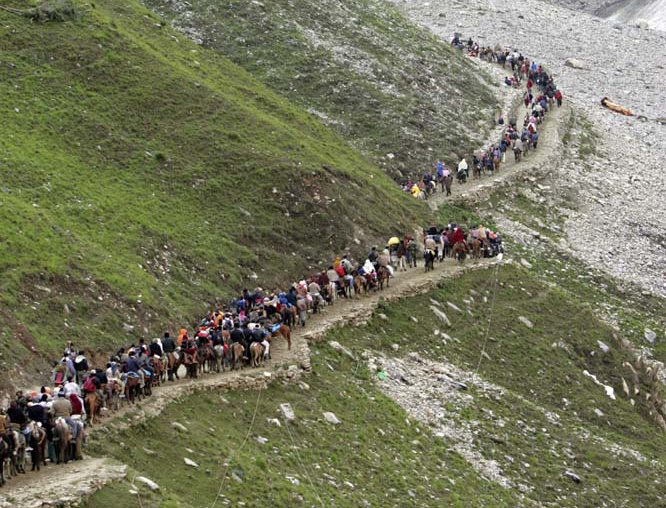
Where to eat: Apart from the exclusive hotel eateries, several “Bhandaras” and Tea stalls around the main caves, provide ample food to the pilgrims. Carrying your own water bottles is advised, as the trek is long and tedious.
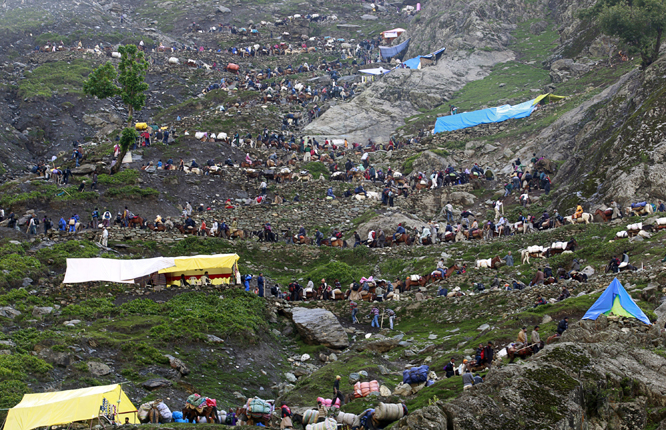
Some tips to help you during the Yatra:
1. Carry your official documents and the Yatra registration forms along with you at all times.
2. People with serious ailments, breathing problems and physical impairments are advised not to make the Yatra as the trek is tedious and long.
3. The weather of Pahalgam is highly unpredictable, thus, it is highly advisable to carry things like raincoats, umbrellas etc which will help you combat it.
4.Pilgrims are advised to keep their medicines and health equipments intact during the course of the Yatra.
5.Carrying minimal luggage and traveling light is recommended.
(Image Courtesy: Reuters)
POSTED BY : VIPUL KOUL
EDITED BY : ASHOK KOUL


Subscribe to:
Posts (Atom)