

The 36 tattvas
From Wikipedia, the free encyclopedia

Tattvas divide into three groups: Ashuddha, or impure (material, sensorial, the organs of action, the mind and the ego), Shuddhashuddha, or pure-impure (the soul and its limitations) and Shudda, or pure (internal aspects of the Absolute). The impure tattvas are the domain of objectivity and duality, the pure-impure tattvas are the domain of knowledge and the pure tattvas are the domain of transcendental unity and non-differentiation.
Contents
- 1 The five mahābhūtas
- 2 The five tanmātras - subtle mediums of the sensations
- 3 The five karmendriyas - organs of action
- 3.1 pāyu - the excretion organ
- 3.2 upastha - the sexual organs
- 3.3 pāda - the locomotion organ
- 3.3.1 Subtle anatomy of the feet
- 3.3.2 Symbol of force
- 3.3.3 Symbol of devotion
- 3.3.4 Symbol of humility
- 3.3.5 Symbol of purity
- 3.3.6 Spiritual sacrifice
- 3.3.7 Symbol of domination
- 3.3.8 Symbol of transcendence
- 3.3.9 The foot in Hatha yoga
- 3.3.10 Feet positions in meditation
- 3.3.11 Walking meditation
- 3.3.12 Sacred dance
- 3.4 pāni - hand, the organ of apprehension
- 3.5 vāk - the speech organ
- 3.5.1 Relationship with other tattvas
- 3.5.2 Mouth and assimilation of food
- 3.5.3 Articulation of speech
- 3.5.4 Speech as a creative power
- 3.5.5 Three creative voids
- 3.5.6 Levels of speech
- 3.5.7 Limiting power of words
- 3.5.8 Occult power of the word
- 3.5.9 Word as a medium for spiritual initiation
- 3.5.10 Words in meditation
- 4 The five jñānendriyas - sense organs
- 5 Antaḥkaraṇa - the inner instrument
- 6 Ṣat kañcukas
- 7 Śuddha tattvas
- 8 Differences from Sāṃkhya
- 9 See also
- 10 Notes
- 11 References
- 12 External links
The five mahābhūtas
The five mahābhūtas are the ingredients of the physical world. They represent the final point of manifestation, where light (Prakāśa) is condensed into matter, yet, at the same time, the mahābhūtas remain identical with Śiva.[1]pṛithvī - earth
Pṛithvī tattva is produced by gandha tattva (medium for olfactory sensations). It is also the abode of Kuṇḍalinī Śakti, the energy that resides in potentiality at the base of the spinal column. Kuṇḍalinī Śakti is identical to Para Śakti when it emerges and rises to the top chakra.According to ṣaḍādhvān the material world is created by Prakāśa (spiritual light, uncreated light). Kaśmir Śaivism describes the reflection of the top principle (Śiva tattva) right into the lowest principle (Pṛithvī tattva) – an idealist monistic world view where transcendence is present right in the middle of physical. Thus, there is no dualism between spirit and matter.
Pṛithvī tattva signifies concreteness, stability, patience, strength, abundance, nurturing and protection. Pṛithvī is symbolised by the Mother Earth – a universal symbol for fecundity, inexhaustible creativity and sustenance. Pṛithvī's specific shape is square, the specific color is yellow-brown. Its corresponding force center is Muladhara Chakra.
jala - water
Jala tattva (also known as apas tattva) refers to the liquid state. It is produced by Rasa tattva (the medium for taste sensations). Jala can assume any form, or we can say it contains all the possible forms. That is why it has been a symbol of the non-manifested, unlimited potentialities and the transcendence. Its basic state is passive and it can become the receptacle of various impressions and energies.Other symbols associated with Jala tattva are: the power of purification, the subconscious mind, empathy, sexuality, abundance, power to dissolve, regenerate, the medium where the human life appears (amniotic fluid), the birthplace of life on our planet (primeval ocean) and the mythical chaos and formlessness that precedes creation. Waters exist before and after any cycle of creation. The linear flow of water as a river signifies the flow of time. Water immersion signifies the ritual regression to the original principle, reincorporation into the undifferentiated.[2]
tejas - fire
tejas tattva is produced by Rūpa tattva, the medium for visual sensations and corresponds to the third chakra, Manipura Chakra. Some of the qualities of fire are: solar, masculine, dynamic, restless and extroverted. Tejas is associated with the digestive fire, passion, intuition and the uncreated light of consciousness (Prakasa). Traditionally it has been associated with a number of animals, both real and mythical: lion, fox, horse, salamander, phoenix and dragon. The tattvic form of Tejas is the upwards pointing triangle and the tattvic color is red.The concept of agni (fire) is associated with the concept of soma (nectar) forming a complementary pair. Soma is fuel to agni and it quenches its continuous thirst. From their union a new creation is born, and vice versa, the pair agni – soma appears everywhere there is a creative process. For example in a loving couple, passion is agni and the loved one is soma. In the human body, digestion is agni and food is soma. In the tantric sexual alchemy, there is the pair tejas (agni) – ojas (soma). Even on a larger scale, in a star, the atomic fire is agni and the hydrogen fuel is soma. When one looks carefully we can find a soma for any agni. In the human psyche, agni acts as desire and intentional will, and soma is whatever is the object of that desire or will.
vāyu - air
Vāyu tattva is produced by Sparśa tattva (the medium for the tactile sensations).The symbolism of air contains among other: masculine, yang, mobile, dry, subtle and elevated. It is a symbol for freedom, open spaces, intellect, mind, the ability to fly, penetrate anywhere (like air does), intangible and elusive (like the wind). Breath symbolises life, to breathe is to assimilate spiritual power. In many languages breath is associated to the notion of soul:
- in Arabic and Hebrew the word "ruh" signifies both "breath" and "spirit"
- in Sanskrit, "atman" means breath, soul or vital principle
- in Greek, "psyche" means both breath and life, soul
- in Latin, "anima" means both breath and soul
- in Romanian, the word "suflet" means soul, and comes from the word "suflu" which means breath
ākāśa - ether
Ākāśa tattva is produced by Śabda, the medium for auditive sensations and is associated with the fifth chakra, Viśuddha. Ākāśa is fundamentally different from the other four mahābhūtas as it is non manifested in the physical world – it is the void, the space, support of the other four tattvas yet, unlike them, untouchable and unseen.Ākāśa tattva is also called the aether or "fifth element". It is invisible, all pervading – a symbol of the spirit. It appears empty yet it contains huge energies (the energy of the void).
Aether is associated to the sky, has no qualities (hot or cold, wet or dry, no odor) and is unchangeable. Ākāśa is the support of the cosmic memory (the ākāśic records). Its form is the ovoid. The ovoid is the form of Brahmāṇḍa, the primordial world-egg, origin of the creation.
The five tanmātras - subtle mediums of the sensations
While mahābhūtas are the basis for the material world, sensations and perceptions are but limited aspects and views of it, in no way able to fully describe it. We cannot actually perceive the reality, all we can access are limited "bands" of information that form a description of reality. This restriction however applies only to the limited beings (jiva, or aṇu). For one who has gone beyond māyā, in the realm of the pure tattvas, there can be direct perception of reality, because as one's self is Atman, so are the external objects. In such a state an enlightened being can perceive the world beyond the five senses (direct perception), in a state of diversity in unity and unity in diversity. Another way to put it is that he then recognizes (Pratyabhijña) himself (Atman) in any object.These bands of information are the five tanmātras. Being closer to the subject than the physical reality, tanmātras are more elevated than mahābhūtas and are described as their source of creation.
gandha - the transit medium for the olfactive sensations
- smell in itself
- creates pṛithvī tattva
rasa - the transit medium for the taste sensations
- taste in itself
- creates jala tattva
rūpa - the transit medium for the visual sensations
- form (and color) in itself
- creates tejas tattva
- it contains forms and colors
sparśa - the transit medium for the touch sensations
- touch in itself
- creates vāyu tattva
śabda - the transit medium for the auditive sensations
- sound in itself
- creates ākāśa tattva
The five karmendriyas - organs of action
Karmendriyas represent both the physical organs and the corresponding subtle (astral) organs of action, specific to activity in the astral plane.As their name says, karmendriyas are karman indriyas, that is internal organs that create karma. They are connected directly to the manas tattva and represent its solar, active function. The jñānendriyas (sense organs) represent the lunar, passive function of manas.
pāyu - the excretion organ
Pāyu tattva, the excretion organ, is the first karmendriya; it is associated with Muladhara chakra, having as inferior octaves the pṛithvī (earth) and gandha (smell) tattvas.Its role in the awakening of Kundalini
Pāyu tattva is the medium of Kundalini[3] and the sexual energy (ojas) – a regenerative, almost inexhaustible power that lies at the lower part of the trunk. Correct control of this lower energy leads to a huge increase in spiritual power.The harmonious activation of pāyu tattva is essential for obtaining control of such an energy. This is why many techniques involving pāyu tattva are methods of awakening of Kundalini:
- aśvini mudrā – the horse gesture
- mulā bandha – the root lock
- śakticalana mudrā – moving the shakti
- mahamudra – the great seal (from hatha yoga)
- siddhasana, an important asana where the heel is pressing the perineum or anus
When pāyu is in harmony, there is a feeling of immense force, and better control. When it is disturbed, many conditions my occur such as: stubbornness, greed, fear and anxiety.[5]
upastha - the sexual organs
The term upastha means in Sanskrit sexual organs, 'the part which is under' or lap. Upastha tattva means the power of procreation and sexual enjoyment, or the generative organ.[6]Upasta tattva is the most differentiated organ in the body, between man and woman. Even the English word sex, coming from the Latin sexus, is related to the original meaning of division. Perhaps the most defining element of a human's body is its sex. We care to know a baby's sex before anything else. Thus sex divides humanity in two and defines our most fundamental psychological traits.
The other fundamental characteristic of upasta tattva is its complementarity. The male sexual organ (lingam) and the female sexual organ (yoni) are complete only in sexual union. In tantra, lingam has come to symbolise Śiva and yoni to symbolize Śakti, the two most elevated aspects of the Absolute. The sexual union depicted in the Yab-Yum posture represents not only the creative act on the human level, but also on a cosmic level. The union of Śiva and Śakti is eternal and supremely blissful, generating in its pulsating rhythm the fundamental movement of consciousness (spanda), which is the source of creation.
On a tangent note, the duality-complementarity principle also appears in physics: the wave-particle duality and the space-time couple are just the most prominent. Physicists talk about symmetry and symmetry breaking as fundamental in the structure of the universe.
Symbolism of the androgyne
Having both the male and female sexual organs, the androgyne represents perfect equilibrium and completeness. Ardhanarishvara is represented as half male, half female, Śiva and Śakti united into one being. Even if not on a physical level, the androgyne is completed in the tantric sadhana by awakening the spiritual force of the body (Kundalini) and uniting it with the principle of consciousness. In this state there is perfect harmony of the yin and yang and absorption into the Absolute.Besides maithuna and the tantric sexual union, there are a series of exercises meant to develop and control the sexual energies. One such exercise is yoni mudra.
pāda - the locomotion organ
Main article: Pada (Hindu mythology)
Pada Tattva represents both the physical organ of locomotion and the subtle energetic structures associated with it. Between the seven force centers it is associated with Manipura Chakra[7] and in the hierarchy of 36 tattvas it is a superior octave of tejas tattva.Subtle anatomy of the feet
Feet acting as grounding conduits: the continuous contact of feet with the ground is a symbol of relying onto and being a part of the sphere of earth. In Hinduism some rites are required to be officiated bare foot.[8] Touching the ground permits a better contact with the earth energies.The sole of the foot is seen as a microcosm of the body. All the organs and aspects are projected on the surface of the sole, forming a mystical map.[9] By massaging the sole of the foot, the healer intends to project his action on the whole body or on the diseased organ. This practice is called padabhyanga in ayurveda and in modern times appears as reflexology.
Symbol of force
The symbolism of the foot derives from that of its main functions: standing and walking. Standing upright is a poise of strength, self-esteem and human dignity. Walking represents an action of domination over space. The feet contain the largest muscles and bones of the body, develop the most powerful physical force and support the whole weight of the body. Thus, reuniting the symbols of force, dignity, uprightness and domination, it is associated with the concept of vira – the heroic being.Symbol of devotion
The foot is seen in Hinduism as a symbol of devotion. The custom of venerating guru's feet is a clear message of acceptance and submission – by placing the foot of the master (lowest part of his body) on the head of the disciple (highest part of the body), the disciple assumes a totally receptive position, which is essential for the process of initiation. A variant of this practice is venerating the feet of a deity, for example Shiva, Vishnu or Buddha (buddhapada):.[10][11]Symbol of humility
Kneeling (half-using the feet) symbolizes submission and humility. In some monasteries, monks not only knee, but lay flat down on the floor[12] face down during prayer (not using their feet at all) – signifying the total submission of the individual will in front of the divine.Symbol of purity
The expression lotus feet appears in many religious texts in a devotional context. Ex: I worship the auspicious lotus feet of the Eternity called Bhagamalini.[13] The lotus is a symbol of beauty and purity. The foot, being in contact with the ground, is considered impure (but only in some contexts, because its symbolism is very complex). Thus, the expression lotus feet is a negation of impurity, a declaration of divinity.Spiritual sacrifice
In pada-yatra, the devotional pilgrimage on foot, the participants seek purification through sacrifice. Sacrifice is considered to be a form of tejas (fire), which is tattvically associated with the pada tattva (feet).Symbol of domination
The feet are also a symbol of domination. In the legend of Vamana, an incarnation of Vishnu, the world is completely covered in three steps (trivikrama) – one covered the earth (human world), the second covered the sky (the world of the deities) and the third was placed on the head of king Bali of asuras. The three strides represent domination over the physical, celestial and human worlds.In another symbolic representation, Nataraja Shiva is crushing with his foot the demon Apasmara (a demon representing ignorance) – thus affirming himself as the supreme force that dissolves illusion through his divine grace.
In a related context, the feet can be a symbol of dependence. Kali, the goddess of time and transformation is represented as standing on the inactive body of Shiva. This image symbolizes the active role of Shakti, its reliance on Shiva in as support and the fact that Shiva needs Shakti in order to manifest.
Symbol of transcendence
The imprint of the feet on the ground is a symbol of transcendence. There are such sacred places of pilgrimage associated with various divine figures (see Buddha footprint and Petrosomatoglyph).The foot in Hatha yoga
In Hatha Yoga, the feet are considered conduits of the energies of earth. They present a number of secondary chakras and nadi. In many asana they act as a grounding pathway.- Padahastasana (foot to hand circuit) – forming a closed circuit through the hands the and feet; feet also act as a conduit of the energies of earth (prithivi)
- Sirsasana (headstand – up-down circuit) – feet are used as antennas for receiving the energies descending from the sky
- Talasana (tree pose – down-up circuit) – hands stretched upwards connect to the energies of the sky while the feet connect to the energies of the earth
- Trikonasana (triangle pose) – feet form a triangle with the earth, the triangle being the tattvic shape of tejas; this posture activates tejas and Manipura Chakra which are associated with Pada Tattva as stated before
Feet positions in meditation
In the traditional meditation postures feet act as physical support and are instrumental in the activation of the vital energies:- Padmasana (lotus pose) – here the feet form a closed circuit, a triangle base for the body and along with the hands, a pyramid shape for the whole body
- Siddhasana (perfect pose) – the heel exerts pressure on the perineum (see payu tattva for more context) thus activating the sublimation of the sexual potential; the feet, associated with tejas, are thus united with the center of sexual energy (ojas), forming a complementary pair tejas-ojas (an instance of the agni-soma couple). Their union is the basis for the creative alchemical act of reverting sexual energy to ananda, its ultimate source.[citation needed]
- Sukhasana (pleasant position) – the crossed legged position often used for meditation
- Virasana (hero's pose) – feet are crossed; feet are also tattvically associated with the concept of Vira (spiritual hero)
- Bhadrasana (position of the throne) – uniting the soles (and the chakras in the soles) a closed circuit appears, activating Kundalini[14]
Walking meditation
In walking meditation (also called Kinhin in Zen) one uses his feet to impose a structured rhythm to the mind. The aim here is to expand consciousness by stopping the fluctuations of the mind by this simple physical device.Sacred dance
Sacred dance is another complex spiritual tradition where the feet play a major role. Here too every gesture is infused with consciousness and symbolism. As a form of art, it brings about the expansion of the consciousness for both the artists and the audience. The dynamic pose of Nataraja is a symbol of universal movement which is identical to the universal creative energy because everything in the world is movement and energy.pāni - hand, the organ of apprehension
Pāni tattva (the hand) is the most complex action organ. Acting as a mirror of consciousness, it immediately reacts to, and expresses the will. It has a complex symbolism and multiple functions. The hand can express emotions and speech. One can see through touch and speak in hand language.Pāni tattva is not equal to the physical hand itself but it is a structure in consciousness associated with the hand. Tattvically, pāni tattva is a superior octave of sparśa tattva (touch) and vāyu tattva (air). From the seven force centers, it is related to Anahata chakra.
Subtle anatomy of the hand
A series of minor force centers (chakras) exist in the palm of the hand, elbow and shoulder, united by a series of force channels (nadi).[15] Thus, the hand is a conduit of subtle energy. By performing a scared hand gesture (or a magical action, mudra) one can tune in a specific resonance. One's handprint is his symbol, signature, mark of possession and domination. Hindu Gods (deva) are often represented with multiple hands, suggesting their multidimensionality. A strong arm is the mark of the hero (vira). The invisible hand of God is a symbol of God's mysterious power.Correspondence of the five fingers with the five elements
There are various ways fingers are associated to the five elements. For example: thumb – fire, index – air, middle – Sky, ring – earth, little – water. Almost all people develop a strong polarity between the hands, forming a preference for either the right hand or the left hand. The dominating hand is associated with yang and the other with yin. The hand and the body both have five extremities thus the hand has been put in correspondence with the body.Pāni tattva is sometimes called the organ of apprehension and is the main external tool of the mind. Writing, in its role of external memory, is associated with ākāśa. The hand is a symbol of action, strength, domination and protection. It is used for imposing a specific resonance, energy transfer, giving a blessing and spiritually investing another person. The "eye in the hand" is associated with protection, luck[16] and 'clairvoyant action'.
Functions and symbols of the hand
More functions and symbols:- the hand that talks – hand language
- the hand expresses emotions – fidgeting, etc.
- the hand as an instrument of memory – writing, drawing
- the hand as an instrument of healing (sometimes, the hand of the king) – miracle worker
- the hand of providence (Hand of God) – symbol of the mysterious and irresistible power of God, forces outside the human control
- the eloquent hand gesture – nonverbal communication, auxiliary communication
- both hands raised – victory, prayer, praising the Divine
- one raised hand – symbol of the voice; symbol of song
- hand on the heart – attitude of the sage
- hand on the neck – sacrifice
- covered or concealed – respect
- folded – tranquility
- palms upward, laid on each other – meditation
- palms together – prayer
- clenching fist – anger
- raising the right hand – threatening
- placed in the hands of another – submission and trust
- clasping – praising the Lord (original symbolism), fraternity, welcome, agreement
- handshake symbol – sincerity, friendship
- many people joining hands – to unite
- palm placed on the top of the head of another – blessing, investiture, relaying energy
- raising a prized object with both hands – victory
Role of the hand in Hatha yoga
In hatha yoga are described a series of hand gestures (mudra). The role of the mudra is to impose a specific resonance. Some of the mudras are:- abhaya mudra – the right hand slightly elevated, the palm turned outwards – fearlessness, renunciation
- namaskara mudra – both palms folded together - prayer, purity, sacrality
- jnana mudra – the tip of the index finger touches the tip of the thumb, forming a circle - concentration
- dhyana mudra – both hands resting on the lap, palms upwards.[19][20]
vāk - the speech organ
Vak tattva is the organ of speech, including the mouth and the subtle structures of consciousness associated with it. As all the other karmendriyas, vak tattva is an instrument for the creation of karma and also an instrument for the practice of karma yoga, a discipline with the purpose of liberation from the bondage of karma.Relationship with other tattvas
A number of other tattvas take part in the process of creation of sound: as support for the propagation of sound and for its cyclical oscillating nature is the time-space tattva, akasa. Because sound is a mechanical vibration, it also needs a physical support which is provided by vayu tattva (air), and thirdly, the articulation of sounds is related to the tongue (rasana tattva).In the sequence of tattvas, vak tattva is the most elevated karmendriya and its corresponding sense organ - śrota tattva (the ear) is the first outward expansion of the mind (manas tattva). The force centers primarily associated with speech are Vishuddha chakra – center placed in the region of vak indriya and Muladhara chakra as the seat of pārāvak.[21]
Mouth and assimilation of food
Vak indriya (mouth), the instrument of eating, is also the first part of the body that comes in contact with the food and plays a role of subtle assimilation of energies, directly from the food. The mouth is described to be lined up with thousands of fine force channels (nadi) that have the role of absorbing prana from food.[22] In the practice of ayurvedic medicine, plants are taken and held under the tongue for a few minutes just for this same purpose.Articulation of speech
Depending on the position where the tongue articulates speech, there are a number of classes of sounds: velar, palatal, cerebral, dental and labial. In Kashmir Shaivism each class of phonemes is correlated with specific mantric energies of the sound.[23] The full sequence of phonematic energies is called mātṛkā and contains 50 sounds, associated with the letters of the Sanskrit alphabet. On a cosmic scale, the creation of the universe is described in Kashmir Shaivism as an evolution of sound, a descending process originating from the level of logos (pārāvak). Each phoneme represents a stage in the process of evolution, a tattva, a world in itself. Sounds are associated with energies and ultimately with aspects of consciousness. The magical power of sounds and words is derived from this association with energy (śakti) and consciousness (śiva). The study of these energies is an essential part of Kashmir Shaivism.[24]Vāk (speech) is seen as the result of the dynamic union of two parts that form the mouth (upper and lower), a complementary union of the opposites, yin and yang. There is always such a fusion of yin and yang at the basis of any creative process.
Speech as a creative power
Vak tattva plays a major creative role in the human being as the instrument of speech and as such, the origin of the interior world of thought. Speech acts as a mirror of the exterior reality, duplicating everything that exists outside into the mind. The word is the vehicle of the limited ego, ahamkara. The word as such is an imperfect tool though, because while it can reflect the exterior reality it always approximates. For example, when we say I saw a man we don't say much - what kind of man, what impressions did he give us, etc. The word is just an abstraction from reality. Thus language is at the same time a tool and an obstacle in knowledge.[25]Three creative voids
Together with the mouth (the void that creates speech), two other creative aspects of the human body are the vulva (yoni) and the Heart (hṛdaya). Yoni creates both human life and of the energy of spiritual evolution (that is, the energy of transmuted sexual fluids and ascending kuṇḍalinī). The heart (hṛdaya, aham), as defined in Kashmir Shaivism, is a matrix of energies centered around the Self (ātman), substrate and center for all the activities of consciousness. Yoni, heart and mouth represent three levels of the void and three centers of creative power.In relation to sexual activity, both mouth and yoni are somewhat similar in form and role and sometimes their use is reversed (see the so-called 69 sexual position). Kissing it begins a prelude to the sexual union and serves as a symbol of it. The mouth is the source of the exterior speech, but on the highest level, parāvak (supreme word) is also named Logos Spermatikos in Greek – (spermatikos=seed, a sexual reference to its role as a creative power).[26] Thus we can see the multiple parallels and connections between mouth and yoni as both are expressions of the creative void, matrices of creation present in the human body.
Levels of speech
Speech is considered in Kashmir Shaivism to exist on multiple levels, but only the exterior (or spoken) speech is expressed through vāk tattva. The full scale of speech is as follows:- vaikharī vāk – spoken word, exterior
- madhyamā vāk – mental speech, interior
- paśyantī vāk – pure intentionality, pre-speech
- parāvāk identical to the nature of the Spirit
As the self is expressed in three levels, ego, soul and spirit, so is speech expressed in three different ways:
- at the level of the ego (ahaṃkāra), speech is fully differentiated; it includes madhyamā vāk and vaikharī vāk, thus the vehicle of speech is the word itself
- at the level of the soul (jivātman, or puruṣa in Kashmir Shaivism) language is not ruptured from its real signification any more; it can be described as paśiantī vāk, the language of mantric syllables, symbols and non-sequential instant knowledge (intuition).
- at the level of the spirit (atman), language is expressed as supreme word - parāvak; in term of sound, it is represents silence;[29] here there is only one single reality and one single meaning and it is described in a multitude of concepts, all approximative, as conscious light (prakāsa-vimarṣa), compact mass of consciousness and beatitude (cid-ananda-Ghana), supreme freedom (svātantrya), atemporal vibration (spanda) and the spontaneous flash of conscious light that projects objects into reality (abhāsa). Thus at this level there is absolutely no difference between the word and its significance.
Limiting power of words
The power of words is that of creating a new world, a world of the mind. Words act as symbols of external reality, yet their very act of indicating (or reflecting the exterior reality) is imprecise. Being trapped into the prison of words, ruptured from direct experience, the western philosophy is limited to an edifice of mental speculation.[30] While philosophy relies solely on words it cannot be a true path to the absolute Truth, because words are imprecise, limited tools.[31] Thus in Kashmir Shaivism as in many other oriental spiritual schools, accent falls on direct experience and realization through the means of the various disciplines of yoga and meditation. In Shaivism, words play as references, mere guide marks or pointers for the consciousness in its endeavor of rediscovering its true nature.[32]Occult power of the word
The word has spiritual, magical, mystical and even demoniac powers, some of which are described in the following concepts:- mantra – the sacred syllable, both sound and spiritual energy, is a fundamental tool in tantra and consequently, in Kashmir Shaivism (see the practice of japa and uccara)
- prayer and religious chanting – are essential instrument in religious rituals
- casting a spell, incantation – speech is the principal magical instrument
- scriptures – sacred words considered to be originated from God Himself, such as agamas in Kashmir Shaivism; a notable difference between the occidental scriptures and the Kashmir Shaivism agamas is that the agamas are considered to be Shiva Himself, in the form of word, not just the mere words of Shiva
- degraded speech – curses and profanities – associated with demoniac resonances
- satya siddhi – the power of efficient speech – whatever one says, comes true – such a power is said to be the result of the practice of satya – truthfulness
- nyāsa – a magical ritual of imposing mantras with the hand on specific parts of the human body, thus awakening the latent occult powers within it
Word as a medium for spiritual initiation
In most spiritual schools, speech is the preferred medium of spiritual initiation. Sometimes written word is used, but the most secret initiations are traditionally transmitted "from mouth to ear". Oral teachings are usually reinforced through repetition (ritual) to become a spiritual foundation.[33]Words in meditation
The practice of meditation aims to stop the mental chatter altogether (the concept of "citta-vritti-nirodha" of Patanjali) or replace it with sacred speech (laya yoga, japa, uccara). Regular speech must be put aside in order for consciousness to reach that level which goes beyond the mental.- mauna (self-imposed silence) – produces the accumulation of a large energy in vak tattva
- bhavana (contemplation) – speech charged with spiritual energy (Sakti) through intense visualisation
- koan – a kind of paradoxical contemplation expressed in words with the purpose of projecting the mind beyond words
- neti neti – a kind of contemplation where negation is used instead of affirmation; the reasoning behind this technique is that the absolute cannot be captured in any affirmative affirmation as it lies beyond the sphere of speech, but it can be discovered through meditation with the help of various negations ("Atman (the spirit) is not this, Atman is not that") that act only as guide marks along the way, pointing to the various mistaken assumptions that need to be surpassed
- devotional speech - known under various names in other spiritual traditions as nembutsu, dhikr; in Kashmir Shaivism too there are a number of remarkable devotional works
The five jñānendriyas - sense organs
ghrāṇa - nose
 | This section is empty. You can help by adding to it. (February 2011) |
rasanā - tongue
| This section is empty. You can help by adding to it. (February 2011) |
cakṣu - eye
| This section is empty. You can help by adding to it. (February 2011) |
tvak - skin
| This section is empty. You can help by adding to it. (February 2011) |
śrotra - ear
| This section is empty. You can help by adding to it. (February 2011) |
Antaḥkaraṇa - the inner instrument
Antaḥkaraṇa, also called the internal organ, is part of the pure-impure tattvas. Activity in these tattvas is subjective cum objective. Antaḥkaraṇa contains five tattvas: manas, ahaṃkāra, buddhi, prakṛti and puruṣa tattva.manas - the lower mind
The manas name comes from the verbal root man – to think. Manas is the instrument for the creation of vikalpa (dual thoughts). Its state is described as always agitated. Manas is the hub connecting the ten organs of action and senses to the upper tattvas (intellect, ego and soul). It does not simply transit the sensations, but also filters and assembles them into a coherent vision. Manas operates based on learned behavior, instincts, habits and automatisms, like a complex computer processing data (from the senses) and transmitting commands. Because of its agitated nature, manas is termed "the undisciplined mind", fraught with contradictions: doubt, faith, lack of faith, shame, desire, fear, steadfastness, lack of steadfastness.Manas interprets everything in terms of attraction and repulsion. While the ego (ahaṃkāra tattva) can understand and assume a moral code, the notions of good and evil, manas is limited to the complementary pair of pleasure and pain, acting only on the desires that arise. Its program is Repeat pleasure and avoid pain.[34]
Manas operates both in the subtle and the physical plane (brain). Manas is the center of logical reasoning while buddhi is the center of intuition, discrimination and will. Depending on the state of consciousness, manas can act either as a cause of conditioning and bondage or as a path towards freedom. The latter is possible for poets, artists and those who are illuminated (can operate within the pure tattvas, beyond māyā).
ahaṃkāra - the empirical ego
Ahaṃkāra tattva is the first seat of subjectivity. Ahaṃ means "I" and kāra means "to do", thus, ahaṃkāra - the instrument of Ahaṃ (the Spirit), the principle of individuation, acting as an independent conscious entity within the impure reality - yet, it does not have consciousness of its own. ahaṃkāra is a receptacle of Cit śakti, its consciousness is but a small spark from Cit, the universal consciousness. Its operating mode is assuming authorship of all the actions of buddhi, manas, the senses and organs of action.Ahaṃkāra lives in the sphere of duality, in a state of identification with the physical body, its needs and desires. In ahaṃkāra predominates rajas guna (agitation). Because it identifies only with a small part of the creation (the body) and rejects everything else as "not me", it becomes subject to a series of afflictions such as: pride, egoism, competitiveness, hate and jealousy.
On the other hand, with ahaṃkāra tattva appears, for the first time, individual will, determination, a sense of morality and ethics and it is thus the first step on the spiritual path. Without a sufficiently harmonious and powerful ahaṃkāra (personality) it is impossible to exert the level of effort required to accede to a higher spiritual level.
The position of ahaṃkāra and buddhi are sometimes presented in reversed order because, as the principle of "I-ness", ahaṃkāra is allowed control over the manas (sensorial mind) and buddhi (superior intellect, intuition). Yet, buddhi is a superior tattva, and ahaṃkāra is only allowed from a functional point of view a superior position to buddhi. From an absolute point of view, ahaṃkāra is created by buddhi and thus subordinated to it.
buddhi - the intellect
Buddhi tattva represents the intuitive understanding, the superior mind, which can rise above ego and the sensorial. It does value judgments, discriminates between possibilities, decides and determines, based on the information presented from the lower tattvas. In buddhi tattva there is a predominance of sattva guna (purity) and the energy of jñāna śakti – the energy of knowledge.The name buddhi contains the Sanskrit radical dhi, meaning reflection, intuitive penetration and higher awareness. Other notable terms containing dhi are samādhi (yogic ecstasy) and dhyana (meditation). One of the prescribed ways of developing buddhi is the study of sacred texts. In Kashmiri Shaivism, Bauddha Jñāna (the intuitive and conceptual understanding) is considered the foundation of illumination because once profoundly understood, something is always accessible, while the second type of knowledge, Paurusha Jñāna (to know through direct experience) is limited only to the moments of inspiration.
prakṛti tattva
Prakṛti tattva is the fundamental operative energy of the soul (jivatman), or, in other words, it creates the world of puruṣa. In Kaśmir Śaivism prakṛti has a different meaning than in Sāṃkhya; while here it means an energy of the individual, in Sāṃkhya it refers to the fundamental energy of the manifestation. Thus, as defined in Kaśmir Śaivism, every puruṣa has his individual prakṛti.Prakṛti and Puruṣa are closely interdependent. They are the reflection of śiva and śakti tattva in the sphere of māyā. The difference is that, while śiva and śakti tattva are infinite and nondual, puruṣa and prakṛti are limited and subject to duality. Other than that, what śiva-śakti do on a universal scale, puruṣa-prakṛti do on a personal scale. They have the same energies of will, knowledge and action and perform the five actions of creation, sustenance, dissolution, occultation and grace.
In G. V. Tagare's The Pratyabhijñā Philosophy, these five actions and their correlates are given as follows:[35]
| Role | Śiva's level | Level of the limited being |
| appearance (creation) | sṛṣṭi | ābhāsana |
| enjoying (maintenance) | sthiti | rakti |
| experiencing within oneself (resorption) | saṃhāra | vimarśana |
| sowing seeds (occultation, reduction of knowledge to a subconscious impression, saṃskāra) | vilaya | bījāvasthapāna |
| dissolution of residual impressions(saṃskāras), grace, nonduality | anugraha | vilāpana |
| Guna | Derives from | Produces |
| Sattva | Jñāna śakti | Buddhi tattva |
| Rajas | Icchā śakti | Ahaṃkara tattva |
| Tamas | Kriyā śakti | Manas tattva |
puruṣa
Puruṣa tattva is defined as the living soul (jivatman), the limited being (jiva), the one who is bound (paśu),[37] the spiritual atom (aṇu). It is not only the human being, but every sentient being.Puruṣa appears as the result of the process of contraction or occultation Śiva assumes willingly. This feat is achieved by the five limitations (kañcuka tattvas) and the cosmic illusion (māyā tattva). Śiva is also known as Pati, the master, while Puruṣa is the Paśu (the bonded one). Between Pati and Paśu is Pāśa - the limitation itself. Pāśa is the cumulative effect of māyā and the five kañcukas, or, from another perspective, the effect of the three impurities or poisons (malas): ānava mala, kārma mala and māyīya mala.
- Ānava Mala – the belief that he is limited, finite and small in comparison to the world
- Kārma Mala – the belief that he (the limited self) is the author of the action, instead of recognizing Atman as the real agent
- Māyīya Mala – the belief in duality, separatedness [37]
Ṣat kañcukas
Kañcukas means armour. Here it is used in the sense of limiting filter, a restrictive force creating a "prison" for the consciousness inside the dual creation.Powers that maintain the individual soul resting in the middle like Trishanku, which otherwise would fall into the condition of complete inertia like a rock, etc, or would ascend into the sky of Consciousness like the Supreme Lord. Abhinavagupta [38]The theory of the 5 sheaths existed long before. Shankara writes in his 'Atma Bodha'[39] about the five sheaths the Immaculate Atman appears to have borrowed.
Trishanku is a mythical character who wanted to ascend to heaven in his physical body. While the sage Viswamitra was helping him ascend, the Gods were in opposition, thus he became suspended half way through.
Abhinavagupta describes the kañcukas as five forces that create a middle ground between the realm of the pure tattvas and objectivity; the purpose of this middle ground is to reunite both the spiritual and the material, the subjective and the objective - a playground of spiritual evolution that is needed if such entities as jiva (the limited being) are to exist.
Thus kañcukas have a triple role: they act as an entry barrier towards the realm of the pure tattvas for the limited beings (jiva), they also act as a gateway for the illuminated, who can pass without impediment between the pure and impure realities, and finally, they create a middle ground of subjective-cum-objective activity, where spiritual evolution can take place.
The five kañcukas present both a limited aspect and a universal aspect. They are like intervals, with one end in the infinite and the other end in the finite. They are:
| omnipotence – sarvakartṛtva | limited power – kalā |
| omniscience – sarvajñatva | limited knowledge – vidyā |
| fullness, perfection – pūrṇatva | limitation of desire – rāga |
| eternity – nityatva | limitation of time or life – kāla |
| omnipresence – vyāpakatva | limitation of space – niyati |
The combined effect of the five limitations (kañcukas), is described as follows, by Abhinavagupta, in just one phrase:
Thus, the subject, being limited or intertwined with kāla, vidyā, kalā, rāga and niyati and being deprived of divine glory by māyā, shines as limited, feeling 'that which knows something now, does this and is attached to this, am I' – Īśvarapratyabhijñā Vimarśinī of Abhinavagupta.[41]
niyati - spatial limitation
Niyati tattva reduces the state of omnipresence to the level of finitude. The subject can be only in one place, his body is limited and outside his body is the domain of "not myself". This is the fundamental duality of the existence in the impure domain (meaning tattvas from puruṣa to pṛithvī).Based on the duality between the limited subject and the world, a series of physical limitations arise, like: hunger, fatigue, sickness and the need to protect oneself. By constant identification with these limitations the ego (ahaṃkāra) is formed. Ahaṃkāra exerts itself tirelessly in its pursuit of happiness, yet it understands happiness in a very limited and dual fashion, which can never be a stable fulfillment.
kāla - limitation in time
Kāla tattva reduces the experience of eternity to that of time and limited life span. Under kāla tattva time takes three aspects: past, present and future. But while the past is just a memory and the future is a probability, only the present is actually experienced.Time limitation has to do with death, rebirth and becoming subject to the cosmic cycles of life. Time is relative to the observer. Objective time is sometimes faster, other times slower than the subjective (interior) time. As the consciousness expands, time flow is perceived as being slower. When a state of enlightenment (the revelation of the Self, Atman) is achieved, kāla kañcukas (limitation) becomes transparent and eternity shines as the present moment.
rāga - incompleteness, the limitation of desire
Rāga tattva is the limitation of the "perfect fullness of the Absolute". While in the realm of the pure tattvas (from śiva tattva to śuddha vidyā tattva) every possibility is simultaneously fulfilled, under the effects of this limitation, there is experience of incompleteness, and so, desire for various objects appears.The source of perfect bliss is a Ānanda. Ānanda is the reflection of absolute consciousness (Cit) on itself. In an analogy, the white light of Cit is said to become the rainbow of Ānanda, expressing every possible color at the same time. Yet, in the dual world, the infinite nuances of Ānanda cannot be experienced at once, and appear as various distinct forms of emotion or rasa (aesthetic flavours). This is the work of the rāga kañcuka.
vidyā - the limitation of knowledge
Vidyā tattva is the constriction of infinite knowledge to limited and imperfect knowledge. In the realm of pure tattvas, Śiva has direct access to any information about anything as the whole creation rests inside Him, like one's thoughts rest inside one's mind. Yet, to know everything at once is to know that which is inside everything and beyond. Acting as its source and the witness, Cit is said to be the basis for the whole creation, the ultimate Truth, which is the only truth one needs to know. Everything else is derived from it.The limited being, unable to recollect his essence of Cit (infinite consciousness), operates in the realm of dual knowledge. His objects of knowledge are distinct/differentiated. This type of knowledge may become more and more subtle with study and practice, yet it is never able to describe Cit. The only way to rise to the level of non dual knowledge is through the act of Grace of Śiva. This point is specific to Kaśmir Śaivism.
One can prepare for the descent of grace by studying the sacred texts and purifying his body (physical and subtle). Even so, the Grace of Śiva will come only at Śiva's absolutely free will.
kalā - limitation in power
Kalā tattva – the limitation in power, is what makes one forget his original status of omnipotent being and assume the belief in the limitation of his power. This wrong belief acts as a chain limiting his spiritual progress. In this state, he identifies with his limited actions and bears the fruits of the karma they generate.In order to recollect his true nature, of infinite consciousness and bliss – cit-ānanda, he needs a level of power unavailable to limited beings. Only by understanding this and accepting that it is Śiva that is acting, not his ego, will he become open to the Grace of Śiva, which is identical to a huge impulse of power that shatters duality and transports him directly into the realm of the pure tattvas.
By opening his heart to Śiva, thinking of himself as a channel of Śiva's energy, he creates a special status of "spiritual son". A spiritual son's actions are endowed with efficiency by virtue of a direct link between his heart and the infinite heart of Śiva.
māyā - the origin of illusion and duality
Māyā tattva is a very important stage in the process of manifestation. Mā means "to measure"; measurable means finite. From the infinite being that is Śiva, it creates the finite: the illusion of multiplicity, differentiation in multiple objects and limitation of objects. This process of manifestation is based on a series of multi-levelled reflections (pratibimba), creating a series of octaves or intervals. From pure consciousness and bliss Śiva-Śakti becomes vital and mental energy, and then matter. Thus the process of creation is a process of descent and Māyā is the tool by which this descent starts. On the other hand, māyā is the portal towards the rediscovery of Śiva - when it is seen in the context of the spiritual evolution.In Kaśmir Śaivism māyā is not separated from Cit (supreme consciousness). This is a major difference between Kaśmir Śaivism and Advaita Vedānta. Thus, māyā is created by Ānanda Śakti, the operative energy of Śiva. In turn, māyā is the instrument of creation for the dual world.[42]
Even though Śiva assumes limitations in his role as a limited being jiva, Śiva never becomes a subject to any external limitations. Svātantrya, the absolute free will Śiva, is the sole cause for the apparition of duality [43] One cannot possibly understand at the level of dual existence, the motive why Śiva creates duality and the world with all its individual beings. It remains a profound mystery [44]
God, Consciousness in essence, like a magician, makes the whole ensemble of things which reside in Him appear outside Himself without any external cause, solely by the power of His will. Utpaladeva [45]The effect of māyā is the sensation of division into interior and exterior, subject and object. In Kaśmir Śaivism it is considered that exterior objects and limited beings (jiva) are never separated from one's consciousness, or Śiva's consciousness.[45]
Śuddha tattvas
This group of five tattvas describe the Divine Consciousness. They appear by the projection of the five principal energies of the Absolute:- Cit śakti – divine consciousness – creates śiva tattva
- Ānanda śakti – supreme bliss – creates śakti tattva
- Icchā śakti – divine will – creates sadāśiva tattva
- Jñāna śakti – divine power of knowledge – creates īśvara tattva
- Kriyā śakti – power to manifest – creates śuddha vidyā tattva [46]
Even though there are five aspects of Śiva, they are always one, beyond any duality. Śiva remains always one, there are no five separate entities here.
śuddha māyā
Śuddha māyā means pure delusion. From here on, the limitations of māyā are existent and the dualistic knowledge shines. As per Swami Sivananada's book Tantra Yoga, Kundalini Yoga, Nada Yoga this is the 3rd manifestation.Note: Placeholder Section. Needs to be elaborated
śuddha vidyā
Śuddha vidyā means pure knowledge. From here on, the limitations of māyā are inexistent and the pure non-dual knowledge shines.When puruṣa, through the grace of Śiva reveals his essence of Atman, he gets first into the realm of śuddha vidyā tattva. But the realisation of identity with Śiva is not perfectly stable yet and his access to this state comes and goes. Here, the subjects thinks: "I am Śiva, the universe is real".
I-ness and This-ness are equally balanced and the experience of the universe gets more distinct.[47] It is a state of unity in diversity.
Śuddha vidyā acts as the instrumental function of sadāśiva tattva and īśvara tattva.
īśvara
The affirmation at the level of īśvara tattva is: "This universe is my expansion, not an illusion". It is associated to jñānana śakti, the divine power of knowledge.Beings residing on this level are called mantreśvara (lords of the mantra). Here the world is explicitly detailed yet the creation hasn't yet begun. Thus, it is a state of divine existence where Śiva first projects the world in his mind, before creating it in reality.
The īśvara and sadāśiva tattvas are associated to the flux and reflux of the divine consciousness, Cit (Īśvara is unmeṣa - the expansion of the universe).
sadāśiva
The affirmation at this level is "I am this Universe". The accent here falls on "I". The focus is on the subject. Here Śiva manifests as sovereign will - ichhā śakti. Beings residing on this level are called mantra-maheśvara (great lords of the mantras). On sadāśiva tattva objectivity exists only in a very incipient form. Here the universe is said to be vague (asphuṭa) and dominated by the experience of "I-ness" (Kṣemaraja) [48]śakti
The term Śakti comes from the root shak - to be capable of. Śakti is the operative (or kinetic) aspect of consciousness, its power to act and the cause of all motion in the universe.[49] Because Śakti brings everything into existence She is the feminine aspect of the universe in the cosmic couple Śiva-Śakti.Śiva and Śakti tattva are inseparable and interdependent; Śiva is the interior aspect of consciousness and Śakti is the exterior [50] - they are united like fire and its capacity to burn. Any difference between them is just a matter of semantics. In another metaphor, Śiva is an infinite ocean and Śakti a wave on its surface. In a third metaphor, Śiva is a perfect mirror and Śakti is the image inside the mirror. All these analogies try to express the unity of Śiva and Śakti. Like the image cannot be separate from the mirror in which it exists, so Śiva and Śakti are but one reality.
On the level of Śakti tattva the experience of I-ness is pure and universal and there is no trace of the experience of This-ness. The top two tattvas (Śiva and Śakti) are said to be non manifested because they don't participate to the cycle of creation. They act only as a backdrop or canvas for the creation.
In the triad sat-cit-ananda, Śakti tattva is associated to ānanda - infinite bliss. Where Śakti is predominant, there is experience of bliss. In the pair Prakasa-Vimarsa, Śakti tattva is Vimarsa - the reflexive aspect of Śiva - that is - Śiva perceiving Himself (reflecting on his own nature). On account of it being dynamic and ever vibrating, Śakti is also known as spanda. Spanda is the fundamental vibration of consciousness that permeates the whole universe.
The will to create the universe appears first in Śakti tattva. Even though māyā is the actual instrument of creation, it relies in turn on Śakti for its power.
śiva
Śiva tattva is the transcendental consciousness, the canvas on which the whole creation is projected. Śiva tattva appears as Cit, the passive aspect of pure consciousness, non manifested, inactive in report with creation, the static center and substratum of all change.[49]Another way to describe Śiva tattva is Prakasa - the uncreated light. It is the power of consciousness to shine without any external support. Prakasa is existence, as nothing that exists is different from it and there is nothing outside it. In Kaśmir Śaivism, from the Vedic expression Sat-cit-ananda, Sat (pure existence) is omitted on account that Cit (pure consciousness) contains it implicitly; thus the expression becomes just Cit-Ānanda.
Śiva tattva is the supreme subject. His nature is that of pure I-ness without any This-ness. His existence cannot be detected by an act of perception. Only on account of his effects can we postulate his existence.[49]
Śiva and Śakti tattvas are the plane where the supreme Self, Atman, exists. Beyond Śiva tattva there is only the Transcendence (Parama Śiva).
Differences from Sāṃkhya
The unique point of view of Kashmir Shaivism is expressed in the exposition of supplementary 11 tattvas compared to Veda or Sāṃkhya. They are māyā, niyati, kāla, rāga, vidyā, kalā, śuddha vidyā, īśvara, sadāśiva, 'śakti and śiva tattva. The rest of 25 tattva, which are common to Sāṃkhya, have in Kashmir Shaivism a slightly lesser position, as the categories of matter specific to the impure creation (dual creation).



 Cave
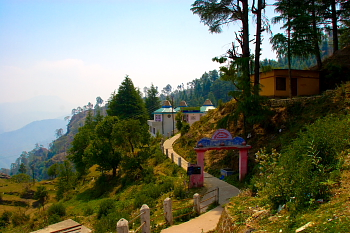
Temple at Patal Bhubaneswar is one of the main attractions of Kumaon
region. Located in Pithoragarh district this Cave is open from sunrise
to sunset. It will take approximately one and half hour to visit the
cave temple and return. Inside the cave it will take nearly 30 to 45
minutes. From parking area you have to travel nearly 100 meters to reach
the entrance of the cave. This cave is one of the protected monument of
Govt of India. Before entering into the caves tourist have to remove
shoe and shocks. Camera and mobile phones are not allowed inside the
cave and they are to be deposited at the entrance. Before entering into
the cave full address of the tourist are to be entered in a register.
Nominal entry fee is charged, it was Rs 90 for four persons. One of the
priest will guide you and will travel with you into the cave.
Cave
Temple at Patal Bhubaneswar is one of the main attractions of Kumaon
region. Located in Pithoragarh district this Cave is open from sunrise
to sunset. It will take approximately one and half hour to visit the
cave temple and return. Inside the cave it will take nearly 30 to 45
minutes. From parking area you have to travel nearly 100 meters to reach
the entrance of the cave. This cave is one of the protected monument of
Govt of India. Before entering into the caves tourist have to remove
shoe and shocks. Camera and mobile phones are not allowed inside the
cave and they are to be deposited at the entrance. Before entering into
the cave full address of the tourist are to be entered in a register.
Nominal entry fee is charged, it was Rs 90 for four persons. One of the
priest will guide you and will travel with you into the cave.
 You
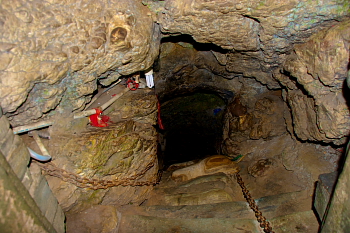
have to decent nearly four floors down through a narrow path holding
chains. The width of the path at some places reduces to around half a
meter and you have to almost sit and slide down through this circular
sloppy ( 45 degree downward ) path. It is better not to use sari or
white dresses as they are likely to get dirty as you will be almost
crawling while going down and coming up. Better to use jean paints and
fold it one round from bottom. After the entrance inside the cave it is
high enough and you can freely stand and carefully walk as floor will
be little slippery and muddy inside. After coming out you can wash your
foot.
If you are aware of Hindu Mythological stories ( Mahavarat , Ramayan etc
) then your guide cum priest will show you resemblance of all stories
and events on the formations of stalactites and stalagmites. There are
white formation looks like twisted hair ( jata ) of Lord Shiva holding
Ganga inside it. After passing through the narrow entry path first you
will see the shape of a snake known in Hindu Purans as Sesnag the snake
which holds the earth. There are several Shiva lingas and status inside
the cave. Some of the narrow paths are blocked and tourists are not
allowed to explore.
You
have to decent nearly four floors down through a narrow path holding
chains. The width of the path at some places reduces to around half a
meter and you have to almost sit and slide down through this circular
sloppy ( 45 degree downward ) path. It is better not to use sari or
white dresses as they are likely to get dirty as you will be almost
crawling while going down and coming up. Better to use jean paints and
fold it one round from bottom. After the entrance inside the cave it is
high enough and you can freely stand and carefully walk as floor will
be little slippery and muddy inside. After coming out you can wash your
foot.
If you are aware of Hindu Mythological stories ( Mahavarat , Ramayan etc
) then your guide cum priest will show you resemblance of all stories
and events on the formations of stalactites and stalagmites. There are
white formation looks like twisted hair ( jata ) of Lord Shiva holding
Ganga inside it. After passing through the narrow entry path first you
will see the shape of a snake known in Hindu Purans as Sesnag the snake
which holds the earth. There are several Shiva lingas and status inside
the cave. Some of the narrow paths are blocked and tourists are not
allowed to explore.