Sunday, July 6, 2014

SHRI SWAMI AMARNATH JE MAHRAJ

The Legend
There is famous Rigvedic Verse that says "Ekam Sat " that is "There is one Being, the sages call him by many names." The  God (Parmeshwar) has three deities who carry on the world .This is Known as Holy Trinity. Brahma- the creator, Vishnu - the perpetuator of life and Shiva (Mahesh ) -the purifier and perpetuator of good and destroyer of evil. Rig Veda refer Shiva as Rudra as in its following verse .  "We Worship Tryambaka (Rudra) , Who spread Fragrance and Increases Nourishment , May He release me, like the cucumber from its stem, From Mortal Life, But not From Immorality. "(Rig Veda Mandal VII Sukta 59 and Mantra 12)
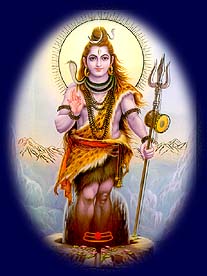
    The Yajurveda describes Shiva as ascetic warrior Whose robe is of Deer Skin  and he carries Trishul. 
According to the verse Satyam, Shivam, Sundaram the life is described as having three facets Truth (Satyam), Good (Shivam) and the Beautiful (Sundaram).
        Shiva is a living God. The most Sacred and  ancient books of India, the Rig Veda narrates his presence in the hymns. Vedic myths, rituals and even astronomy testifies to His existence from the dawn of time. The Mohinjodaro and Harappa findings confirm Shiva worship in the ancient India. According to the older scriptures, He has three places of his residence. One is  Kailash Parvat another is Lohit Giri under which Brahamputra flows and third is Muzwan Parvat. 
  The Amarnath Cave has special significance .
    The  Legend about the  importance of Amarnath Cave is as follows :-
      This is The Cave which was chosen by Bhole Shankar  for narrating the secrets of immortality and creation of Universe to Maa Parvati ji. The story goes like this. Centuries ago Maa Parvati asked Shiv ji  to  let her know why and when  he started wearing the beads of heads ( Mund Mala). Bhole Shankar replied when ever you are born  I add one more head in my beads. Maa Parvati said, " My Lord, my body is destroyed every time and I die again and again, but you are Immortal. Please let me know the secret of this ." Bhole Shankar replied that it is due to Amar Katha ."
         Maa Parvati insisted that she may be told that secret. For long Shiva ji continued postponing .   Finally on consistent demand from Maa Parvati he made up his mind to tell the immortal secret . He started  for lonely place where no living being could listen it. He choose Amarnath Cave. In preparation to that he left his Nandi ( The Bull which he used to ride ) at Pahalgam (Bail gaon). At Chandanwari he released Moon from his hairs (Jataon). At the banks of Lake Sheshnag he released the snakes. He decided to leave his son Ganesha at Mahagunas Parvat (Mahaganesh Hill ). At Panchtarni, Shivji  left the Five Elements behind (Earth , Water, Air , Fire and Sky) which make living being. He is the Lord of these elements. It is believed that as a symbol of sacrificing the earthly world, Shivaji and Maa Parvati  had Tandav Dance. After leaving behind all these, Bhole Shankar enters the Holy Amarnath Cave along with Parvati Maa. Lord Shiva takes his Samadhi on the Deer Skin and concentrate . To ensure that no living being is able to hear the Immortal Tale, He created Rudra named Kalagni and ordered him to spread fire to eliminate every living thing in and around the Holy Cave. After this he started narrating  the secret of immortality to Maa Parvati. But as a matter of chance one egg which was lying beneath the Deer skin remained protected. It is believed to be non living and more over it was protected by Shiva -Parvati Asan (Bed). The pair of pigeons which were born out of this egg became immortal  having listened the secret of immortality (Amar Katha). 
 Many pilgrims report seeing the pair of pigeons when they trek the arduous route to pay their obeisance before the Ice-Lingam (the phallic symbol of Shiva). Discovery of Holy Cave
The story narrated by people about the discovery of this Holy Cave  is of  a Gujjar ( shepherd) Buta Malik . He is given the credit of discovering this Holy Cave. Story goes like this, that a saint gave Buta Malik a bag full of Coal. On reaching his home when he opened the bag , to his utter surprise the bag was full of gold coins. This made him overwelmed with joy. He ran to thank the Saint. But,  what he found was that the Saint had disappeared. Instead, he found  The Holy Cave and Shiv Lingam in there. He announced the discovery of this to the Villagers. Then onwards this has become the sacred place of Pilgrimage .
    The ancient epics narrate an other  story which  goes like this. The valley of Kashmir was under water. It was a big lake. Kashyap Rishi drained the water through number of rivers and rivulets . In those days Bhrigu Rishi came that way on a visit to The Himalyas. He was the first to have Darshans of this Holy Cave. When people heard of the Lingam, Amarnath for them became Shiva’s abode and a Centre of pilgrimage. Since then Lacs of devotees perform the pilgrimage through tough terrain and avail eternal happiness.
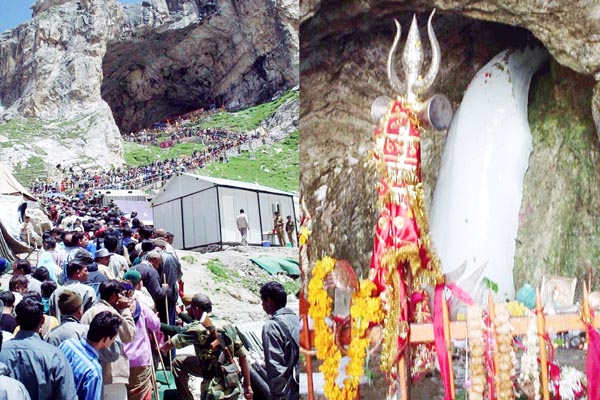
The trek to Amarnath, in the month of sharavan ( July–August) has the devout flock to this incredible shrine, where the image of Shiva, in the form of a Lingam, is formed naturally of an Ice Stalagmite, which waxes and wanes with the Moon's cycle. By its side are fascinating, two more Ice Lingams, that of  Maa Parvati and of their son, Ganesha .

YATRA DATES : 28 JUNE 2014 to 10 AUGUST 2014

YATRA DATES : 28 JUNE 2014 to 10 AUGUST 2014

SENIOR HIGH COURT ADVOCATE VOLUNTERY OR ON PAYMENT BASIS FOR YATRA ISSUES
&
M.D. DOCTOR SPECIALIST CARDIOLOGIST / ASTHMATIC WILLING TO SERVE YATRIS VOLUNTERY OR ON PAYMENT BASIS.
THOSE INTERESTED MAY PLEASE CONTACT MR.SHASHI BHUSHAN CONATCT NO. 09815090780.
email : sb11168@yahoo.com

WE HUMBLY REQUEST TO DONATE GENEROUSLY FOR THIS NOBLE CAUSE


The Legend
Amarnath Yatra
Route Map
Pictorial View
How to go ?
Do's & Dont's !
Spiritual Sites
Trust Information
Suggestions


Click here for Darshan


Important Links Regarding Shri Amarnathji Yatra  2014
» Guidelines for Doctors/Medical Institutions authorized to issue Compulsory Health Certificates (Yatra 2014)
» Compulsory  Health  Certificate for Yatra 2014
» Food Menu for  Shri Amarnathji  Yatra 2014
» List of  Authorised  Institutions/Doctors for issuing Compulsory Certificates ( CHC)  for  Yatra 2014
» List of  Bank Branches for Registration
» Procedure for  Registraion of  NRI/ Devotees living Overseas
»
Group  Registration
»
On-line booking of Heli tickets Yatra 2014
»
Insurance Cover for Yatris
»
Procedure for Registration of NRIs /  Devotees living abroad
»
Application form for Registration
»
How to get Registration

TO DONATE ACCOUNTS INFORMATION:
A/C HOLDER : BHOLE BHANDARI CHARITABLE TRUST (REGD.)
HDFC BANK LTD.   A/C No. 00341000146265   IFSC : HDFC0000034
BRANCH : MALL ROAD, LUDHIANA
STATE BANK OF INDIA  A/C No. 30051187789
BRANCH : LUDHIANA

PAN NO. :  AAATB5138Q

BHOLE BHANDARI CHARITABLE TRUST (Regd.)
(A Non-Govt Non-Profitable Charitable Trust)
E-316, Phase-IV A, Focal Point, Ludhiana. INDIA
Mobile : 09814120850, 09872910707, 09653933101, 09216772220, 09872965650
Telephone : 0161-2672657, 09872987968
Fax: +91-161-2671030

E-Mail: info@amarnathyatra.org

 SHRI AMARNATHJI SHRINE BOARD HELPLINE NO. 01942501679

You are Visitor No. 
Bravenet Counter Stats
Powered by Bravenet
View Statistics
 
Designed & Hosted By

Saturday, July 5, 2014

The Kashyap News: Gopinathji

The Kashyap News: Gopinathji: Posted on 6/07/2014 by Dailyexcelsior Tej Krishen Raina Jagadguru Bhagawaan Gopinathji was one among the mo...

Gopinathji


Tej Krishen Raina
gopi nathJagadguru Bhagawaan Gopinathji was one among the most eminent Saints that have ever graced the sacred land of India. Unlike the other Saints, he was called Bhagawaanji and recognized as such in his life-time as all the six attributes which that word stands for were prominently seen in him. He was a Jeewan-mukta, having attained mukti or liberation while still in the gross body, to which he was not attached in the least. HIS spiritual state was what the Shaivites call Shaambhavi avastha (the state of Shiva Himself) and the Vedantins, Brahmisthiti (the state of ever dwelling in Brahman, or God without form).
With his spiritual prowess, he did a lot of good to many spiritual aspirants, house-holders and to the country at large. He brought many sinners round to the path of virtue. Though essentially detached, he showed much concern for the country and its people as a spiritual icon. Bhagawaanji also exercised a beneficent influence on the modern age and the prevailing concepts.
Gopinathji, one among several brothers and sisters, was born in a middle class Kashmiri Pandit family at Banamohalla, Srinagar, Kashmir on 3rd July, 1898. His mother, Shrimati Haara Maali, passed away when he was only twelve and his father, Pandit Narayan Joo Bhan, breathed his last when he (Bhagawaanji) was in his late twenties.
Gopinathji was educated upto the Middle standard, however, he was well conversant with Urdu, Hindi, Persian and Sanskrit languages besides English.
The family into which he was born, being in dire financial straits, he was asked to take up some work; so, at the young age of fifteen or sixteen, he started working at a local Printing Press as a compositor – a job he performed competently. However, he gave up the job after about three years. In his twenties, he ran a grocer’s shop, at which he was noticed generally absent-minded, being inwardly absorbed in meditation. HIS elders in the family pressed him to marry, hoping that marriage would bind him to the world, and so he would be a permanent financial support but he was adamant in his refusal to shape into a house holder. Bhagawaanji started with the spiritual discipline known as Panchaanga-Upaasanaa, involving meditation on the five deities ­– Ganesha, Surya, Naarayana, Shiva and Shakti. Later, his target was the Divine Mother Shaarika, whose vision he had for the first time, at the age of Twenty Seven. Gradually, he shifted to nirguna upaasana, that is, meditating on the Supreme Reality without a form. In his early thirties, he took to intense Saadhana (spiritual discipline). Shutting himself up in a room, which no one except mostly a niece of his, was free to enter, an earthenware lamp was kept burning there all the twenty four hours and the Bhagawaan did not allow any intrusion or the room to be even swept. His concentration was so intense and he grew so oblivious of his body that a rat nibbled a hole in one of his heels. During this seven-year period of Saadhanaa, he would take no food for long intervals — extending even to six months, sometimes. Bhagawaanji helped two girl-devotees, separately, to have a darshana (vision) of the Divine Mother of the Universe. A third was helped to have an illuminative experience – a darshana of the Mother in the form of dazzling effulgence matching that of several suns. He did not initiate a disciple directly by word of mouth as tradition demands. He did so by a mere glance, by giving the devotee a little bhasama or prashad, or in the case of a male devotee, offering him puff from his chillum.  He felt happy when particularly a celebate came to see him though he never asked a house holder disciple or devotee to give up his wife and children in pursuit of self-realization.
Bhagawaanji was far above any consideration of caste, creed or nationality. From 1947 onwards, people of all creeds would come to see him and he would shower his love and compassion equally on all. Once he said, in answer to a devotee’s question, “is a Hindu one and a Muslim another?” Among his disciples and devotees today are many who never met him in his life time. These are spread over in other countries like Australia, the USA, Canada, Switzerland and the UK. Globally famous, he has come to be called a Jagadguru, a world spiritual teacher. During his earthly sojourn and even after abandoning the mortal coil the Bhagawaan cared for his devotees in and outside Kashmir and India. While sitting in his room when alive or having left his physical frame, he was seen at warfronts guiding and directing our troops in the years 1948, 1962, 1965, 1971 and 1999. Bhagawaanji was Tatvajnani (one who has all the knowledge about the elements of Nature). By a special type of saadhanaa, he had gained control over all the elements. During a pilgrimage to the holy cave of Amarnath, he brought rain to a vast drought-hit area. On some occasions, he stopped rain when it was likely to cause sufferings or death. He was able, with his control over the elements, to know which organ of a person’s body was diseased. He could cure a person with a mere look or by offering the Bhasam from his Dhoni; “he cured dreaded diseases like cancer, epilepsy, and other physical ailments of the supplicating devotees.”
He would often urge the devotees to lift the veil of ego that envelops the Atman. He observed vehemently: AHANKAARAS NAMASKAR, SUIGAV OMKAR – TAMISAATI BANI SAAKSHATKAAR, which conveys, ‘Bid good bye to the ego and be face to face with Truth’ (implying the attainment of God Realization).
Almost on every Sunday, musicians singing till late in the night, the Bhagawaan would never ask them to stop. But on his last Sunday on earth, 26th May, 1968 he directed the musicians to stop, remarking, “we shall not listen to any more music”. Then came May 28th, 1968 Tuesday, the day Bhagawaan Gopinathji finally chose to cast off his Bhautik Sareera. At about 3 p.m. he had the last few puffs at his chillum. A devotee started making tea but Bhagawaanji said, “we shall not take tea any more”. He asked for water at 5:30 p.m. and at 5:45 p.m. he uttered Om Namah Shivaya in a low voice, looked around with infinite love towards those present and closed his eyes.
After Bhagawaanji attained Nirvana, his disciples built an Ashram at Kharyar, Srinagar where his marble statue was installed in 1973. This Ashram has become a centre for the spiritual upliftment of his devotees. After the mass exodus of the Pandits from the Valley, other Bhagawaanji ashrams came up at Udaiwala Road, Bohri, Jammu and at Pamposh Enclave, New Delhi. At these ashrams all activities that were regularly performed in Srinagar Ashram are being performed regularly. The number of devotees participating in all such activities is going up day by day. Bhagawaanji Trust has expanded the activities of all these Ashrams over and above the infrastructure. With the ever increasing number of devotees across the globe, Ashrams, meditation Centres and Satsang Mandals at Mumbai, Pune, Bangalore, Chandigarh, Australia, Switzerland have been rapidly coming up.
In all these ashrams and centres disseminate Bhagawaanji’s gospels of spirituality and universal brotherhood, with great zeal and enthusiasm.
In recognition of his spiritual stature as an extra-ordinary Saint, the Govt. of India issued a commemorative postal stamp on Him in 1998 – his birth centenary year.

The splendor that is Amarnath

  by Dailyexcelsior
Chander M. Bhat
Almost every part of India is known for many a sacred shrine, but the Amarnath Cave embossed in the snowy valley of Kashmir reveals the unique sight of natural Ice Linga of Lord Shiva perched on a glacial gorge which waxes and wanes with the movements of the moon. According to a common belief, it reaches the maximum height on Purnima in the month of Shravan (July-August), when Shiva is supposed to have divulged to Parvati the secret of salvation. On this day thousands of pilgrims negotiating the most difficult ridges arrive at the holy cave for Dharshan of the Lord. The pilgrimage of thousands of devotees to the far way cave of Amarnath, nestled in a glacial gorge of the western Himalayas, through some of the most charming scenery in the world, is fascinating in the extreme. One is stuck with wonder at the quiet and ordinary way in which a canvas town springs up with incredible rapidity of colours and of all shapes and sixes and broad streets running through the middle, and all vanishing as quickly at the break of dawn when the whole army of pilgrimages set out on the march again. The glow of countless cooking fires, the ashen smeared Sadhus under the canopy of discussing or meditating before the Dhunis, the Sannyasins of all orders in various garbs, the men and women with children, from all parts and their devote faces, the torches shimmering at nightfall, the blowing of conch-shells and horns, the singing of hymns and prayers in chorus………. all these are most impressive, and convey an idea of mastering passion of the race for religion.
Amarnath literally means the Immortal Lord. Lord Shiva stands for Deathlessness. He confers this boon on his devotees. Deathlessness is not trying to preserve the physical sheath forever but in growing so fearless as to look at death in its face! The truth of this will be evident to one who undertakes a pilgrimage to Amarnath……….the hallowed pilgrimage center of Kashmir.
In olden days the route was via Rawalpindi (Pakistan) but now a direct train is there connecting rest of India to Jammu, the winter capital of the State. The best part of journey is between Guru Purnima and Shravan Purnima. The Government of Jammu and Kashmir makes all arrangements for the comfort of the pilgrims for undertaking the ritualistic journey for visiting the shrine on Shravan Purnama. But the highly unpredictable weather of the mountains should be more obliging before Guru Purnima as rains would not start. There is a bus service from Jammu to Pahalgam (7,500 ft.). At Pahalgam the pilgrims arrange for coolies or ponies to carry gear of food and clothes etc. Everybody remains busy making arrangements for the Yatra. The golden glow of, the sun falls on the turbulent river at Pahalgam. Pahalgam in Kashmiri means the land of shepherds.
The journey from Pahalgam commences towards the first halting station Chandanwari (8,500 ft.) is ten miles away. With the bright sunlight reflected in silvery snow-clad peaks above, and gurgling river meandering through the valley below, the pilgrim already is in a different, world. The trekking undoubtedly is slow but not, boring as the scenery alongside is most picturesque.
Early the next morning the caravan again proceeds further towards a straight two mile climb towards Pisutop (12,200 ft.). From Pisutop one has to cover seven miles to reach Seshnag (13,148 ft.) next halting station. Ascent is stiff and steep, climbs are difficult to negotiate. The path is clear but at some places the glaciers become slippery. It is here where a stick carried by a pilgrims become useful and in some cases savers ones life. Before entering the small pilgrim camp one gets the enchanting sight of blue still waters of Seshnag Lake. One has to walk a mile to take a refreshing bath. The lake is very deep and is fed by the melting snow of the glaciers above and water is bluish green below. It is believed that some one has seen Adishesha………. the many hooded serpent streaking through these waters. Whatever may be the explanation, it is true that one experiences an invisible presence of some super power near the lake. The mountains are fully covered with snow and its peaks resemble the seven heads of the mythical snake. The quiet place looks so thickly populated, then, that everybody, despite intense cold, appears in high spirits, probable feeling proximity to the diving. The roaring sound of gushing streams, the gigantic snow clad mountains, the moonlight beaming through foggy enclosure, the neighing horses and the dim tent-tops all around presents an indelible impression. One feels nearer to God and in such a blissful environment.
From Sheshnag one reaches Panchtarni, the valley cress-crossed by five rivulets. The journey is most difficult as one has to climb to a height of 14,500 ft. and then to descend. The highest point is Mahagunus, which means the great serpent. There is no vegetation at this height and one begins to feel lack of oxygen. It is said that the fragrance of the herbs in Mahagunus is so alluring that the pilgrims are warned not to have any rest at this place and Ponywallas are very careful not to allow their horses to graze here which otherwise, is fatal for these animals. The four miles descent from Mahagunus to Panchtarni is slippery especially after a rain, which is a common occurrence. The night is spent is great expectation so reaching the cave in the morning. The journey starts early in the morning. Again a steep ascent to Sant Singh Top (13,500 ft.) and a slippery descent until one reaches the low-lying glaciers over which are seen the pilgrims walking in a row. At last one reaches the Amar Ganga where one takes his bath in ice-cold water and climbs up the steep to the cave. This bath and steep climb are final tests of devotion.
The holy cave is approximately 50′ long 25′ wide and 15′ high. When one reaches the cave, he becomes over struck at the sight of Ice Linga completely filling the right corner of the, cave, the top of the Linga touches the root of the cave. The base of the cave is also covered with ice, like a carpet. Here Shiva is worshipped by nature in the purest way. The cave is the nature’s temple and is undefiled, by human touch. Shiva is snow-white and pure. Linga is formed by drops of water falling from the top of the cave and two other small ice Lingas are also formed, believed to be the symbols of Goddess Parvati and Lord Ganesha. On early morning a white pair of doves (believed to be Shiva and Parvati) appear at the cave corner. Austerity and strenuous mountain climbing with all its attendant risks are soon forgotten and one gets a sense of grand fulfillment here.
After having darshan one climbs down with a heavy heart casting “a longing lingering look behind” and slowly starts returning. The river Amar Ganga flows with a gentle murmur Shiva, Shiva and the tall peaks echoed it, to be heard by the Heavens. Himalayas around Kashmir have their special grandeur. Even a loud shout is sufficient to dislodge a huge boulder or rock precariously handing on the tip of the mountain and bring it hurtling down leveling everything, pilgrims and all. Rarefied atmosphere again burns the exposed skin of the face with its ultra violet radiation. At every step death stares in the face! But who cares? One can return through the same route or by a different route, which takes a short time but is very risky.
Despite innumerable difficulties and hindrances the pilgrimage to Amarnath provides not only adventure and spiritual solace, but also an ineffable experience that abides with one for ever.

 vipul koul