Sunday, March 4, 2018

Swami Vivekananda in Kashmir

Swami Vivekananda in Kashmir

Compiled by Swami Bodhasarananda, Kolkata
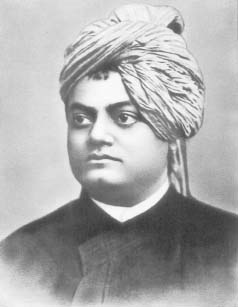
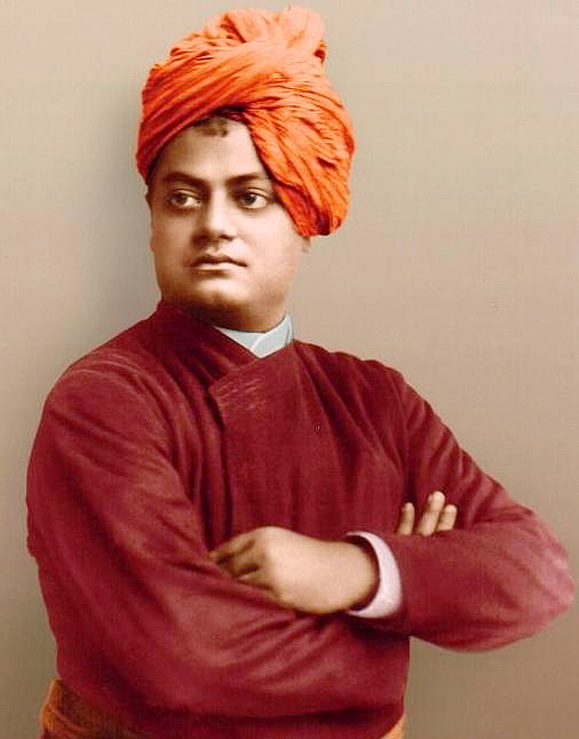
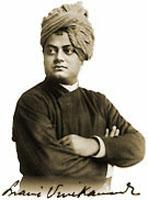
Swami Vivekananda
Swami Vivekananda
(Parliament of World's Religions', Chicago, U.S.A., Photograph)
This article has been compiled from authentic life of Swami Vivekananda. It gives a day to day record of his stay in Kashmir more than one hundred years ago. He visited many shrines. From the visions and experiences he had, we find these shrines surcharged with God's presence. Only we have to open our hearts to allow the God's grace flow inside us.
Swami Vivekananda visited Srinagar twice. The first time he reached Srinagar was on 10th September 1897. At Srinagar he was the guest of Justice Rishibar Mukhopadhyaya. On the third day after his arrival he paid an informal visit to the place of the Maharaja. Since the Maharaja was then at Jammu, his brother Raja Rama Singh received the Swami with marked cordiality and honour, seating him on a chair, and himself sitting with officials on the floor. The Raja was deeply impressed by Swamiji's thoughts on religion and his eagerness to improve the condition of the poor. He voiced his desire to help the Swami in carrying out his plan of work.
Early in the first week of October the Swami was busy filling many engagements, private and public, and visiting the places of historic interest with which Kashmir abounds. Sadhus, Pandits, students, officials of high rank went to meet him.
The Swami left Srinagar for Baramulla and reached Murree on October 8 and from there to Rawalpindi on October 16, 1897.
The second time also Swami Vivekananda had to go to Srinagar via Rawalpindi, Murree and Baramulla. The distance had to be covered partly by tonga and partly by boat. Sister Nivedita, Mrs. Ole Bull and Miss MacLeod accompanied him.
Swami Vivekananda had great fascination for Lord Shiva during his childhood. As he grew older his love for Shiva, the Lord of monks and yogis deepened. And now in the Himalayas, the abode of the Great God, the thought of Him was uppermost in the Swami's mind. To his disciples he spoke of the Puranic conception of the oneness of Shiva and His consort, Uma, under the guise of half-man and half-woman. It represented the junction of two great streams of thought, Monasticism and Mother-worship; or it represented the vision of truth where renunciation through philosophy and supreme love become inseparable. And "he understood, he said, for the first time the meaning of the nature-story that made the Ganga fall on the head of the Great God, and wander in and out amongst His matted locks, before she found an outlet on the plains below. He had searched long, he said, for the words that the rivers and waterfalls uttered, among the mountains, before he had realized that it was the eternal cry `Vyom! Vyom! Hara!' `Yes!' he said of Shiva one day, `He is the Great God, calm, beautiful and silent; and I am His great worshipper'."
While coming from Baramulla when he entered further into Kashmir, the Swami's mind was filled with the legends of the Kashmiris. The Vale of Kashmir had once been a lake; and it is related that at this point where the Swami was entering the Vale, the Divine Boar pierced the mountains with his tusks, and let the Jhelum go through.
The period from June 22 to July 15, 1898 was spent in houseboats (dungas) on the Jhelum, in and about Srinagar. He told his Western disciples many things about Kashmir, for instance, the different religious periods through which Kashmir had passed, with special attention given to the period under Kanishka; the morality of Buddhism and the religious imperialism of Ashoka; and again the history of Shiva-worship.
On June 26, the Swami suddenly felt a longing to leave the party and go to a quiet place. But not knowing that this was his intention, the party followed him to Kshir Bhavani. It was said to be the first time that Christian or Muslim had set foot there. The irony of the occasion was that the Muslim boatman would not allow the Swami and his Christian disciples to land with shoes on, "so thoroughly Hinduistic," says Nivedita, "is the Mohammedanism of Kashmir with its forty Rishis, and pilgrimages made fasting, to their (i.e. the Hindus') shrines."
Among the local excursions that the Swami made with his disciples was that on July 29 to the small, massively built Shiva temple that stands atop the Shankaracharya Hill. This hill is also known as Takt-i-Suleiman, and rises a thousand feet above the surrounding terrain. The famous floating gardens can be seen below, for miles around. The beauty and extensive sweep of the scene drew from the Swami the exclamation : "Look, what genius the Hindu shows in placing his temples! He always chooses a grand scenic effect! See, the Takt commands the whole of Kashmir. The rock of Hari Parvat rises red out of blue water, like a lion couchant, crowned. And the temple of Martand has the valley at its feet!"
On July 4, the day of American Independence, he wrote a poem entitled "To the Fourth of July" which can be interpreted as a passionate utterance of his own longing for the Final Freedom in the Infinite. Time was to prove that it had been penned in a prophetic vein; for, four years later, on that very day, his shackles of work broken, he entered in "springing joy" into the Final Freedom, concerning which he had written.
A desire for quiet and peace seemed to grow more and more upon Swami Vivekananda in these days. On July 10 he left alone for a pilgrimage to Amarnath ji by way of Sonamarg. On the 15th he returned, having found that route impracticable because the summer heat had melted some of the glaciers.
On July 19 the whole party started for Anantnag by boat. On the first afternoon they sought out and found the quaint old Temple of Pandrethan (derived from Puran-adhishthana meaning "old capital"), sunken in a scum-covered pond within a wood, by the side of the Jhelum. This is four and a half miles to the southeast of Srinagar. The temple is a small cell, with four doorways opening to the cardinal points. He drew their attention to the interior decorations, with their sun-medallion, and to the fine sculpture, in low relief, of male and female figures intertwined with serpants. Among the outside sculptures is a fine one of the Buddha standing with hands uplifted. And there is a much-defaced frieze, showing a seated woman and a tree. This evidently represents Maya Devi, the Buddha's mother. The temple is built of grey lime-stone, and dated from the tenth century A.D. "To the Swami," writes Sister Nivedita, "the place was delightfully suggestive," and she adds :
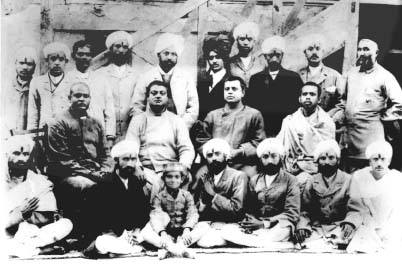
 
Kashmir, 1897. Sitting on chairs, left to right: Swamis Sadananda, Vivekananda, Niranjanananda, and Dhirananda.
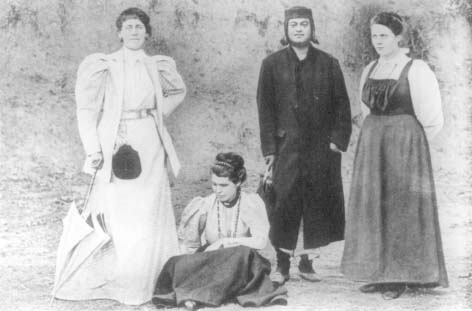
Kashmir, 1898. Left to right : Jesophine McLeod, Mrs. Ole Bull, Vivekananda, and Sister Nivedita.
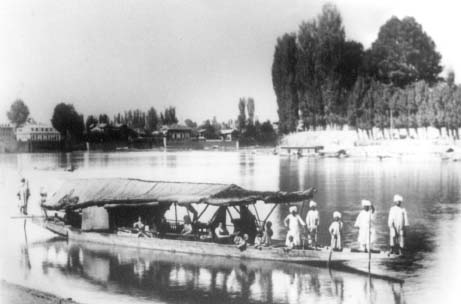
On a houseboat in Kashmir, 1898. Left to right : Jesophine MacLeod, 
Vivekananda, Mrs. Ole Bull, and Sister Nivedita.
"It was a direct memorial of Buddhism, representing one of the four religious periods into which he had already divided the history of Kashmir : 1) Tree and snake worship, from which dated all the names of the springs ending in Nag, as Veernag and so on; 2) Buddhism; 3) Hinduism in the form of sun-worship; and 4) Mohammedanism. Sculpture he told us, was the characteristic art of Buddhism. The figures with the serpants reffered to pre-Buddhism."
Moving up the river, the party came next day (July 20) to the ruins of the two great temples of Avantipur; legend of which relates to Pandava times. Its sculptures drew his admiration. In his view the temples were more than two thousand years old. Swamiji said in the course of conversation : "In order to strengthen the national life, we must reinforce the current of that life itself along the line of its own culture of ideals. For instance, Budha preached renunciation, and India heard. Yet within a thousand years, she had reached her highest point of national prosperity. The national life in India has renunciation as its source. Its highest ideals are service and Mukti."
On July 21 when the party landed at the temple of Bijbehara, then already thronged with Amarnath pilgrims, he was able to join them for a little while. After visiting the temple, they left for Anantnag which was reached on the afternoon of July 22. He sat on the grass of an apple orchard and he started talking about the rarest of rare personal experiences. Picking up two pebbles, he said, "Whenever death approaches me, all weakness vanishes. I have neither fear, nor doubt, nor thought of the external. I simply busy myself making ready to die. I am as hard as that" — and the stones struck one another in his hand� "for I have touched the feet of God!"
On the 23rd morning the party went to see the ruins of Martand. "It had been a wonderful old building � evidently more abbey than temple — in a wonderful position," writes Nivedita, "and its great interest lay in the obvious agglomeration of styles and periods in which it had grown up."
On July 25 the party went on to Achabal and in the afternoon came back to Anantnag. It was at Achabal that the Swami announced his intention of going to Amarnath with the two or three thousand pilgrims then en route to that shrine. As a special privilege, Sister Nivedita was allowed to join him as a pilgrim. It was settled that his other Western disciples would accompany the party as far as Pahalgam and there wait for the Swami's return.
On July 27 they halted for a night at Bhavan (Martand, also called Matan) and reached Pahalgam on July 28. Throughout the rest of the journey Swami Vivekananda would bathe in the holy waters, offer flowers, fruits and sweets to the object of worship before breaking his fast, make obeisance by prostrating himself on the ground, tell his beads, make ritual circumambulation, and the rest. At every halt, the Swami's tent was besieged by scores of monks seeking knowledge from him. Many of them could not understand his broad and liberal views on religious matters. The Muslim Tehsildar, the state official in charge of the pilgrimage, and his subordinates, were so attracted to the Swami that they attended his talks daily and afterwards entreated him to initiate them.
On July 30 the Swami left for Chandanwari. Next day a steep climb towards Pishu top followed and then a long walk on the narrow path that twisted round the mountain-side. At last they camped (July 31) at Wavjan at a height of 12,500 ft.
Next day (August 1), after crossing the Mahagunus Top, a pass at 14,500 ft., they reached Panchtarani, the "place of five streams".
On August 2, the day of Amarnath itself, there was first a steep climb followed by a descent, where a false step would have meant death. They walked across a glacier till they reached a flowing stream. When Swami Vivekananda reached the cave, his whole frame was shaking with emotion. The cave itself, says Nivedita, was "large enough to hold a cathedral, and the great ice-Shiva in a niche of depressed shadow, seemed as if throned on its own base." His body covered with ashes, his face aflame with devotion to Shiva, the Swami entered the shrine itself, nude except for a loin-cloth, and prostrated in adoration before the Lord. A song of praise from a hundred throats resounded in the cave, and the shining purity of the great ice-linga over-powered him. He almost swooned with emotion. A profound mystical experience came to him, of which he never spoke, beyond saying that Shiva Himself had appeared before him, and that he (the Swami) had been granted the grace of Amarnath, the Lord of Immortality, namely not to die until he himself should choose to do so. Shri Ramkrishna had prophesied regarding this disciple of his : "When he realizes who and what he is, he will no longer remain in the body!"
Never had the Swami, in visiting a holy place, felt such spiritual exaltation. Afterwards he said to his European disciple, "The image was the Lord Himself. It was all worship there. I never have been to anything so beautiful, so inspiring!" Later on, in the circle of his brother disciples and his own disciples, he said dreamily : "I can well imagine how this cave was first discovered. A party of shepherds, one summer day, must have lost their flocks and wandered in here in search of them. What must
have been their feeling as they found themselves unexpectedly before this unmelting ice-Linga, white like camphor, with the vault itself dripping offerings of water over it for centuries, unseen of mortal eyes! Then when they came home, they whispered to the other shepherds in the valleys how they had suddenly come upon Mahadeva!" Be that as it may, for the Swami this was truly so : he entered the cave and came face to face with the Lord!
On the journey back the Swami and party returned to Anantnag, and from there by boat to Srinagar which they reached on August 8.
In Kashmir the Swami and his party were treated with great respect by the Maharaja; and during his stay various high officials visited the Swami's houseboat to receive religious instruction and converse with him on general topics. The Swami had come at the invitation of the Maharaja, to choose a piece of land for the establishment of a monastery and a Sanskrit college. It was a disappointment to the Swami when, about the middle of September, he heard that official discussion of the site that he had chosen, had been twice vetoed by the British Resident.
Following the pilgrimage to Amarnath, the Swami's devotion became concentrated on the Mother. It was touching to see him worship, as Uma, the four-year old daughter of his Muslim boatman. He once told his disciples, during these days, that "wherever he turned, he was conscious of the Presence of the Mother, as if she were a person in the room."
His meditation on Kali became intense, and one day he had a vision of Her, the mighty Destructress lurking behind the veil of life, the terrible one, hidden by the dust of the living who pass by, all the appearances raised by their feet. In a fever he groped in the dark for pencil and paper and wrote his famous poem "Kali the Mother"; then he dropped to the floor, losing consciousness, while his soul soared into Bhava-samadhi.
On September 30, the Swami abruptly went to Kshir Bhavani, leaving strict instructions that no one was to follow him. It was not until October 6 that he returned. Before this famous shrine of the Mother he daily performed Homa (Havan), and worshipped Her with offerings of Kheer (thickened milk) made from one maund of milk, rice, and almonds. He told his beads like any humble pilgrim. Every morning he worshipped a Brahmin Pandit's little daughter as Uma Kumari, the Divine Virgin. He practised severe austerities. He became like a child before the Divine Mother. All thought of Leader, Worker, or Teacher was gone. He was now only the monk, in all the nakedness of pure Sannyasa.
One day at Kshir Bhavani he had been pondering over the ruination and desecration of the temple by the Muslim invaders. Distressed at heart, he thought : "How could the people have permitted such sacrilege without offering strenuous resistance! If I had been here then, I would never have allowed such a thing. I would have laid down my life to protect the Mother." Thereupon he heard the voice of the Goddess saying : "What if unbelievers should enter My temple and defile My image? What is that to you? Do you protect Me, or do I protect you?" Referring to this experience after his return, he said to his disciples : "All my patriotism is gone. Everything is gone. Now it is only Mother! Mother! I have been very wrong. I am only a little child."
Another day, in course of his worship, the thought flashed through the Swami's mind that he should try to build a new temple in the place of a present dilapidated one, just as he had built a monastery and temple at Belur to Shri Ramkrishna. He even thought of trying to raise funds from his wealthy American disciples and friends. At once the Mother said to him : "My child! If I so wish I can have innumerable temples and monastic centres. I can even this moment raise a seven-storied golden temple on this very spot."
"Since I heard that divine voice," the Swami later said, "I have ceased making any more plans. Let these things be as Mother wishes."
Thus we see during his stay in Kashmir, Swami Vivekananda was in a different world altogether. Visions of Shri Amarnath, Mother Kali and Kshir Bhavani remained always with him. Later at Belur Math he said : "Since visiting Amarnath, I feel as though Shiva were sitting on my head for twenty-four hours a day and will not come down."
The party left Kashmir on October 11 and came down to Lahore. Swamiji reached Belur Math on October 18, 1898.  
POSTED BY  :  VIPUL KOUL 
EDITED BY   : ASHOK KOUL


swami vivekananda

Swami Vivekananda- How relevant is he today?

An Inspirational Monk
Swami Vivekananda
How relevant is he today?

Gopinath Raina

His words are great music, phrases in the style of Beethoven, stirring rhythms like
‘The March of Handel Choruses’, I cannot touch his sayings without receiving a thrill through my body like an electric shock. And what shocks must have been produced when in burning words they issued from the lips of the hero. –Romain Rolland

If you want to know India, read Vivekananda.
-- Rabindranath Tagore

he world today is passing through a very difficult period, characterized by a widespread feeling of insecurity caused by global terrorism unleashed by Al Qaeda. The volume of violence and unrest prevailing in Afghanistan, Pakistan, Iraq or Palestine, has cast dark shadows on the future of mankind. Even great advances in knowledge of science and technology, including the humanities have failed to arrest the social and economic confusion, leading to rapid decline of moral and ethical values.
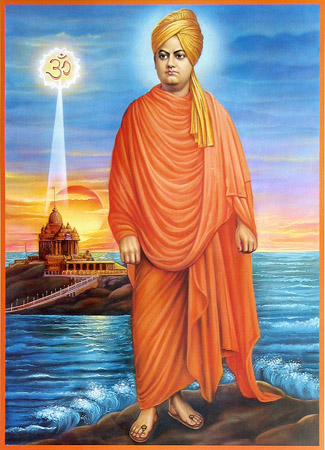
Relevance of Vivekananda

At such a time, one feels the need to turn to people like Swami Vivekananda, in order to find peace of mind. Had the world taken seriously to what this great son of India had said that “if every religion conceded that every other religion could help a person reach the same God that they are trying to reach, harmony alone would prevail”, we would not have witnessed one of the most heinous examples of cultural conflict in the form of 9/11, exactly 108 years after Swami’s historic call in Chicago.

Thus, harmony of religions, universal solidarity, and human being as the highest manifestation of Spiritual Consciousness are the basic fundamentals one should not lose sight of in reading or understanding Swami Vivekananda. The practical aspects of these teachings reflect in renunciation and service. This forms the twin ideal of Swami Vivekananda's emphasis for the modern man and woman to strive for. Along with excellence and perfection in every field of human endeavor, one should follow these ideals, lest the person should miss the aim.

Cyclonic Hindu Monk

A ‘Cyclonic Hindu Monk’ as he was then called, was, indeed, a true globalist as every true Hindu is. ‘Vasudhaiva Kudumbakam’ (the whole world is one family) was his credo. He had foreseen that a global situation is developing and that the time has come when even local problems have to be seen in the context of the global perspective and solutions to be sought from that point of view. “Think globally and act locally” was not a concept which was strange or unknown to him. In fact he followed that dictum.

Some of the most pressing problems of the day threatening the very survival of human civilization were foreseen by Vivekananda. Religious intolerance, cultural exclusiveness and blind fanaticism were identified by him as dangerous portents. In his famous Chicago address he very forcefully brought out that these dark forces had deluged the world with rivers of human blood and brought beautiful civilizations to extinction.

Bane of Exclusivity

"Our watch-word then,”, he said, “will be acceptance, and not exclusion. What we call toleration means that one just allows another to live, even if one is wrong. It is a blasphemy to think that you and I are allowing others to live?”
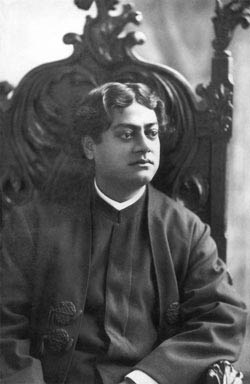
He told the Parliament of Religions, “I accept all religions that were in the past, and worship with them all, I worship God with every one of them, in whatever form they worship Him. I shall go to the mosque of the Mohammedan; I shall enter the Christian’s church and kneel before the crucifix; I shall enter the Buddhist temple, where I shall take refuge in Buddha and in his Law. I shall go into the forest and sit down in meditation with the Hindus, who is trying to see the Light which enlightens the heart of every one.”

Continuing, he said, “not only shall I do all these but I shall keep my heart open for all that may come in the future. Is God’s book finished? Or is it still a continuous revelation, going on? It is a marvelous book—these spiritual revelation of the world. The Bible, the Vedas, The Koran and all other sacred books, are but so many pages, and an infinite number of pages remain yet to be unfolded. I would leave it open for all of them. We stand in the present, but open ourselves to the infinite future. We take in all that has been in the past, enjoy the light of the present and open every window of the heart for all that will come in the future. Salutation to all the prophets of the past, to all the great ones of the present, and to all that are to come in the future.”

Vivekananda spelt out his mission, “We want to lead mankind to the place where there is harmonization of the Vedas, the Bible and the Koran. Mankind ought to be taught that religions are but the varied expressions of the Religion, which is Oneness, so that each may choose the path that suits him best.”

The Two Civilizations

Affirming that there existed two civilizations, which had developed and thrived upon two different approaches to life, Vivekananda said, the Western approach was based upon the quest as to how much a man needed to acquire and possess in order to be happy and the Eastern—the Hindu—approach was a quest as to what is the minimum that a man requires to possess in order to remain happy.
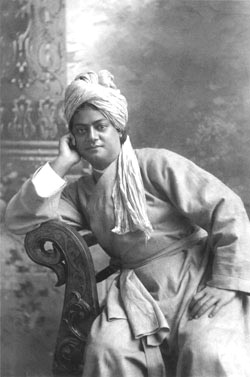
The West developed a mighty civilisation of ‘Bhoga’ (consumerism), while India produced a civilization based on ‘Tyaga’, (renunciation). In the name of globalization the Bhoga inspired approach is today engulfing the whole world causing grave threat of environmental degradation and possible ruin of all living species on earth. The only remedy is Tyaga inspired philosophy of life preached and practiced by Hinduism, taking into consideration every aspect and aspiration of human beings. The west has failed to evolve such a comprehensive view of life that could harmonize the individual with society, man with Nature,

Vedanta Philosophy

Vedanta believes in the unity of existence. Man, nature and universe are all one, inter related, interconnected and interdependent. One cannot exist without the other. There is a rhythm and a delicate balance in the universe, which sustains it in its totality. When man exploits nature, there is bound to be a backlash and consequent chaos. This makes it imperative that man and nature replenish each other and both attain maximum well-being.

At the Parliament of Religions

The Parliament of Religions opened on Monday, September 11, 1893. The spacious Hall of the Art Institute was packed with nearly 7,000 people and every organized religion from all corners of the world had its representatives seated on the platform.
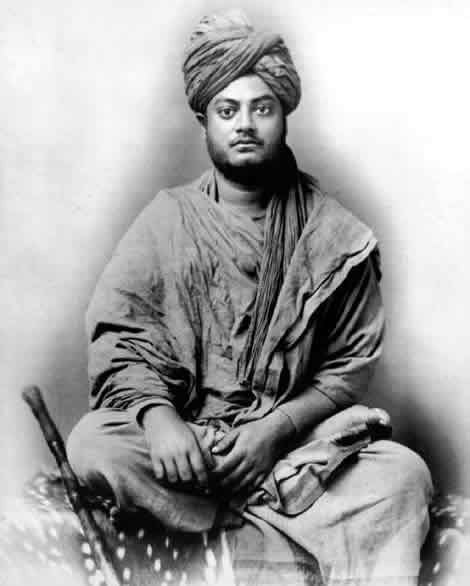
And when his turn to address the august assembly came, Vivekananda, a young man of 30, rose like the morning sun and created almost a sensation when he addressed the audience as “Sisters and Brothers of America” and said “It fills my heart with joy unspeakable to rise in response to the warm and cordial welcome which you have given me. I thank you in the name of the Mother of Religions and in the name of the millions and millions of Hindus of all classes and sects.”

Vivekananda continued: “I am proud to belong to a religion which has taught the world both tolerance and universal acceptance. We believe not only in universal toleration, but we accept all religions as true. I am proud to belong to a nation that has sheltered the persecuted and the refugees of all religions and all nations of the earth. I am proud to tell you that we have gathered in our bosom the purest remnant of the Israelites, who came to southern India and took refuge with us in the very year in which their holy temple was shattered to pieces by Roman tyranny. I am proud to belong to the religion, which has sheltered and is still fostering the remnants of the grand Zoroastrian nation.”

Stirring Message

His stirring message of oneness of religions came like the breath of fresh air to a suffocated people. Rising above cramping creeds and dwarfing dogmas, Vivekananda spoke of harmony, understanding and universalism in his address at the final session of the Parliament on 27th September,

Vivekananda roared, “If anything, the Parliament of Religions has proved to the world that holiness, purity and charity are not the exclusive possessions of any church in the world. Sectarianism, bigotry, and its horrible descendant, fanaticism, have long possessed this beautiful earth. They have filled the earth with violence, drenched it often and often with human blood, destroyed civilizations, and sent whole nations to despair. Had it not been for these horrible demons, human society would be far more advanced than it is now. But their time is come. I fervently hope that the bell that tolled this morning in honor of this convention may be the death- knell of all fanaticism, of all persecutions with the sword or with the pen, and of all uncharitable feelings between persons wending their way to the same goal.” In the face of this evidence, if anybody dreams of the exclusive survival of his own religion and the destruction of others, I pity him from the bottom of my heart, and point out to him that upon the banner of every religion will soon be written: ‘Help and not fight,’ ‘Assimilation and not Destruction,’ ‘Harmony and Peace and not Dissension'.”

Hinduism Re-interpreted

Like a true Hindu, Vivekananda envisioned religions as different radii leading to the center of the circle. Each religion, he pleaded passionately, must assimilate the spirit of the others and yet preserve its individuality and grow according to its own law of growth.
Vivekananda would often recall few lines of a Vedic hymn that in nutshell provided the essence of lofty Hindu thought. The hymn declared: ‘As the different streams having their sources in different places all mingle their water in the sea, O Lord, the different paths which men take through different tendencies, various though they appear, crooked or straight, all lead to Thee.’

He did not limit his concept of God to any one religion or faith but defined it as the worship of the Virat Purusha, the cosmic form of God, the Transcendental Reality that embraced the whole of humanity. This principle of the Universal Oneness of the Self formed the basis of his inherent belief in the equality of all people, irrespective of the considerations of three Cs-caste, creed or color. "Each soul”, he said, “is potentially divine, and the purpose of life is to realize that potential and manifest its essential nature of divinity."

Concern for the Lowly and the Lost

As a man of religious experience, Vivekananda had few parallels. Instead of seeking personal salvation by means of contemplation, he turned all his energy to the amelioration of the suffering humanity. “I do not care for liberation”, said he once, “I would rather go to hundred thousand hells doing well to others. This is my religion.”

His heart ached at the plight of the poor and the downtrodden. He was upset at the fact that his people lacked physical vigor and mental energy and were weighed down by barren customs, sterile traditions, priest-craft and caste-ism. The crying evil in the developing world, he said, was not want of religion but want of bread. “It is an insult to a starving people to offer them religion; it is an insult to a starving man to teach him metaphysics.”

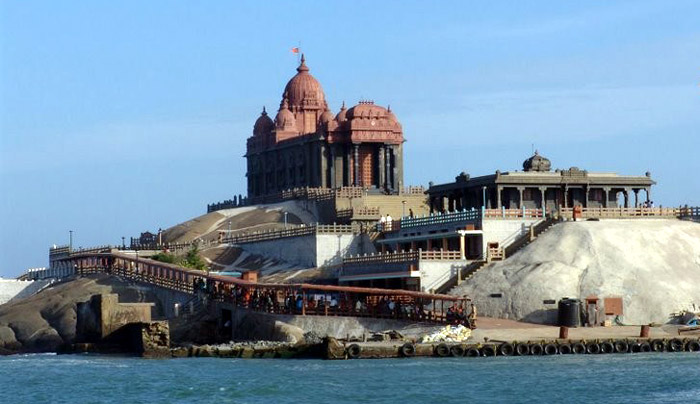
Vivekananda Rock Memorial at Kanyakumari
The philosophy of service advocated by this giant among men emanated from his chore belief that "Jiva is Shiva”. He would thunder in his lectures exhorting youth to “see Shiva in the lowliest and the lost". The worship of Narayana has to be through service to Daridra-Narayana, the poor, the needy and the homeless, he said.

He gave the people the clarion call to “Arise, Awake and Stop not till the Goal is Reached.” The call woke up the people of India from their slumber and inertia of petty mindedness and superstitions and broke their hypnotic spell of diffidence caused by thousands of years of subjection; it inspired the seekers, the thinkers and the lay people alike and made them fearlessness and strong. "They alone live, who live for others, the rest are more dead than alive”, he would often say.

It is this paradigm that inspired and influenced John Rockefeller whose life underwent a complete transformation after a personal meeting with the Indian monk. Vivekananda made Rockefeller realize that he was only an instrument and a channel and that God had given him wealth as an opportunity
to help other people.

What could India teach the World?

“Each nation, like each individual, has one theme in life”, he would say, and if any nation throws off its national vitality, it dies. He knew that India could teach the world, as the great American historian, Will Durant, believed,
“tolerance and gentleness of the mature mind, the calm of the understanding spirit, the quite content of the un-acquisitive soul, and a unifying, pacifying love for all living things.”

*Swami Vivekananda’s 148th birth anniversary falls on 12th of this month.

*A journalist by profession, a scholar by temperament and a writer by choice, Gopinath Raina was inclined to the study of religion from his very young age. It was Swami Vivekananda’s dynamic exposition of Hindu thought that fired his imagination while he was still at school, and by the time he entered college, he had been drawn to the writings of Gandhi, Aurobindo, Narayana Guru, Radhakrishnan and Bertrand Russel.

After retiring from Indian Information Service (I.I.S.) in 1983 where he distinguished himself as an editor, correspondent, commentator and administrator in All India Radio, he edited, AICC Journal, Varnika, (Jan.'84-Dec.'90), Koshur Samachar (March'91-Oct'95, Sanatana Sandesh,(1997-2005) and KASHEER (2003-2004),

He has been writing profusely on various aspects of Hindu thought. He enjoys writing, particularly on saints and sages, not only of Kashmir, but of the other parts of India as well. Presently he lives in Miami, and spends his time writing personal memoirs.

Copyrights © 2007 Shehjar online and KashmirGroup.com . Any content, including but not limited to text, software, music, sound, photographs, video, graphics or other material contained may not be modified, copied, reproduced, republished, uploaded, posted, or distributed in any form or context without written permission. Terms & Conditions.
The views expressed are solely the author's and not necessarily the views of Shehjar or its owners. Content and posts from such authors are provided "AS IS", with no warranties, and confer no rights. The material and information provided iare for general information only and should not, in any respect, be relied on as professional advice. Neither Shehjar.kashmirgroup.com nor kashmirgroup.com represent or endorse the accuracy or reliability of any advice, opinion, statement, or other information displayed, uploaded, or distributed through the Service by any user, information provider or any other person or entity. You acknowledge that any reliance upon any such opinion, advice, statement, memorandum, or information shall be at your sole risk.

Comments
Very enlightening article. Vivekananda's teachings and his philosophy is even more relevant in today's world.
Added By Kalpana Raina
ADVERTIZE HERE

Saturday, March 3, 2018

PEOPLE OF HUNZA


The Truth, Myths, and Lies
About the Health and Diet of the "Long-Lived" People of Hunza,
The Burusho or Brusho, also known as the Hunza people or Botraj,[3]live in Hunza, Nagar, Chitral, and in valleys of Gilgit–Baltistan in northern Pakistan, as well as in Jammu and Kashmir, India. All of them are Ismaili Muslims,
The Burusho people also reside in the Indian state of Jammu and Kashmir, being mainly concentrated in Batamalu, as well as in Botraj Mohalla, which is southeast of Hari Parbat.This Burusho community is descended from two former princes of the British Indian princely states of Hunzaand Nagar, who with their families, migrated to this region in the 19th century A.D.They are known as the Botraj by other ethnic groups in the state,[4] and practice Shiite Islam.Arranged marriages are customary. Since the partition of India in 1947, the Indian Burusho community have not been in contact with the Pakistani Burusho. The Government of India has granted the Burusho community Scheduled Tribe status, as well as reservation, and therefore, most members of the community are in government jobs.The Burusho people of India speak Burushashki, also known as Khajuna, and their dialect, known as Jammu & Kashmir Burushashski (JKB), "has undergone several changes which make it systematically different from other dialects of Burushaski spoken in Pakistan"] In addition, many Jammu & Kashmiri Burusho are multilingual, also speaking Kashmiri and Hindustani, as well as Balti and Shina to a lesser extent.

It is believed that these people are the descendants of the Macedonian soldiers who traveled to Pakistan with Alexander the Great. Whether this is true or not, the Hunza people are one of the most remarkable societies in the world and have a lot to teach the people of this planet.
The story of Hunza is thought to have begun with Alexander III or Alexander the Great (July 356 BC to June 10, 323 BC), son of King Philip of Macedon (Ancient Macedonia northwest of Greece). Alexander was a brilliant warrior, more capable than his father. After his father's murder, Alexander set out toward the east to conquer neighboring kingdoms. He conquered Greece in short fashion and continued toward Persia where he eventually burned the capital and the national library in a great defeat of the Persians.

Three generals in Alexander's army are said to have married Persian women. The generals betrayed Alexander by giving the Persians his plans. When Alexander heard of the betrayal he sought to take revenge, but the generals, wives, and a band of many soldiers fled. The valley of Hunza is thought to have been their valley of refuge because of its remote and secure location.

It is likely that the Hunza valley was already sparsely inhabited when the Macedon generals arrived. Certainly these tough fighting warriors made quick work of slaughtering the ancient inhabitants of Hunza. Though this is purely speculation, it is highly probable. The desolate rocky valley could not have supported the Macedonians unless some farms had been slowly built by others over the preceding centuries.
Hunza People Never Get Sick and Live up to 120 years - This Is Their Secret
The most fascinating thing about this community is that they seem to have remarkable health. Many people in the Hunza community live to be over 150 years old, and there have been reports of women giving birth naturally in the area at the age of sixty-five.

Life in the Hunza communities is characterized by its peacefulness. While bitter animosities over religion and ethnic identity are common in this particular region of the world and often stem into violent conflict, the Hunza are known for their tolerance and acceptance of difference. While the community is predominantly Muslim, there are a number of individuals who practice different faiths. All of these people co-exist peacefully, and the area is known for its warm and friendly community relations.

Inline image

Inline image

Friday, March 2, 2018

Attukal Temple

The Attukal Bhagavathy Temple is a Hindu religious shrine at Attukal, Trivandrum in Kerala, India. Goddess Bhadrakali (Kannaki), mounted over 'vethala', is the main deity in this temple. Bhadrakali, a form of Mahakali, who killed the demon king Daruka, believed to be born from the third eye of lord Shiva. 'Bhadra' means good and 'Kali' means goddess of time. So Bhadrakali is considered as the goddess of prosperity and salvation. Goddess 'Attukal devi', itself is the supreme mother 'Bhaadrkali devi', (in soumya aspect) the goddess of power and courage. She is often referred as Kannaki, the heroin of Ilanko Adikal's 'Silapathikaaram'. The temple is renowned for the annual Attukal Pongala festival, in which over three million women participate.[1] A festival that has figured in the Guinness Book of World Records for being the single largest gathering of women for a religious activity, the Attukal Pongala continues to draw millions of women with each passing year. According to the Attukal Temple Trust, around 4.5 million devotees are expected to attend the pongala in 2016. Attukal Temple is situated near the heart of the city, 2 kilometres away from Sree Padmanabhaswamy Temple, East Fort in Thiruvananthapuram. Devotees believe that all of their wishes will be fulfilled by the goddess, provide prosperity and can attain salvation. Attukal devi is often worshipped in 3 forms such as Maha Saraswati (goddess of knowledge), Maha Lakshmi (goddess of wealth) and Mahakali/ Durga/ Parvathy (goddess of power).

History 


The Goddess Kannaki (Bhadrakali) is the main deity in this temple. The mythology behind the temple, relates to the story of Kannagi who was married to Kovalan, son of a wealthy merchant. After marriage, Kovalan met a dancer Madhavi and spent all his riches on her forgetting his wife. But when he was penniless, he went back to Kannagi. The only precious thing left to be sold was Kannagi's pair of anklets. They went with it to the king of Madurai to sell it. But an anklet was stolen from the Queen which looked similar to Kannagi's. When Kovalan tried to sell it, he was mistaken for the theft and beheaded by the king's soldiers.
Kannagi got infuriated when she heard the news and rushed to the King with the second pair of anklet. She broke one of the anklets and it contained rubies while the Queen's contained pearls. She cursed the city of Madurai, and it is said that due to her chastity, the curse came true and Madurai burned. Kannagi is said to have attained salvation after the Goddess of the city appeared before her.
It is said that on her way to Kodungallur, Kannagi passed Attukal. She took the form of a little girl. An old man was sitting on the banks of a stream, when the girl went to him and asked him whether he could help her cross it. Surprised to find the young girl alone, he took her home. But she disappeared. She came back in his sleep and asked him to build a temple where he found 3 golden lines in his grove. He went ahead and did the same, and it is said that this is at the location of the present Attukal temple. Goddess Kodungallooramma (Bhadrakali/Kannaki) is believed to be present at Attukal during the festival days. Ponkala is offered to celebrate the victory of Kannaki over the king Pandya. Another story says that 'Attukal devi' is Bhadrakali, born from the third eye of lord Shiva to kill the demon king Daruka. Mother Bhadrakali is a form of Shakthi devi (Mahakali) worshipped mainly in Kerala. 'Bhadra' means good and 'Kali' means goddess of time. So Bhadrakali is often referred as the goddess of prosperity, time and salvation.

Pongala festival 

Attukal Pongala is the main festival of this temple. Attukal Pongala Mahotsavam is a 10 days festival which falls on February - March every year (Malayalam month of Kumbham). The festival begins on the Karthika star with the traditional Kappukettu and Kudiyiruthu ceremony, the idol of Devi, is embellished with Kappu (Bangles). The 9th day of the festival, 'Pooram day' is the major attraction, The Attukal Pongala day and the festival will conclude with the Kuruthitharpanam at 10th day makam star night.
Attukal pongala
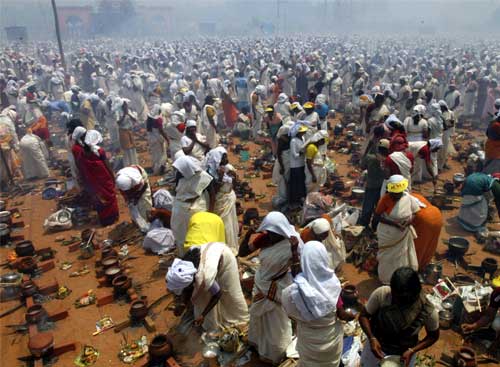
Millions of women gather every year in the month of Kumbham around this temple and prepare Pongala (rice cooked with jaggery, ghee, coconut as well as other ingredients) in the open in small pots to please the Goddess Kannaki. Pongala (literally means to boil over) is a ritualistic offering of a sweet dish, consisting of rice porridge, sweet brown molasses, coconut gratings, nuts and raisins. It is done as an offering to the presiding deity of the temple - the Goddess - popularly known as Attukal Amma. Goddess Attukal devi is believed to fulfill their wishes and provide prosperity. [4]
Attukal Pongala is the main festival of this temple. Attukal Pongala Mahotsavam is a 10 days festival which falls on February - March every year (Malayalam month of Kumbham). The festival begins on the Karthika star with the traditional Kappukettu and Kudiyiruthu ceremony, the idol of Devi, is embellished with Kappu (Bangles). The 9th day of the festival, 'Pooram day' is the major attraction, The Attukal Pongala day and the festival will conclude with the Kuruthitharpanam at 10th day makam star night.
Attukal pongala
Millions of women gather every year in the month of Kumbham around this temple and prepare Pongala (rice cooked with jaggery, ghee, coconut as well as other ingredients) in the open in small pots to please the Goddess Kannaki. Pongala (literally means to boil over) is a ritualistic offering of a sweet dish, consisting of rice porridge, sweet brown molasses, coconut gratings, nuts and raisins. It is done as an offering to the presiding deity of the temple - the Goddess - popularly known as Attukal Amma. Goddess Attukal devi is believed to fulfill their wishes and provide prosperity.
posted by : vipul koul
sources    : ayappan ailveil and Wikipedia
 

ATTUKAL BHAGAVATHI


ATTUKAL BHAGAVATHI


ATTUKAL BHAGAVATHI

The Attukal Bhagavathy Temple is one of the ancient temples dedicated to the divine mother in Kerala. It is very close to the famous Sri Padmanabha Swamy temple in Trivandrum. It is popularly described as the Sabarimala of women, since women form the major portion of the Devi’s devotees. The Goddess in the temple of Attukal is worshipped as the Supreme Mother, creator of all living beings as well as their destroyer. All pilgrims who visit the Sri Padmanabha Swamy Temple make it a point to visit the shrine of the supreme Mother known as Attukalamma. When the world was riddled with demonic forces, the gods prayed to Vishnu to send some power to protect them and his maya took the incarnation of the Devi to annihilate evil and protect the good in the world in the present era of Kali. Attukal Bhgavathy is one such incarnation.

Attukal Bhagavathi
Bhadrakali

According to mythology, Attukal Bhagavathy is supposed to be the divinised form of "Kannaki", the famous heroine of Chilappatikaram, the sangham work of Tamil Literature written by Ilamkovadikal. Kovalan and Kannaki are the heroic characters of this famous work of literature. Kovalan was unjustly accused of stealing the queen’s anklets and executed. Kannaki in her wrath destroyed the ancient city of Madurai. It is said that on her way to Kodungalloor (another famous Devi shrine of Kerala) she went first to Kannyakumari and then stopped at Attukal. The songs of the "Thottampattu” sung during the annual temple festival, are based on the story of Kannaki. Moreover, architectural depictions of Goddess Kannaki seen on the gopuram of the temple substantiate this story.
Kannaki is supposed to be the incarnation of Parvathy, the consort of Siva. The all powerful and benign Attukal Bhagavathy reigns eternally supreme at Attukal and looks after her devotees as lovingly as a mother does her children.

There are many stories connected with this temple. It is said that the goddess revealed herself to a fervent devotee of a notable family called the Mulluveettil family. One evening a young girl appeared before the head of the family while he was bathing in the Killi River and requested him to help her across the river. He was so impressed by the charm of her personality that he prostrated before her with awe and reverence and helped her to cross the river and invited her to his house nearby. The whole household was charmed by her sudden appearance in their midst and started preparing some food and other offerings for her for they felt sure she was of divine origin. However by the time they finished their preparations the girl had vanished.

ATTUKAL BHAGAVATHI
ATTUKAL BHAGAVATHI

 That night the old man had a dream in which she showed herself as an idol and demanded that he should establish an abode for her in the nearby grove. She promised to mark the exact spot with three lines. The next morning the old man went to the spot revealed to him in the dream and to his great surprise he did find three marks indented on the ground. He lost no time in erecting a temple on this consecrated spot for the goddess who had blessed him with her beatific vision both physically and in his dream. This temple remained unnoticed for many years. But due to her increasing power more and more people were drawn to her. Fairly recently, the temple was renovated by the local devotees. They also installed a beautiful and majestic icon of the Devi with four arms, bearing weapons of destruction, like the spear, sword, skull, shield etc. The consecration ceremony of this temple was performed by no less a person than the high priest of the Badrinath Temple in the Himalayas.

There are two idols of the goddess in the sanctum sanctorum. At the centre of the Sanctum the original idol of the goddess Attukal Bhagavathy has been installed. It is enclosed within a gold covering  embedded with jewels. The second idol of the goddess is installed besides the original one.
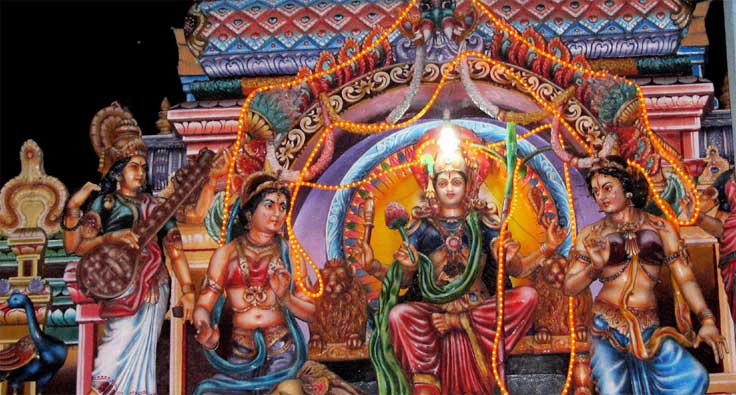
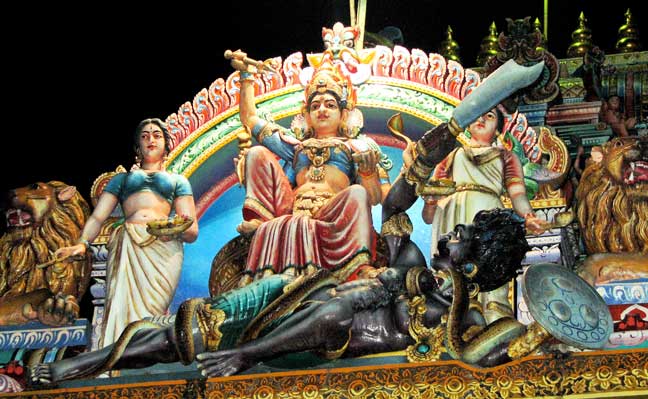
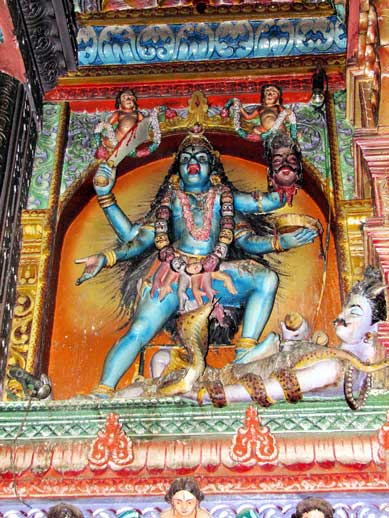
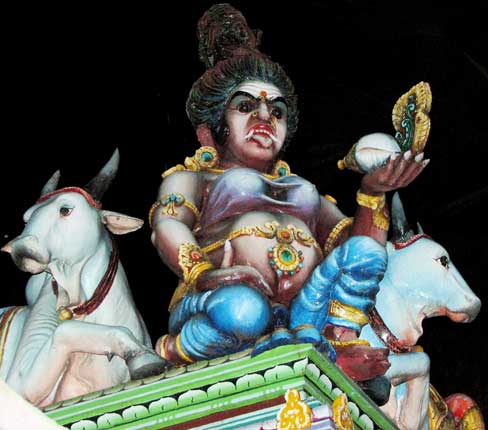
The present temple is a harmonious conglomeration of both Kerala and Tamil styles of architecture. It is fairly new and lacks the charm of the ancient temple architecture of this region. However there are some beautifully carved figures of Mahishasuramarddini, Goddess Kali, Rajarajeswari, Parvathi with Lord Siva and various other depictions of the goddess in her various forms in and around the temple. Around the corridors surrounding the temple, various other gods are depicted as well as the epic stories of the ten incarnations of Lord Vishnu . On either side of the elegant front gopura or gate - are the icons based on the story of Goddess Kannaki. On the southern gopura, the puranic story of "Dakshayaga", where the goddess Sathi immolates herself in her father’s Yaga or fire sacrifice is vividly depicted. The decorated gate at the entrance of the temple is another example of modern sculpture.

Pongala Mahotsavam
Pongala Mahotsavam

The Pongala Mahotsavam is the most important festival at the Attukal Bhagavathy Temple. It is actually an offering of rice to the goddess cooked by women in the grounds adjoining the temple. Though this practice is prevalent in some parts of South Kerala and Tamil Nadu, nowhere has it gained the popularity that it has at Attukal. In fact it has gained world fame. Women bring rice and milk and sugar or just plain rice as well as fire wood and make little ovens in the grounds of the temple and cook the rice and offer it to the goddess. They undertake it in fulfillment of their vow. They vow that they will offer Pongala to the goddess if their desire is fulfilled. Many, many miracles are reported as to how the goddess has fulfilled all types of wishes from the desire for a bridegroom or a baby to the recovery from a serious illness. In ancient times this was a small affair conducted within the precincts of the temple grounds. Hardly ten or fifteen women took part in it. But due to the increasing popularity of the goddess and her ability to fulfill all the varied desires of her devotees, more and more women are taking part in it.
Slowly the place for making the little ovens spread beyond the grounds of the temple to the neighboring regions and now it has spread right up to the big temple of Sri Padmanabha Swami which is about five kilometers away. From a small one day affair it has become a ten-day program commencing on the Karthika star of the Malayalam month of Makaram-Kumbham (February-March) and closing with the sacrificial offering known as Kuruthitharpanam on the tenth night. It is on the ninth day of the festival that the world famous Attukal Pongala Mahotsavam takes place. The entire area of about five kilometer radius around the temple including the grounds of the houses of people of all castes, creeds and religions, open fields, roads, commercial institutions, premises of Government offices etc. are all used as the consecrated ground for conducting the Pongala ritual. Thousands of women devotees come from different parts of Kerala and India. Drawn by the magic of her wish fulfilling ability you find that in the last few years some foreign women have also taken part in the ceremony.

The festival is exclusively for women and the enormous crowd, which comes to Trivandrum on this auspicious day is reminiscent of the Kumbha Mela Festival in North India except that it consists entirely of women while in the Kumbha Mela, the sadhus (yogis) predominate. It is a sight to be seen indeed where thousands of little fires are lit and women start to blow desperately at their flames. The temple priest blows the conch and this is the signal for all the women to place their little pots, preferably of mud, containing rice and water on the fire and blow and blow at the fire to cook the rice. Many of the devotees come from very rich families and have never lit an oven with firewood and have absolutely no idea how to handle it but the locals are very helpful and assist them to get a roaring fire going. When the rice is cooked the conch is blown again and all the offerings are taken to the temple.

RD

The author visited this temple with the web master and his wife. We were taken there in a very strange manner. We knew nothing of the temple history though I had heard of the Pongala festival. I never realized that the celebrated temple was so close to the Padmanabha Swamy temple. It was the Devi alone who guided us to her sacred presence. My friends who were American Hindus had accompanied me to many Kerala temples without any problems. Unfortunately they were stopped from entering the Sri Padmanabha Swamy temple without the permission of the Raja of Travancore! Naturally all of us were very disappointed. They waited outside while I made a quick visit to the temple and told Lord Vishnu how my friends were stopped from entering his wonderful temple.

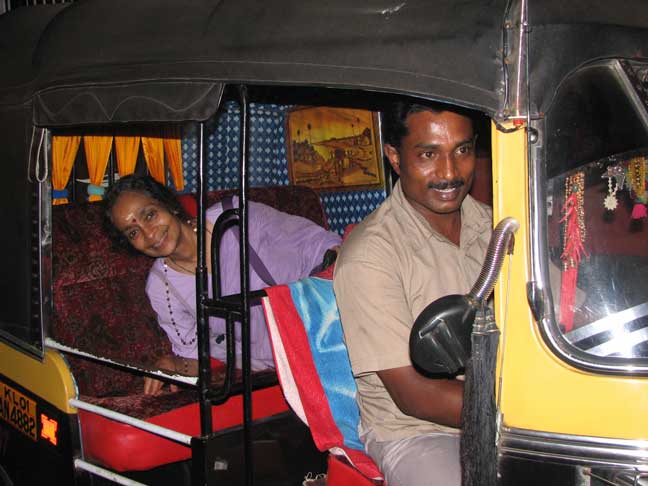
When I came out we found an auto rickshaw driver and I asked him if there were any interesting temples in the vicinity which we could go to. He immediately mentioned Attukal Bhagvathy. Actually I had no idea of who she was and did not connect her with the Pongala festival of which I had heard much. We reached there at twilight. As soon as I entered the precincts I felt her magic overpower me. It was time for her evening arati and without realizing her grace we were lead straight to the front and given a special place right in front of her. The door closed and opened again in a blaze of light and beauty which made me gasp in delight. There stood the divine mother bathed in light with many lights being waved before her, ready to grant the wishes of her devotees. It was an indescribable scene and we were overwhelmed with a sense of awe and wonder. It was only later that I was told by a friend that to get a front place during the evening arati is indeed a special honour which only she can give! People are said to queue for miles just to get a glimpse of her even at ordinary times and to have the privilege of standing right in front of her during the evening arati is indeed a miracle! We were poor ignorant people totally unaware of anything. She herself had lead us to her blessed feet and allowed us to have this blissful vision. It was truly a miracle and it certainly more than made up for having been denied entrance to the Sri Padmanabha Swami temple. When we came out I saw the posters advertising the next Pongala festival, announcing the date and other details. It was only then that I realized the extent of her grace for I had not known anything concerning the temple and the whole trip had been arranged entirely by her! May her grace be showered on all those who happen to read this article.
Aum Aim Hreem Kleem

 AB

 Small wonder then. that, Sri. Vidyadhiraja Chattambi Swamy, the well known saint of Kerala, found this temple premises ideal for his meditations. There are so many stories which prove the greatness of the Goddess and which attract thousands of devotees to the temple.