Sai Baba of Shirdi
From Wikipedia, the free encyclopedia
Sai Baba of Shirdi
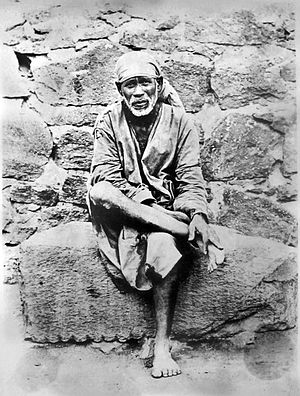
Sai Baba of Shirdi
|
| Born |
Unknown
Unknown |
| Died |
15 October 1918
Shirdi, India |
| Era |
19th to 20th century |
| Region |
Shirdi, Maharashtra, India |
Sai Baba of Shirdi (unknown – 15 October 1918), also known as
Shirdi Sai Baba, was a spiritual master who was and is regarded by his devotees as a saint,
fakir,
avatar (an incarnation of God), or
sadguru,
according to their individual proclivities and beliefs. He was revered
by both his Muslim and Hindu devotees, and during, as well as after, his
life on earth it remained uncertain if he was a Muslim or Hindu
himself. This however was of no consequence to Sai Baba himself.
[1] Sai Baba stressed the importance of surrender to the guidance of the true
Sadguru or Murshad, who, having gone the path to divine consciousness himself, will lead the disciple through the jungle of spiritual training.
[2]
Sai Baba remains a very popular saint,
[3]
especially in India, and is worshiped by people around the world. He
had no love for perishable things and his sole concern was
self-realization. He taught a moral code of love, forgiveness, helping
others, charity, contentment, inner peace, and devotion to God and guru.
He gave no distinction based on religion or caste. Sai Baba's teaching
combined elements of
Hinduism and
Islam: he gave the Hindu name
Dwarakamayi to the mosque he lived in,
[4] practised Muslim rituals, taught using words and figures that drew from both traditions, and was buried in
Shirdi. One of his well known epigrams, "
Sabka Malik Ek" ("One God governs all"), is associated with
Islam and
Sufism. He also said,
"Trust in me and your prayer shall be answered". He always uttered
"Allah Malik" ("God is King").
[2]
Background
No verifiable information is given regarding Sai Baba's real name,
place or time of birth. When asked about his past, he often gave elusive
responses. The name "Sai" was given to him upon his arrival at
Shirdi, a town in the west Indian state of
Maharashtra. Mahalsapati, a local temple priest, recognised him as a
Muslim saint and greeted him with the words 'Ya Sai!', meaning 'Welcome Sai!'.
Sai or
Sayi is a
Persian title given to
Sufi saints, meaning 'poor one'
[5] and in Banjara language, "sayi" means good one.
[citation needed]
The honorific "Baba" means "father; grandfather; old man; sir" in most
Indian and Middle Eastern languages. Thus Sai Baba denotes "holy
father", "saintly father" or "poor old man".
[1] Alternatively, the
Sindhi and
Urdu word "sāī.n" (سائیں), an honorific title for a virtuoso, a saint, or a feudal lord (i.e. a patron), is derived from the
Persian word "sāyeh", which literally means "shadow" but figuratively refers to patronage or protection. The
Hindi-Urdu word "sāyā" comes from the same borrowing. Thus, it could also mean "Master Father." However,
Sāī may also be an acronym of the
Sanskrit term "Sakshat Eshwar", a reference to God.
Sakshat means "incarnate" and Eshwar means "God".
Some of Sai Baba's disciples became famous as spiritual figures and saints, such as Mahalsapati, a priest of the
Khandoba
temple in Shirdi, and Upasni Maharaj. He was revered by other saints,
such as Saint Bidkar Maharaj, Saint Gangagir, Saint Janakidas Maharaj,
and Sati Godavari Mataji.
[6][7] Sai Baba referred to several saints as 'my brothers', especially the disciples of
Swami Samartha of Akkalkot.
[7]
Early years

Shirdi Sai Baba (right) and some of his devotees at Dwarakamai, his own
Temple.
Historians and devotees agree that there is no reliable evidence for a
particular birthplace or date of birth. Communities have claimed that
he belongs to them, but nothing has been substantiated. It is known that
he spent considerable periods with Muslim fakirs, and his attire
resembled that of a fakir. He did not discriminate based on religion and
respected all forms of worship to God.
Little has been officially documented on the early life of Shirdi Sai
Baba. An account of Shirdi Sai's missing childhood years has been
reconstructed by his disciple Das Ganu, after researching in the area
around the village of
Pathri. He collected this story in four chapters on Sai Baba, later also called the
Sri Sai Gurucharitra.
[8][9]
Das Ganu states that Sai Baba grew up in Pathri, with a fakir and his
wife. At the age of five, says Das Ganu, the fakir's wife put him in the
care of the saintly
desmukh Venkusha, where the boy stayed several years. Dasganu calls the young Sai Baba the reincarnation of
Kabir.
Because Das Ganu was known to take poetic liberties when telling
stories about Sai Baba, and as there are no other sources to corroborate
this story, it usually is left out of biographies of Sai Baba of
Shirdi.

Shirdi Sai Baba with some devotees
Sai Baba's biographer Narasimha Swamiji claims that Sai Baba was born as the child of Brahmin parents:
"On one momentous occasion, very late in his life, he revealed to
Mhalsapathy the interesting fact that his parents were Brahmins of Patri
in the Nizam's State. Patri is part of Parvani taluk, near Manwath. Sai
Baba added, in explanation of the fact that he was living in a Mosque,
that while still a tender child his Brahmin parents handed him over to
the care of a fakir who brought him up. This is fairly indisputable
testimony, as Mahlsapathy was a person of sterling character noted for
his integrity, truthfulness and vairagya." —Narasimha Swamiji, Life of Sai Baba[10]
According to the book
Sai Satcharita, Sai Baba arrived at the village of
Shirdi in the
Ahmednagar District of
Maharashtra,
British India, when he was about 16 years old. He led an ascetic life, sitting motionless under a
neem tree and
meditating while sitting in an
asana. The
Shri Sai Satcharita recounts the reaction of the villagers:
The people of the village were wonder-struck to see such a young lad
practicing hard penance, not minding heat or cold. By day he associated
with no one, by night he was afraid of nobody.[11]
His presence attracted the curiosity of the villagers, and he was
regularly visited by the religiously inclined, including Mahalsapati,
Appa Jogle and Kashinatha. Some considered him mad and threw stones at
him.
[12]
Sai Baba left the village, and little is known about him after that.
However, there are some indications that he met with many saints and
fakirs, and worked as a weaver. He claimed to have been with the army of
Rani Lakshmibai of
Jhansi during the
Indian Rebellion of 1857.
[13]
It is generally accepted that Sai Baba stayed in Shirdi for three
years, disappeared for a year, and returned permanently around 1858,
which suggests a birth year of 1838.
[14]
Return to Shirdi
In 1858 Sai Baba returned to Shirdi. Around this time he adopted his
famous style of dress consisting of a knee-length one-piece
Kafni robe
and a cloth cap. Ramgir Bua, a devotee, testified that Sai Baba was
dressed like an athlete and sported 'long hair flowing down to the end
of his spine' when he arrived in Shirdi, and that he never had his head
shaved. It was only after Baba forfeited a wrestling match with one
Mohiddin Tamboli that he took up the kafni and cloth cap, articles of
typical Sufi clothing.
[15]
This attire contributed to Baba's identification as a Muslim fakir and
was a reason for initial indifference and hostility against him in a
predominantly Hindu village.
[16]
For four to five years Baba lived under a
neem
tree and often wandered for long periods in the jungle around Shirdi.
His manner was said to be withdrawn and uncommunicative as he undertook
long periods of meditation.
[17]
He was eventually persuaded to take up residence in an old and
dilapidated mosque and lived a solitary life there, surviving by begging
for
alms, and receiving itinerant Hindu or Muslim visitors. In the mosque he maintained a sacred fire which is referred to as a
dhuni, from which he gave sacred ashes ('Udhi') to his guests before they left. The ash was believed to have healing and
apotropaic powers. He performed the function of a local
hakim
and treated the sick by application of ashes. Sai Baba also delivered
spiritual teachings to his visitors, recommending the reading of sacred
Hindu texts along with the
Qur'an. He insisted on the indispensability of the unbroken remembrance of God's name (
dhikr,
japa), and often expressed himself in a cryptic manner with the use of
parables,
symbols and
allegories.
[18]
Sai Baba participated in religious festivals and was in the habit of
preparing food for his visitors, which he distributed to them as
prasad. Sai Baba's entertainment was dancing and singing religious songs.
After 1910 Sai Baba's fame began to spread in
Mumbai.
Numerous people started visiting him, because they regarded him as a
saint with the power of performing miracles or even as an
Avatar.
[19] They built his first temple at
Bhivpuri,
Karjat.
[20]
Teachings and practices

Shirdi Sai Baba, leaning against the wall of his
masjid, with devotees
Sai Baba opposed all persecution based on religion or
caste. He was an opponent of religious orthodoxy – Christian, Hindu and Muslim.
[21] Although Sai Baba himself led the life of an
ascetic, he advised his followers to lead an ordinary family life.
Sai Baba encouraged his devotees to pray, chant God's name, and read
holy scriptures. He told Muslims to study the Qur'an and Hindus to study
texts such as the
Ramayana,
Bhagavad Gita, and
Yoga Vasistha.
[22] He was impressed by the philosophy of the Bhagavad Gita and encouraged people to follow it in their own lives.
[23]
He advised his devotees and followers to lead a moral life, help
others, love every living being without any discrimination, and develop
two important features of character: devotion to the Guru (
Sraddha) and waiting cheerfully with patience and love (
Saburi). He criticised
atheism.
[24]
In his teachings, Sai Baba emphasised the importance of performing
one's duties without attachment to earthly matters and of being content
regardless of the situation. In his personal practice, Sai Baba observed
worship procedures belonging to Hinduism and Islam; he shunned any kind
of regular rituals but allowed the practice of
namaz, chanting of
Al-Fatiha, and Qur'an readings at Muslim festival times.
[25] Occasionally reciting the Al-Fatiha himself, Baba enjoyed listening to
mawlid and
qawwali accompanied with the
tabla and
sarangi twice daily.
[26]
Sai Baba interpreted the religious texts of both Islam and Hinduism.
He explained the meaning of the Hindu scriptures in the spirit of
Advaita Vedanta. His philosophy also had numerous elements of
bhakti. The three main Hindu spiritual paths —
Bhakti Yoga,
Jnana Yoga, and
Karma Yoga — influenced his teachings.
[27]
Sai Baba encouraged charity, and stressed the importance of sharing.
He said: "Unless there is some relationship or connection, nobody goes
anywhere. If any men or creatures come to you, do not discourteously
drive them away, but receive them well and treat them with due respect.
Shri
Hari
(God) will certainly be pleased if you give water to the thirsty, bread
to the hungry, clothes to the naked, and your verandah to strangers for
sitting and resting. If anybody wants any money from you and you are not
inclined to give, do not give, but do not bark at him like a dog."
[28] Other favourite sayings of his were "Why do you fear when I am here" and "He has no beginning... He has no end."
[29]
Sai Baba made eleven assurances to his devotees:
- No harm shall befall him, who steps on the soil of Shirdi.
- He who comes to my Samadhi, his sorrow and suffering shall cease.
- Though I be no more in flesh and blood, I shall ever protect my devotees.
- Trust in me and your prayer shall be answered.
- Know that my spirit is immortal, know this for yourself.
- Show unto me him who has sought refuge and has been turned away.
- In whatever faith men worship me, even so do I render to them.
- Not in vain is my promise that I shall ever lighten your burden.
- Knock, and the door shall open, ask and it shall be granted.
- To him who surrenders unto me totally I shall be ever indebted.
- Blessed is he who has become one with me.
Worship and devotees
The Shirdi Sai Baba movement began in the 19th century, while he was living in Shirdi. A local
Khandoba
priest, Mhalsapati Nagre, is believed to have been his first devotee.
In the 19th century Sai Baba's followers were only a small group of
Shirdi inhabitants and a few people from other parts of India. The
movement started developing in the 20th century, with Sai Baba's message
reaching the whole of India.
[3]
During his life, Hindus worshiped him with Hindu rituals and Muslims
considered him to be a saint. Many Hindu devotees – including Hemadpant,
who wrote the famous
Shri Sai Satcharitra —consider him as an
incarnation of Lord
Krishna[30] while other devotees consider him as an incarnation of Lord
Dattatreya. In the last years of Sai Baba's life, Christians and
Zoroastrians started joining the Shirdi Sai Baba movement.
[3]
Because of Sai Baba, Shirdi has become a place of importance and is counted among the major Hindu places of pilgrimage.
[31] The first Sai Baba temple is situated at
Bhivpuri,
Karjat.
The Sai Baba Mandir in Shirdi is visited by around 20,000 pilgrims a
day and during religious festivals this number can reach up to a
100,000.
[32] Shirdi Sai Baba is especially revered and worshiped in the states of
Maharashtra,
Odisha,
Andhra Pradesh,
Karnataka, Tamil Nadu and
Gujarat.
In August 2012, an unidentified devotee for the first time donated two
costly diamonds valuing Rs 11.8 million at the Shirdi temple, Saibaba
trust officials revealed.
[33]
The Shirdi Sai movement has spread to the
Caribbean and to countries such as the United States, Australia,
United Arab Emirates,
Malaysia, and Singapore. The Shirdi Sai Baba movement is one of the main Hindu religious movements in English-speaking countries.
[34]
Notable disciples
Sai Baba left behind no spiritual heirs, appointed no disciples, and
did not even provide formal initiation (diksha), despite requests. Some
disciples of Sai Baba achieved fame as spiritual figures, such as
Upasni Maharaj of
Sakori. After Sai Baba left his body, his devotees offered the daily
Aarti to Upasni Maharaj when he paid a visit to Shirdi, two times within 10 years.
[35]
Reported miracles
Sai Baba's millions of disciples and devotees believe that he performed many miracles such as
bilocation,
levitation,
mindreading,
materialisation,
exorcisms, making the river
Yamuna, entering a state of
Samādhi at will, lighting lamps with water, removing his limbs or intestines and sticking them back to his body (
khandana yoga),
curing the incurably sick, appearing beaten when another was beaten,
after death rising on third day, preventing a mosque from falling down
on people, and helping his devotees in a miraculous way. He also gave
Darshan (vision) to people in the form of Rama, Krishna, Vithoba and
many other gods depending on the faith of devotees.
[36]
According to his followers he appeared to them in dreams even after
he left his body and gave them advice. His devotees have documented many
stories.
[37]
Historical sources
Biographers of Sai Baba (e.g., Govindrao Raghunath Dabholkar, Acharya
Ekkirala Bharadwaja, Smriti Srinivas, Antonio Rigopolous) have based
their writing on primary sources. One such source is the
Shirdi Diary by
Ganesh Shrikrishna Khaparde, which describes every day of the author's stay at Shirdi.
Speculation about the unknown episodes of Sai Baba's life are primarily based on his own words.
The most important source about Sai's life is the
Shri Sai Satcharita, written in
Marathi
in 1916 by Govindrao Raghunath Dabholkar, whom Sai Baba nicknamed
'Hemadpant'. Consisting of 53 chapters, it describes Sai Baba's life,
teachings, and miracles. The book compares Sai Baba's love to a mother's
love: caring and loving, but reprimanding when needed. It describes
Baba's lifestyle, his selfless attitude, and his love for his devotees.
The book describes how one should surrender one's egoism at God's feet
and trust one's guru. It explains how God is supreme and His devotees
should trust Him and love Him. It teaches that God is omnipresent in all
living things, so that everything on Earth must be treated with love
and respect.
Sai Baba of Shirdi and His Teachings by Acharya Ekkirala
Bharadwaja is an in-depth study of Sai Baba's life routine and
activities. Shortly after Sai Baba's passing, devotee B.V.
Narasimhaswamiji compiled accounts by eyewitnesses such as
Sri Sai Baba's Charters and Sayings and
Devotee's Experiences of Sai Baba.
Regarding the original photographs of Shirdi Sai Baba, research still
needs to be done to identify the authentic ones, as there are also
paintings as well as photographs of other persons of similar appearance
in circulation besides the few genuine photographs.
In various religions
Hinduism
During Sai Baba's life, the Hindu saint Anandanath of Yewala declared Sai Baba a spiritual "diamond".
[38] Another saint, Gangagir, called him a "jewel".
[38] Sri Beedkar Maharaj greatly revered Sai Baba, and in 1873, when he met him he bestowed the title
Jagad guru upon him.
[39][40] Sai Baba was also greatly respected by
Vasudevananda Saraswati (known as
Tembye Swami).
[41] He was also revered by a group of
Shaivic yogis, to which he belonged, known as the
Nath-Panchayat.
[42]
According to B.V. Narasimhaswami, a posthumous follower who was
widely praised as Sai Baba's "apostle", this attitude was prevalent up
to 1954 even among some of his devotees in Shirdi.
[43]
In 1940,
Indian guru,
Sathya Sai Baba proclaimed himself to be the reincarnation of Sai Baba of Shirdi.
[44]
Islam
In a minor section of
Islam community, Sai Baba is mainly considered a
Muslim Fakir. He appears in
Sufism as a
Pir.
[citation needed]
Zoroastrianism
Sai Baba is worshiped by prominent
Zoroastrians such as
Nanabhoy Palkhivala and
Homi Bhabha, and has been cited as the Zoroastrians' most popular non-Zoroastrian religious figure.
[45]
Others
Meher Baba, who was born into a
Zoroastrian family, met Sai Baba once, during
World War I,
in December 1915. Meher Baba was a youngster named Merwan Sheriar
Irani, when he met Sai Baba for a few minutes during one of Sai Baba's
processions in Shirdi. This event is considered as the most significant
in Meher Baba's life.
Shri Sai Satcharita (Sai Baba's life story), makes no mention of Meher Baba. But in
Lord Meher, the life story of Meher Baba, there are innumerable references to Sai Baba.
[35]
Meher Baba credited his Avataric advent to Upasni, Sai Baba, and three other Perfect Masters:
Hazrat Babajan,
Hazrat Tajuddin Baba, and
Narayan Maharaj. He declared Sai Baba to be a
Qutub-e-Irshad (the highest of the five
Qutubs, a "Master of the Universe" in the spiritual hierarchy).
[46]
In culture
Sacred art and architecture
In India, its a common sight to find a Sai Baba temple in any city or
town; in every large city or town there is at least one temple
dedicated to Sai Baba.
[3] There are temples located outside India as well, like United States,
Netherlands,
Kenya,
Cuba, Canada,
Pakistan, Australia, United Kingdom and more.
[47] In the mosque in Shirdi in which Sai Baba lived, there is a life-size portrait of him by Shama Rao Jaykar, an artist from
Mumbai.
Numerous monuments and statues depicting Sai Baba, which serve a
religious function, have been made. One of them, made of marble by a
sculptor named Balaji Vasant Talim, is in the Samadhi Mandir in Shirdi
where Sai Baba was buried.
[48] In Sai Baba
temples, his devotees play devotional religious music, such as
aarti.
[49]
Steam cooker
On 30 July 2009, the New and Renewable Energy Minister Farooq
Abdullah inaugurated what has been acclaimed as the largest solar steam
system in the world, at the Shirdi shrine. The Shri Sai Baba Sansthan
Trust paid an estimated Rs. 13.3 million for the system, Rs. 5,840,000
of which was paid as a subsidy by the renewable energy ministry. It is
said the system can cook 20,000 meals per day for pilgrims visiting the
temple.
[50][51]
Film and television
Sai Baba has been the subject of several feature films in many languages produced by
India's film industry.
| Year |
Film |
Title role |
Director |
Language |
Notes |
| 1955 |
Shirdi Che Sai Baba |
Unknown |
Kumarsen Samarth |
Marathi |
Won All India Certificate of Merit at 3rd National Film Awards |
| 1977 |
Shirdi Ke Sai Baba |
Sudhir Dalvi |
Ashok V. Bhushan |
Hindi |
Also featuring Manoj Kumar, Rajendra Kumar, Hema Malini, Shatrughan Sinha, Sachin, Prem Nath |
| 1986 |
Sri Shirdi Saibaba Mahathyam |
Vijayachander |
K. Vasu |
Telugu |
Dubbed into Hindi as Shirdi Sai Baba Ki Kahani, into Tamil as Sri Shiridi Saibaba. Also featuring Chandra Mohan, Suthi Veerabhadra Rao, Sarath Babu, J.V. Somayajulu, Rama Prabha, Anjali Devi, Raja. |
| 1989 |
Bhagavan Shri Sai Baba |
Sai prakash |
Sai prakash |
Kannada |
Also starring Ramkumar, Brahmavar, Vijaylakshmi. |
| 1993 |
Sai Baba |
Yashwant Dutt |
Babasaheb S. Fattelal |
Marathi |
Also featuring Lalita Pawar |
| 2000 |
Maya |
Sai Baba |
Ramanarayanan |
Tamil |
Also featuring S. P. Balasubrahmanyam |
| 2000 |
Sri Sai Mahima |
Sai Prakash |
Ashok Kumar |
Telugu |
Also featuring Murali Mohan, Jaya Sudha, Sudha, P.J.Sharma |
| 2001 |
Shirdi Sai Baba |
Sudhir Dalvi |
Deepak Balraj Vij |
Hindi |
Also featuring Dharmendra, Rohini Hattangadi, Suresh Oberoi |
| 2005 |
Ishwarya Avatar Sai Baba |
Mukul Nag |
Ramanand Sagar |
Hindi |
Composite movie drawn from Sagar's Sai Baba (TV series). |
| 2010 |
Malik Ek |
Jackie Shroff |
Deepak Balraj Vij |
Hindi |
Released in 2008. Also featuring Manoj Kumar, Divya Dutta, Rohini Hattangadi, Zarina Wahab and Anup Jalota as Das Ganu. |
| 2012 |
Shirdi Sai |
Nagarjuna Akkineni |
K.Raghavendra Rao |
Telugu |
Released on 6 September 2012. Also featuring Srikanth (actor), Srihari, Kamalini Mukherjee, Rohini Hattangadi, Sharat Babu, Brahmanandam |
POSTED BY ............VIPUL KOUL
EDITED BY..............ASHOK KOUL
INIFORMATIOON VRECEIVED FROM