What a difference there is between the garden of the Daitya maiden
and this mountain of Kaunsa Nag.
Ah ! what is this strange event ?
Is it an illusion or a wandering of the mind ?
It was early morning, just before the break of dawn, Pandit Miskeen sat
at his favorite spot in the house, the high window on the top floor, Dab
of his Kani, staring at the hill. He could feel the weight of the hill
on his shoulders like he was one of those miserable rice gunny carriers
that frequent the ghat below his house at Safa Kadal, the bridge of
merchants. He thought he knew the hill, knew everything about it, but
these days the hill looked back at him with sneer of a taunting
stranger.
"Who are you? Please tell me!"
He pleaded the hill over and over again in his head. The day had just
begun and already the misery had already started . He was going to spend
the rest of the day staring at the hill. He had been at it for a month.
Miskeen had been doing it since childhood, admiring the hill from this
window, just like his father had in his time and his father's father in
his.
"What would my children see?," a nerve pinched in his brain at the
thought and his eyes twitched in pain. "They will see what I tell
them...but what do I tell them?"
Today too he could see the fort on the hill, yellow, standing in proud
contrast to distant white hills. It was going to be a beautiful day,
wooly clouds in sky and a gentle breeze carrying the scent of spring
flowers . Any other day the sight of the hill would have soothed his
eyes, lightened his being. The hill stood for all that was beautiful
about the world, a world brought into existence by divine pen of God, a
writer, no different than him but only the best writer of them all. Any
other day, Miskeen could have written poems in praise of the hill but
today the sight of it drowned his mind in pain.
"What do I know about you? Tell me little bird, is that all? Tell me all. How should your story be told?"
Pandit Miskeen had been tasked with writing the story of the hill, a
royal decree, but his pen had run dry. The new King of Kashmir was from
Jammu, a Hindu, finally a Hindu ruler after ages of Muslim rule and the
new king wanted all the stories of holy spots of Kashmir written down in
Sanskrit - the language of high gods - so that these stories would
travel and pilgrims could arrive from distant lands. A department was
created and for a moment it felt the glorious era of Dharma had been
revived. Pandit Sahib Ram, "the man who knew everything" had done a
great job identifying all the holy spots that were going to get their
own final tale of glory. But, it took him years to collect all the
information and it was the wish of Gods that Pandit Sahib Ram should die
before finishing the task. Sahib Ram was a mountain of knowledge and
men like Miskeen, minor pebbles, and Pandit Miskeen had no shame
admitting it publicly and yet, he agreed to finish the task. He couldn't
refuse. Not after the Pandit from Rainawari wrote a brilliant inspired
Mahatmya of the Spring of Tulamulla and earned for himself a gold coin
with insignia of the sun. Miskeen convinced himself, "If that Pandit son
of bad grammar can do it, why not I? I, Pandit Miskeen Shastri, shall
write the Mahatmya of Parbat. I shall write it not for the king, I shall
write for the true readers."
He could now hear the hill laugh at him. It was laughing at him in an alien tongue, in Chinese.
Chi Chi Chi.
The sound in his ears broke his chain of sad thoughts. He thought he
was going mad but it was only the chirping of little sparrows dancing on
the window sill, asking for their daily feed. Pandit Miskeen gave a wry
smile to the birds, took one more look at the hill and rose up to
perform his next ritual. On way out of the house, passing by the
kitchen, he put on his dastaar and called out to his wife and commanded
her to feed the birds.
"Your friends are looking for you. I am going for Prakram."
Like his father and his father before him, Pandit Miskeen every able
morning used to circumambulate the hill. He walked out of his house and
onto his street, looking around, he could see others making their way to
the hill. On the bridge, among all the dastaar heads making way to the
hill, he could see a young boy of eight with shaven head, making his way
through them. It was Hajam Subaan Dar's son Mahmdu on way to Mulla
Karimulla Karim's school. As they crossed each other, the boy carrying a
smile, nodded his head in greeting while Miskeen nodded back. The old
man was going up the hill to speak to the old God and the young man was
coming down the hill to learn the language of another new God. Not a
word was spoken between them. It was their daily ritual.
Miskeen entered the familiar ground, he walked under Sangin Darwaza, the
Mughal gate and recalled his notes, "Here was the city of temples with
painted walls." Past the old graves, not looking at them, not a good
morning sight, "here are the graves in Sharda and Persian script. There,
the ruins of mosque of Akhund Mullah the guru of Mughal
Dara...legendary king Ranaditya's Matha for Pasupata order. There, the
applicants at hospice of Maqdoom...the stones and matrikas all around
with the signs and figures. "
Reaching the south-easter end of the hill, Miskeen bowed his head at the elephant stone and stopped to take a breath.
"Vinayaka Bhimasvamin...as old as this city. The god of King Pravarasena
that self-manifested to bless the new city. Surely, to bless the new
pilgrims too. Does it look like head of an elephant? The stone that
turned from west to east just to look at the magnificent city built by
Pravarasena. The stone that again looked west when disgusted with the
city destroyed by Sikander Butshikan. Yes, our god looked away. If we
remove all this vermillion, may we see which way the god it is turned
now?"
Miskeen turned to look at the hill..."200...300...600 feet to go" the
sun was up, he stood in its shadow, the eagles had arrived in sky and
were now circling, eyeing offerings of sheep lungs from faithful
worshipers. He lowered his gaze to look down into the remains of Maya's
hell pit. The pit, a asuravivara, one of many built by Mayasura, the
magic man of Asuras and a mureed of Shiva, the God who lords over
netherworld as Hatakesvara.
"...the pit now renamed Waris Shah's pit, it's mouth closed by boulders
for the fear of demons, lest they find their way to surface from Patala.
Foolish men, it can't happen till Maa Sharika keeps watch. Maej Sharika kar daya...kar daya tche hee bhaweenii....The
Maya's pit and the way to Pataal-lok. The Hill of Pradyuman and the
Hill of Sharika. Hill, how should it be? Should I tell the story of
Anirudh's love for a demon maiden? Or should I tell the story of Goddess
Sharika? During Budshah's time, Bhatavatara, told the story in Kashmiri
as "Banasur Katha". However, Somadeva told it first and told it
best...how can I better it? Somadeva re-opened the demon pit of Maya
when he retold the love story of King Bhunandana of Kashmir and Kumudini
the enchantress. The story starts with Anirudh who was the grandson of
Lord Krishna and son of Pradyumna. Usha the daughter of asura Lord
Banasur, grand daughter of Mahabali was smitten with Anirudh. She found
these secret natural caves for her lover and invited him frequently into
her pleasure gardens. Their secret was soon discovered and Banasur
imprisoned Anirudh in netherworld. Anirudh's father Pradyumna looked for
a way into Pataal. He found it in Kashmir, but prayed to Goddess Durga
to keep watch over the pit and ensure that no demon comes out after he
goes in. The mother goddess took the form of bird Sarika and picking a
pebble from mount Meru in its beak dropped it into the opening of the
pit so that no demon comes on the surface."
Making the steep climb, Miskeen almost stumbled on a stone, but like an
ageing old tom cat about to fall off from a wall, old pandit dug into
the last remains of his nimble senses and out-maneuvered his imminent
fall. He kicked the stone aside and continued walking up the hill.
"This spot on the hill where Sharika keeps watch, a brahmin knew this
spot, he spilled some mustard seeds, the great bane of demons, and...Khul Ja Simsim...revealed
this pit to King Bhunandana of Kashmir who had seen demoness Kumudini
in a dream and got a huge erection that would only subside after meeting
her for real. The king gave away his throne and headed for Kausar Nag
to pray for sensual pleasures of Pataal-lok. A Brahmin finally arrived
as a blessing and showed him the way to his real dream. He showed him
the spot where Goddess Shakira still stood guarding the portal to Pataal
in the village of Yaksha Atta around Pradyumna hill. Kashmiris were
ever hungry for union with these demon beauties...Ksemendra tells us how
men would often end-up dead in a lonely pits, robbed at the hands of
some beautiful harlot. All a game of Maya and Mahakali. Yaksha
Atta..Atta...adhasa ye kus...who is this Atta. Somadeva before
telling us the story of Bhunanda tells us the story of a Yaksha named
Atttahasa in the story of Brahmin Pavitradhara and Yakshini Saudamini
daughter of Prithudara. Atttahasa and Saudamini were about to get
married. But, for his bachelor's night, Atttahasa went out to party with
friends and had a few drinks too many. He pretended to be King Kubera
and the King of Yakshas didn't get the joke and cursed him to be re-born
as mere mortal. As often happens with these divine beings, Kubera too
eventually realized he was being too harsh to the two lovers and
promised them that they would meet again on earth and on cognition, the
curse shall break. Ha!Ha!Ha! Prithudara... Earth's surface...
Bhunandana, the son of soil... Pavitradhara...the pure surface.
Somadeva, you drunk devil! Atttahasa! Lord of Self Annihilating Loud
Laughs! Ha!Ha!Ha! I know you. Ha!Ha!Ha!"
Pandit Miskeen had reached his summit - Chakreshwara. Beyond this,
further up was the fort, and inside it the new Kali temple. But, for
Miskeen and other faithfuls the journey stopped here at this rock. Some
faithfuls, they just stood with folded hands, while others, sang songs.
Still some other faithfuls sat in front of the rock, like flies, waving
their hands around their head in slow rhythmic motions, holding breadth,
breathing in, breathing out, whispering in lost tongue, and at times
snapping fingers.
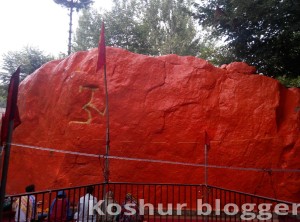
The big ochre red rock with the self-manifested sacred marking stood
solemnly greeting an old pandit. Miskeen bowed his head and his eyes
secretly adored the ancient marking, the Sri Chakra . Triangles and
circles, one inside another, small inside big and big inside still
bigger, and still more triangles and a circle.
"It's a web. Everything is connected to everything. In the center is
nothing and everything," he whispered to the rock that stood guard.
Miskeem taking off his turban turned to face east and took in the vast
sight before his eyes. Below him was the Nagar of Sri, encompassing its
rivers, lakes, trees, few thatched roof, distant bridges and mud roads.
"This was once a city befitting the gods. Pravarpura, this was the new
city that Pravarasena built around Pradyumna Hill. And how? Kith paeth?
It is written that when the King was looking for a site to build his
city, one night he arrived at a river and on the other side of the river
he could see the ghat where the dead used to be set afire. Kashmir,
perhaps always had too many dead, for that night too, the ghat was
tinted red in the light of burning pyres. While the king stood watching
the red flame paint shadows of tall tree, a loud sound pierced the sky,
"Hahahaha!" A Rakshasa appeared with his arms raised, hands-up. The king
was afraid but the Rakshasa asked the King to look beyond his
appearance and manners. He was here to offer him his service, provided
the King crossed over to his side like the king Vikramaditya. Saying so,
the Rakshasa extended his arm in friendship, the hand became a bridge. The King took out a blade, a Kshurika and cut steps into the bridge so that he could cross over. The place is still known as Suth.
On reaching the other side, the Rakshasa threw a measuring tape in the
air, away from the spot, and told the King to build his city where he
finds this measuring tape in the morning. And then the Rakshasa
disappeared. Little of this makes sense but the next morning he found
the thread at village Sharitaka, the seat of Goddess Sharika looked over
by Yaksha Atta, the Lord of Watchtower. "
Miskeem had started walking down the hill, his steps were faster now, as if to keep pace with his meandering thoughts.
"Atta...Atta...Atta-hasa...Haha! How do we lesser mortals make
sense of this story? What was Kalhana saying? Maybe the King formed an
alliance with an older race who still lived outside newly evolving
civilized world. The unknown and rich world of Yakshas, maybe the two
were at war earlier...little cuts...little razor cuts...small skirmishes
between the two powers were to be put aside in exchange for peace and a
village was put in for bargain. The village of Sharitaka where goddess
worship was the norm since ancient times and the hill stood in watch
like a watchtower, Atta. Maybe the King crossed over to the cult of Devi
worship. The place where the King crossed over, the place where the
deal was made is still called Kshurikaval. Kshurikaval, the Razor
town...what we now know as Kundabal village on the southeastern shore of
Manasbal. The soil of that place is still strange, a number of lime
kilns are located in the village. Recently, there was an earthquake and
at Kundabal they say the land was cut as if by a blunt blade, about
twenty houses fell into a chasm which occurred in this village. The
houses just disappeared into razor's cut. "
Miskeem was again at the foot of the hill. He looked back one more time.
"What names haven't they called you "Hiranya Parbat", the Golden
Mountain, on account of your special yellow reddish stones that glow
like gold on some days when the sun hits your right. The 9th day of the
bright of fortnight of Har (June- July). You don't look like hill
anymore, you look like a mountain, a Parbat. That missionary Araki
stopped all the partying and dancing that used to happen on the hill, he
chased away the yakshinis and yoginis, but we are still here, you are
still here. Are we not? Are you not? "
The hill was impervious to such lavish praise and it was still not talking.
"Still more strange tales are told by the jewellers of Jammu. They say
the world famous Kohinoor stone once used to rest under this hill in the
form of Hari Stone or the Symantaka jewel, the earthy form of sun god.
Here in a secret cave, the access to which was from underneath Dal lake.
The stone then in stories travels all the way to Sri Lanka and returns
centuries later as Kohinoor. Those jewellers will tell all type of tales
to sell their stones. They created the tale of "Curse of Kashmir", that
who so ever, who so ever unworthy of it, wears it, shall have a
miserable life. It is interesting that the last owner of Kohinoor, Shah
Suja Durrani was imprisoned atop this very hill in that very fort.
Strange, very strange. Maybe, just may, some scribe no different than me
created this tale so that Shah Suja would give up the stone to Ata
Mohammed Khan, the governor of Kashmir. A stone in the beak of a
scribe."
Miskeen stopped in his steps. He just froze and let a thought sink in.
"Ata...Atta... Atttahasa. Hahah! Maybe all this a ruse. All these
stories....an elaborate encrypted message that can only be read with the
right key. A key that is now lost. May, they all,
Kalhana...Somadeva...they were talking about something that could have
been easily understood by "rightly" educated of their age, people who
had the right key, people who could read the real meaning of these
tales. Maybe they had deliberately hidden it. Didn't Abhinavagupta
present the tenets of Saiva philosophy in the garb of a Vaisnavite
treatise? Only an adherent of Saiva would have picked the work and truly
understood what was being said. You need the key to understand what was
being said? What was being said?"
"Hosh hasa! Hosh! Watch out!" A tongawalla cried out. Miskeen had
been jaywalking and would have surely come under the wheel had it not
been for mindful tongawalla. "Pandit Ji, you want to meet your god at my
hand! Make a sinner out of me!"
Miskeen apologized but didn't even raise his head to look the tongawalla
in the eye, he just stepped out of the way and continued walking.
"Anirudh fell for Usha, love, went down into demon world, Pradyumna went
after him, Sarika kept watch. Anirudh followed by Pradyumna. Key.
Pradyumna and Anirudh. The Consciousness fell for Maya, the portal to
sensuous and horrors. The Mind went to retrieve the Consciousness by
keeping Shakti in control. It's a formation. A definitive formation.
It's a Vyuha from Pancharatras - the five nights, the followers of
Vishnu who worship him as the transcendent and immanent being,
understood and explained through the formations: from Vasudeva was born
Sankarshan, from Sankarshana, Pradyumna, and from Pradyumna, Aniruddha.
Pandit Grishun Ram explains it quite well: This is as much to say, that
from the Self was born the Prakriti, from the Prakritis, the Mind, and
from Mind, Consciousness. Vasudeva first creates Prakritis, and passes
at the same time into the phase of conditioned spirit, known as
Pradyumna. From the association of Pradyumana with the Mansa springs the
Samkhya Alhambra, and Pradyumna passes into a tertiary phase known as
Aniruddha. From Ahamkara and Aniruddha seeing forth the Mahabutas, or
the primary elements - space (or "ether"), air, fire, water and earth.
Miskeen felt a sudden thunder roll in his stomach. It was wind bellowing
in his empty stomach. He was now hungry. He had reached the bridge,
here, in the middle of the bridge, he started counting the waves,
waiting and wondering.
"Miskeen is on the bridge, bridge is on the river. Miskeen is in the
river. Vyuha .The words of Pancharatras are supposed to be outside of
Vedic and Brahminical world. Everything in this cosmos is explained
through Vyuhas. The indifferent immanent being and his avatars, all of
them. These ideas were very much against the existing popular thought
streams of other cults. Back then it was said that a Brahmin who dealt
in Pancharatras was devoid of Vedic rites, outside of civilized world
and to be avoided. In Vedic time there were no temples, the temples were
invented much later, perhaps out of need of kings, out of need for
pilgrimages, so the image of god had to be philosophically reconciled
with the idea of indifferent god. It was claimed that in the age of
Kali, men needed help, they needed better maps to reach the godhead.
Today who remembers all this! We hear that the first temple of Sharika
was built at the foot of Pradhymana-pith by a still ancient king
Gokarna, son of King Gopaditya who is said to have built the other
famous hill top temple of Srinagar, the one we now call Shankaracharya
Hill. Village Bren was given as grant for maintenance of this temple.
The Bren or Banyan tree of that village is still an ancient deity from
animistic past. Mahabarata has passages encoded in Pancharatras but the
followers of Manu never mention Pancharatras. During Parvasena's time,
Kashmir was still the land of Nagas, Buddhists, Shakti animists and god
knows whats. Nilamata Purana, the key text of Kashmir has Buddha as a
Vishnu Avatar. Buddhists also mention Vyuhas but most of the time leave
out the fifth element - space. In the same text of Nilamata,Vasudeva,
Sankarsana, Pradyumna and Anirudha all appear as Nagas. Would that make
Pradyumna Hill the Parbat of Snakes? If I were to say that in Persian,
the hill will be called "Koh-i-Maraan" or "the Mountain of Snakes". The
afghans, those homesick mad tyrants were right after all when they
called it "Koh-i-Maraan", right accidentally. In Kashmir, the animistic
spirits mixed with Goddesss cult, whose ideas were adopted by Buddhists
and Vashnavites, and finally all merged with Shiva.The new tales
borrowing from old tales. So, in the story of this hill, people go down
into the netherworld, through special paths, meet seductresses who offer
them wine made of human fat and in the same netherworld world Shiva
resides even as Sharika keeps watch on your progress. That's what here
the goddess of Smallpox accepts offering of meat. In Kashmir, the
tantras based on Pancharatras were part of khovir vidhya, the left
handed tantra, vamamarg, the practice that need female partners. Around
Shivratri, the night of Shiva, some Pandits still perform the rites of
Pancharatra, the rites of five nights. Why? What was Hatakesvara doing
in the tale of Pradyumna? What is his shrine in form of a Linga doing in
the netherworld? Temples and shrine. Temples were built on the
principle of tantra that came out of Pancharatras. Cities were dedicated
to Sri and built on certain rules like Pradyumna should be facing east,
Anirudh south, Sankarshan north, Vasudeva west. The ancient Sri rock on
the hill is on the east side, so it was called Pradyumna Hill that
overlooks the city of Sri. The whole story is a map. Or at least the
story is partly a map. Doesn't a similar map exist elsewhere? A map of
another place. The 'Srinagar' of Garwhal also gets its name after the
goddess of Fortune, Laxmi, Sri or 'Sri Yantra', a giant rock which could
kill even if one looked at it. The rock was used by a Goddess to kill a
demon named Kalasura. The local storytellers say that this rock was
turned upside down by Adi Shankaracharya chucked into Alaknanda. He thus
put an end to all the tantric exercises associated with the rock and
laid down the plan for the city of Srinagar. It's an endless pit. A map
within a map."
Just as the beautiful thought occurred to Miskeen, he felt something
plop on his right shoulder and it was followed by an earth shattering
laughter.
"Hahahah! Pandit Ji! The crow just shat on you! Kavin trevi rek ad paav! That too half a paav! "
It was young Mahmdu. He was returning from his class.
"No worries, " Miskeen said as he wiped away the colored wet mass on his
shoulder. "No worries at all. It is good luck. Come let me rub some on
you too!"
Saying so Miskeen mock lunged at Mahmdu. Mahmdu moved back a bit and
catching the joke, started laughing. Miskeen was already laughing. It
was their daily ritual. Miskeen would come down from the hill after his
prayers and Mahmdu would return from his lessons, both would meet on
this bridge and then together head for the bakery. Miskeen had always
been fond of the boy. Miskeen had in fact read his future at the time of
his birth, the boy was not destined for anything great, but the boy's
great great grand daughters were. Miskeen had seen it all and he was
going to do his part.
"Tell me boy, what did you learn today?" asked Miskeen as he tried to keep pace with the young boy.
"Amul-Fil - Year of the Elephant, " replied Mahmdu while running to the bakery eager for fresh warm soft lavasas.
"The story goes back to the time of our Prophet's grandfather who was the caretaker of pagan Kabah temples."
Miskeen recalled in his mind that the temples around were dedicated to Hubal and the goddesses al-Lāt, Al-‘Uzzá and Manāt.
The boy continued talking and Miskeen kept adding his notes,"It was the
year our Prophet was born. A christian ruler of Yemen built a big temple
at Sana in order to overtake the pilgrimage business [key] of Mecca.
Some one from Mecca shit in the temple at Sana. Abraha, the ruler of
Yemen swore revenge and marched with an army of elephants [Ganesha] to
destroy Mecca. Yemen was known for their fierce elephants [probably came
from India]. Before entering the city to destroy it, Abraha's men
pillaged the city [what else]. They took away the camels of Prophet's
grandfather. Prophet's grandfather went to Abraha and asked that his
goods be returned. Abraha was surprised that the brave man was asking
that his goods be returned but wasn't asking that his gods be spared.
Prophet's grandfather is said to have replied, "I am the caretaker of my
goods. God is the caretaker of his." Next morning the elephants and the
army arrived to sack Kabah. The leading elephant of the attacker was an
elephant named Mahmoud [coincidence of name, key]. The elephant somehow
refused to lead the attack, it just wouldn't attack the temples. Just
then a storm arose in the sky. It was a swarm of small birds that
covered the whole sky. Each small bird [key] carrying a small pebble
[key] in its break. A pebble for every solider, each pebble carrying a
name of its target. The birds dropped the pebbles and the soldiers died
the moment it hit them. The entire evil [key] army of Christians was
decimated. It was like a raid from sky. Praise be the lord."
Hearing this Pandit Miskeen Shastri started laughing like a mad man.
Hearing him, even the dogs outside the baker's shop ran away.
"Hahahah! Birds and stones. Birds and stones. Have they heard of you
Somadeva in the land of Arabia! Did you send them the message?"
The boy was used to such eccentric behaviour of Pandit ji. He did not run away. He wanted to know, "What is so funny?"
Miskeen Shastri handed the kid a soft lavasa and said,"My dear boy have
you heard the story of that hill next to your house? Let me tell you a
story..."
Saying so, the two headed home as Pandit Miskeen Shastri told Mahmdu the story of Hari Parbat.

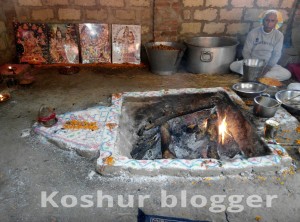 From Raithan Jagatamba moved to Kher Bhawani and it is believed that
Ragnya Mata resides in Raithan throughout the year and visits Tulmul on
special occasions. From the mountains The Ganga still flows at the feet
of the Holy Shila. The Shila of Jagatamba is beautifully surrounded by holy Ganga
which runs around the Shila as a garland around the neck of the
Lordess. Few centuries ago it is believed there was a huge temple of
Jagatamba at this shrine. About 25 years back when the holy
spring (Nag) was discovered and construction work was going on at the
site a large number of statues of Hindu gods and goddesses were
recovered by the Archaeological Survey of India. The existence
of huge decorated Devri stones within the premises of the shrine is
witness to the existence of a huge ancient temple here. This Holy Nag still exists and we can see crystal clear water in the spring.
From Raithan Jagatamba moved to Kher Bhawani and it is believed that
Ragnya Mata resides in Raithan throughout the year and visits Tulmul on
special occasions. From the mountains The Ganga still flows at the feet
of the Holy Shila. The Shila of Jagatamba is beautifully surrounded by holy Ganga
which runs around the Shila as a garland around the neck of the
Lordess. Few centuries ago it is believed there was a huge temple of
Jagatamba at this shrine. About 25 years back when the holy
spring (Nag) was discovered and construction work was going on at the
site a large number of statues of Hindu gods and goddesses were
recovered by the Archaeological Survey of India. The existence
of huge decorated Devri stones within the premises of the shrine is
witness to the existence of a huge ancient temple here. This Holy Nag still exists and we can see crystal clear water in the spring.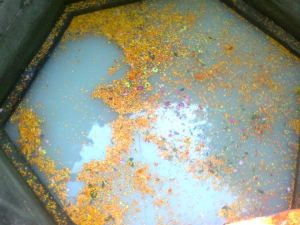

 From Raithan Jagatamba moved to Kher Bhawani and it is believed that
Ragnya Mata resides in Raithan throughout the year and visits Tulmul on
special occasions. From the mountains The Ganga still flows at the feet
of the Holy Shila. The Shila of Jagatamba is beautifully surrounded by holy Ganga
which runs around the Shila as a garland around the neck of the
Lordess. Few centuries ago it is believed there was a huge temple of
Jagatamba at this shrine. About 25 years back when the holy
spring (Nag) was discovered and construction work was going on at the
site a large number of statues of Hindu gods and goddesses were
recovered by the Archaeological Survey of India. The existence
of huge decorated Devri stones within the premises of the shrine is
witness to the existence of a huge ancient temple here. This Holy Nag still exists and we can see crystal clear water in the spring.
From Raithan Jagatamba moved to Kher Bhawani and it is believed that
Ragnya Mata resides in Raithan throughout the year and visits Tulmul on
special occasions. From the mountains The Ganga still flows at the feet
of the Holy Shila. The Shila of Jagatamba is beautifully surrounded by holy Ganga
which runs around the Shila as a garland around the neck of the
Lordess. Few centuries ago it is believed there was a huge temple of
Jagatamba at this shrine. About 25 years back when the holy
spring (Nag) was discovered and construction work was going on at the
site a large number of statues of Hindu gods and goddesses were
recovered by the Archaeological Survey of India. The existence
of huge decorated Devri stones within the premises of the shrine is
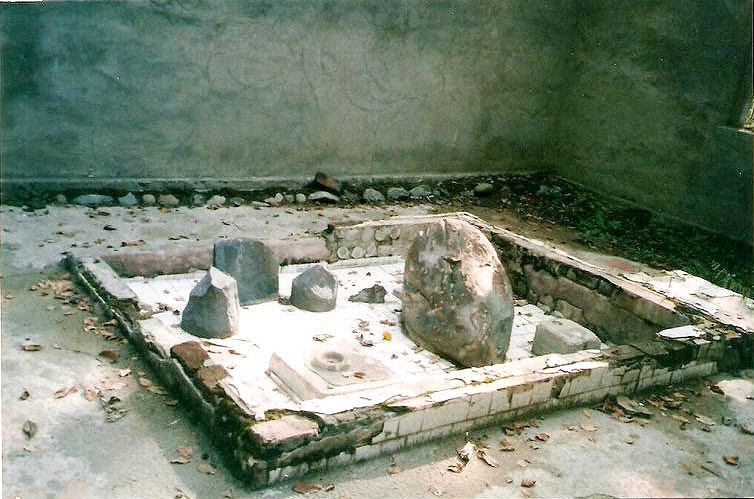
witness to the existence of a huge ancient temple here. This Holy Nag still exists and we can see crystal clear water in the spring.







Leave a Reply