Tuesday, June 17, 2014

Exploring the Remote Mountains of the Eastern Himalayas Arunachal Pradesh, India Amar Dev Singh

Exploring the Remote Mountains of the Eastern Himalayas

Arunachal Pradesh, India
Amar Dev Singh

My computer screen was cluttered with layers of open windows of spreadsheets, charts, calendars, emails and the usual other office stuff but the window that really had my interest was hidden just below. It was a window into the unknown. In-between cups of coffee and meetings I was exploring Google Maps peering into the depths of the remotest and least explored corners of the Himalayas – the Eastern Himalayas of India. I was looking for a line, a route, a challenge. I traced the folds of the terrain and followed the forbidden borders near a place called The Tri Junction, where the borders of Tibet, Burma and India intersect.
Months of searching revealed an elegant line that connects two river systems, the Ghalum and the Sar Di rivers, both tributaries of the Lohit River that originates deep in the Tibetan plateau. A 4500m pass right near the Burmese border separates the watersheds of these two rivers. The pass had neither a name nor was there any record that it had been crossed. I had found what I was looking for!
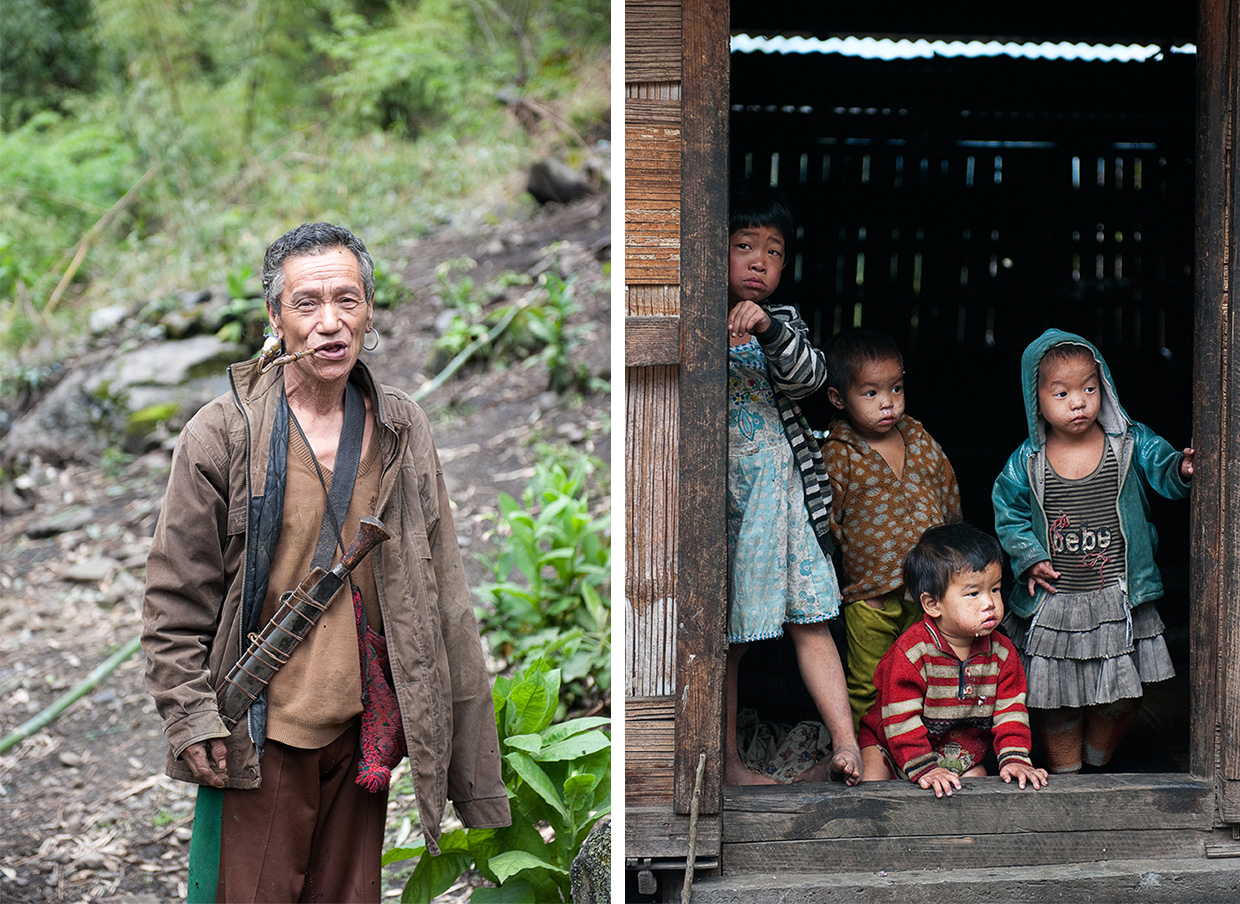
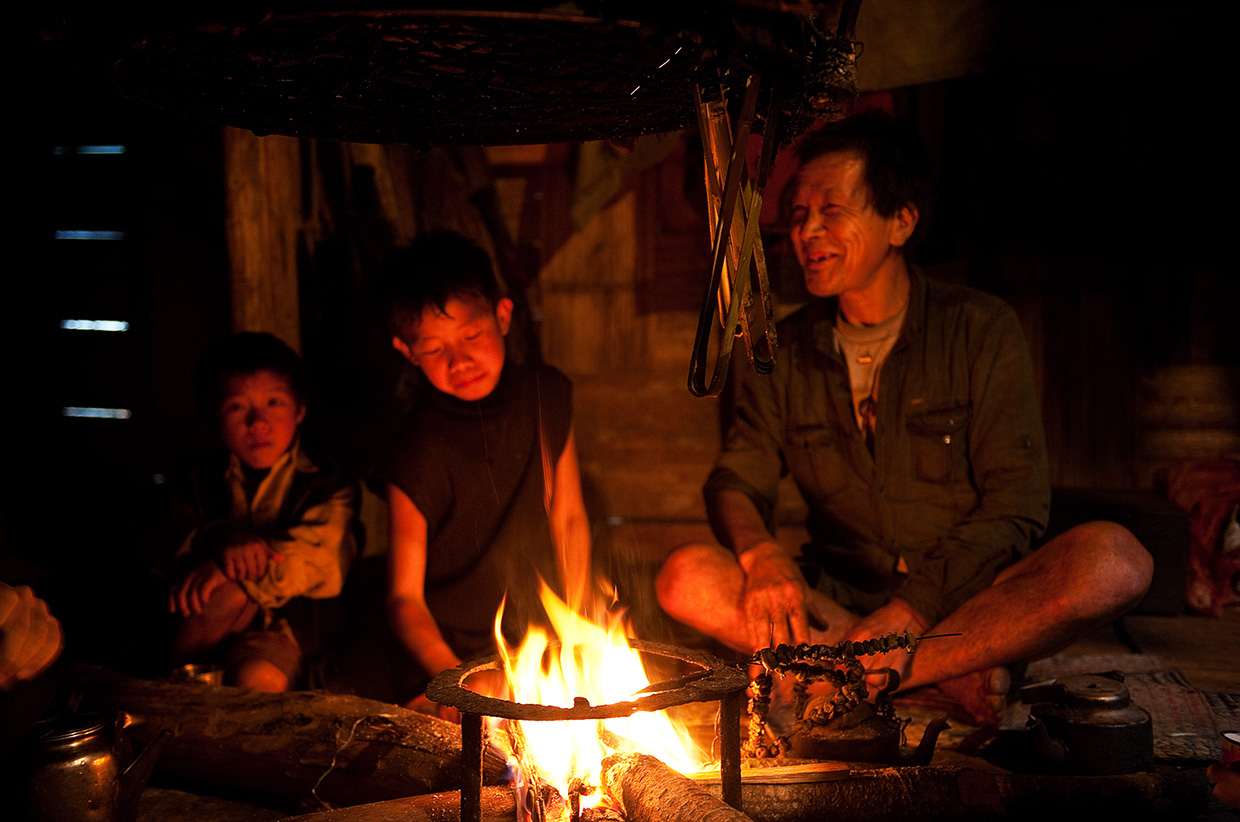
Six months later I was driving in the pouring rain along a twisted Himalayan road that runs along the Lohit river. I was on a recce to find out if the route was possible to follow. After a bone shaking 15-hour drive from the nearest airport we reached the trail head. Minzong consisted of a handful of rough bamboo huts elevated on stilts. Chickens, cattle and pigs wandered around in the mud and drizzle. We hopped over muddy puddles and animal dung as we made our way to the nearest hut. A local from the Mishimi tribe opened his door and beckoned us to come in out of the rain. Warm hospitality is second nature to these people. We sat cross-legged by the fire as they prepared tea for us.
The Mishimi people live very traditional lives and the Spartan hut had almost nothing in it; a few clothes hanging from pegs and a couple of farming implements lying in the corner. The only decoration was a hunter’s trophy rack consisting of a collection of skulls: bear, monkey, buffalo and deer.
Over a few cups of tea we asked if anyone knew of a route up the Ghalum river into the interior. They affirmed that local hunters do make the occasional foray up the valley and there is an old trade route that leads into Burma over the Kumjawng Pass. They noted that not many, if any people, had ventured beyond the pass in the direction I wanted to explore.
Chickens, cattle and pigs wandered around in the mud and drizzle. We hopped over muddy puddles and animal dung as we made our way to the nearest hut. A local from the Mishimi tribe opened his door and beckoned us to come in out of the rain.
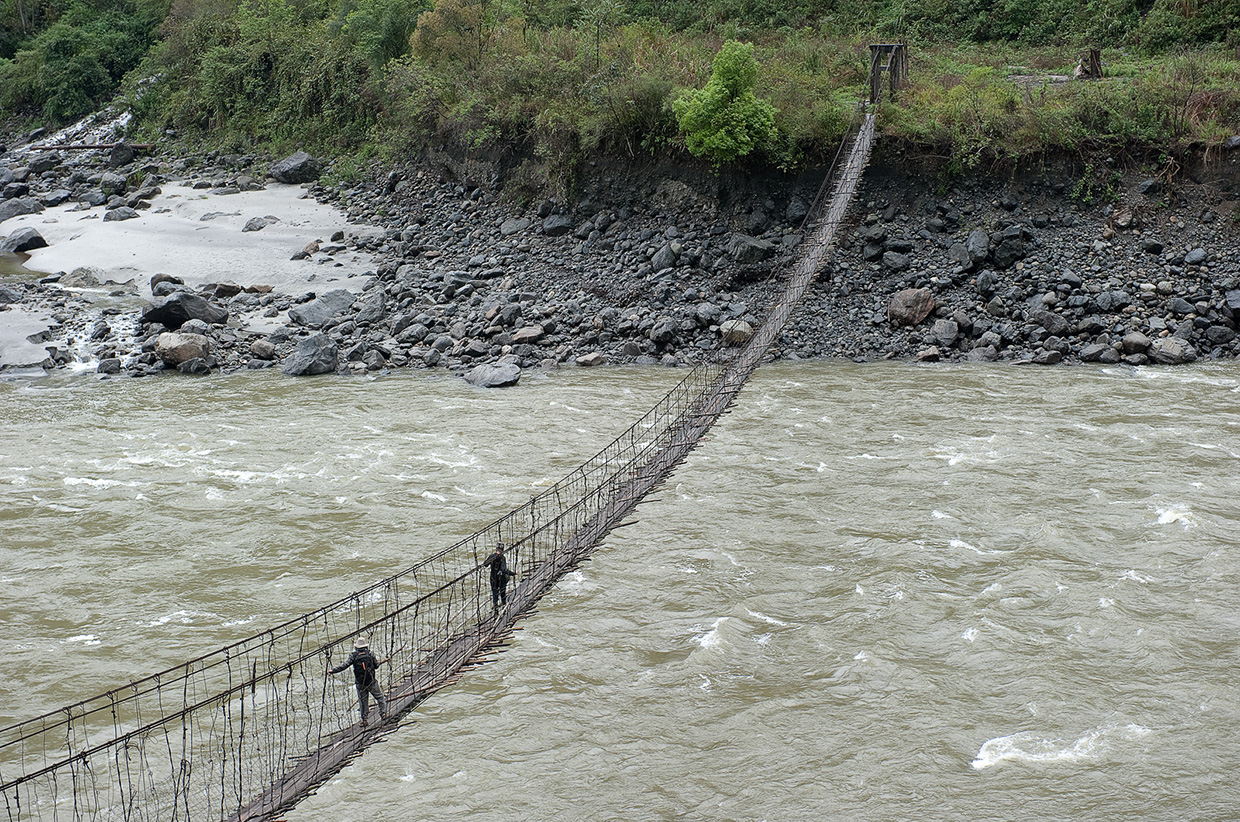
The Mishimi Tribe - The Eastern Himalayas - Photo © Amar Dev SinghThe Mishimi Tribe - The Eastern Himalayas - Photo © Amar Dev SinghGhalum valley - Eastern Himalayas - Photo © Amar Dev Singh
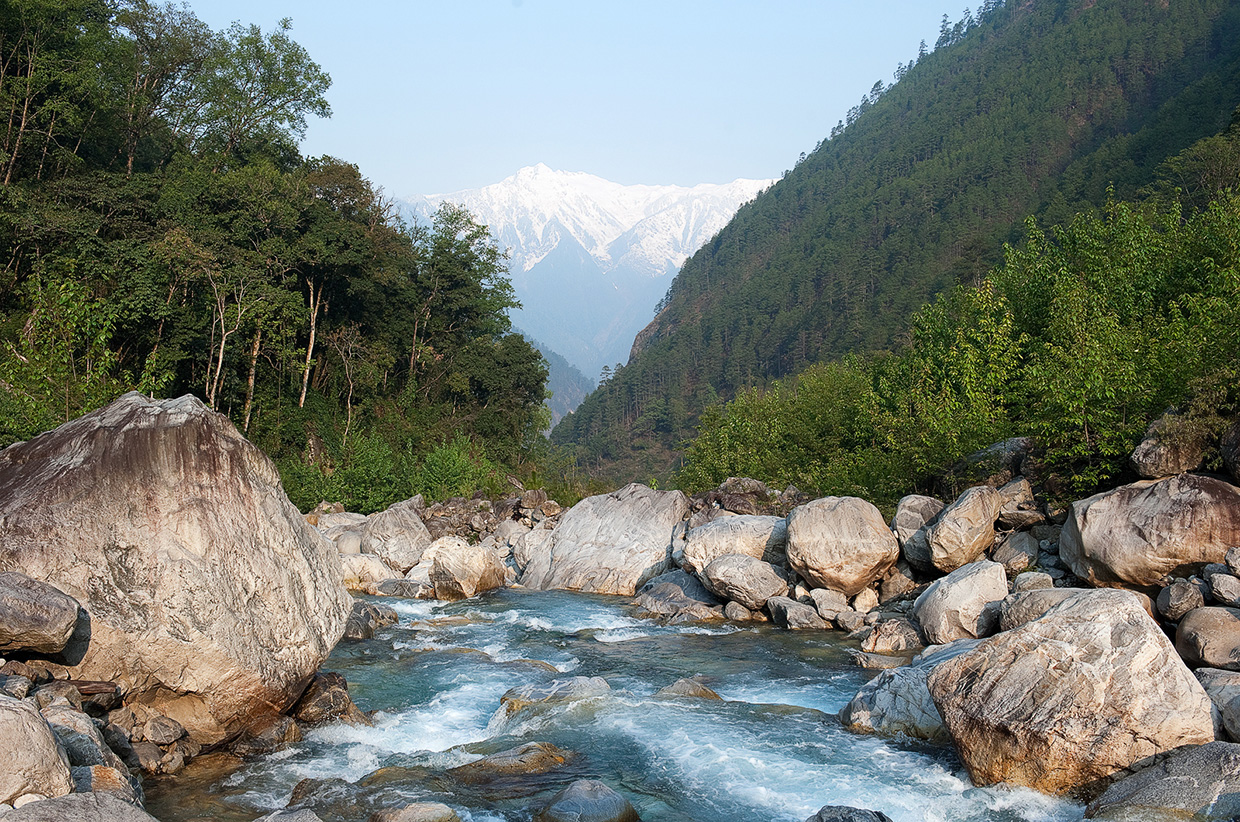
Early next day we started up the Ghalum valley to scout the initial section of the route. It began with an exciting crossing of a very sketchy suspension bridge over the swirling waters of the Lohit. The rusty cables were held together with even rustier off-cuts of wire and rough planks were slippery and loose. On the far side a well-worn path snaked its way through the jungle, hugging the course of the roaring Ghalum river, till the last village of Baon. Beyond that lay the jungle. Along the way we passed a number of huts surrounded by poppy fields. Most of the locals are hopelessly addicted to opium. A few women and grubby kids stared at us in silence before withdrawing into the dark recesses of the huts. Newly erected electricity poles and wires were the only sign of modernity in this quiet valley. Baon had only recently been hooked up to the electricity grid; that’s over 200 years after the invention of the light bulb.
Smoke filtered through the thatched ceiling, indicating that someone was home. We called out and a friendly face popped out of the door. The man quickly recovered from his initial surprise and invited us in.
We crossed and recrossed the Ghalum river a number of times on suspension bridges in various states of disrepair. Animist shrines and totems marked the path along the way. The local people follow the animist Doni Polo religion and worship the sun and the moon. After a few hours of trekking we came across the first huts of the village, rough bamboo structures balanced on stilts. Chickens and pigs scratched around in the ubiquitous poppy fields around the huts. Smoke filtered through the thatched ceiling, indicating that someone was home. We called out and a friendly face popped out of the door. The man quickly recovered from his initial surprise and invited us in. We kicked off our shoes and stumbled into the gloomy smoke-filled interior. We were seated by the fire on bear skins and over sweet cups of tea we quizzed the locals about the route beyond the village.
All the people in these parts speak Hindi fluently. The Indian government has gone to great length to ‘Indianise’ the people of Arunachal to counter China’s claim of the state. China refers to Arunachal Pradesh as Zàngnán or ‘South Tibet’ and regard it as Indian-occupied Chinese territory. The borders of this frontier state have never been officially demarcated. In 1962 India and China went to war and the Lohit valley was the scene of some bloody battles. The area remains heavily militarised and special permits are required to travel here.
We were assured that there was indeed a route for the next four days till the Kamjung Pass that leads into the jungles of Burma. The Indian military runs a couple of patrols up till the pass every year.
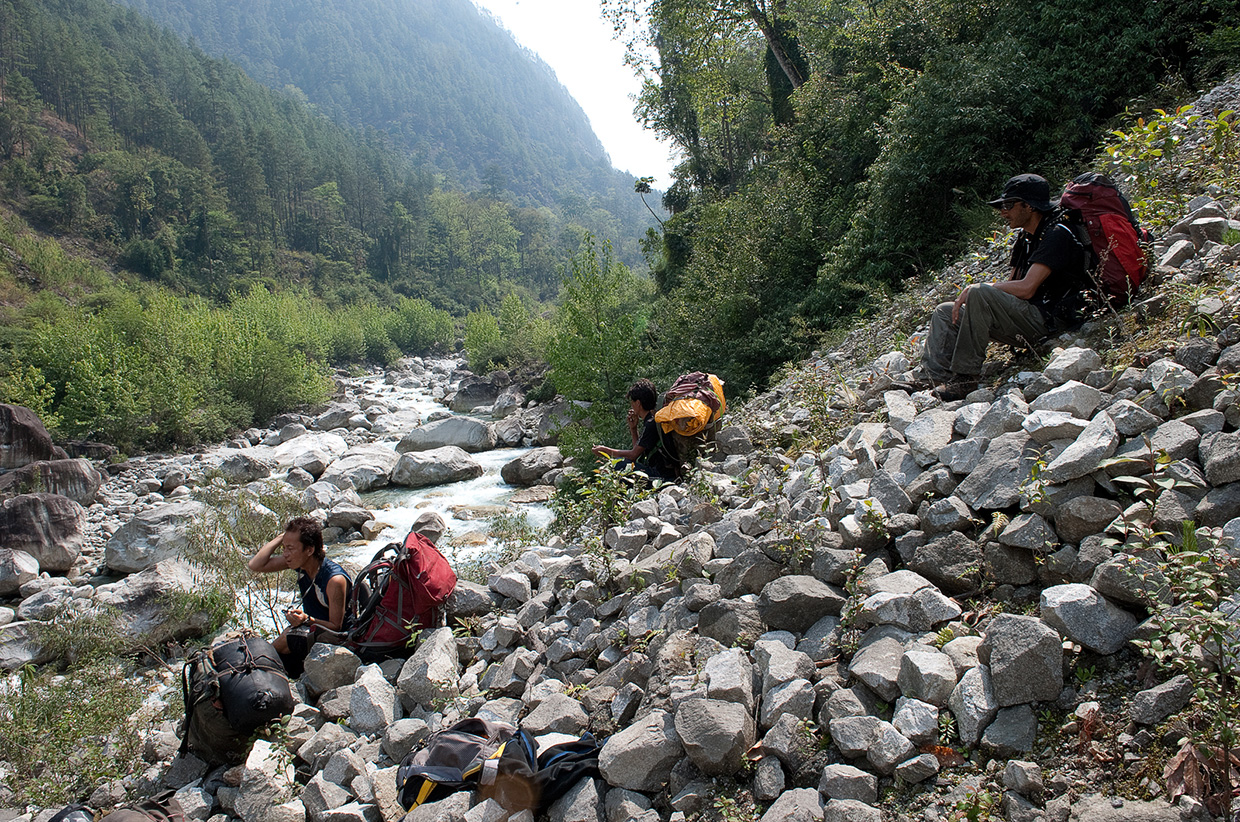
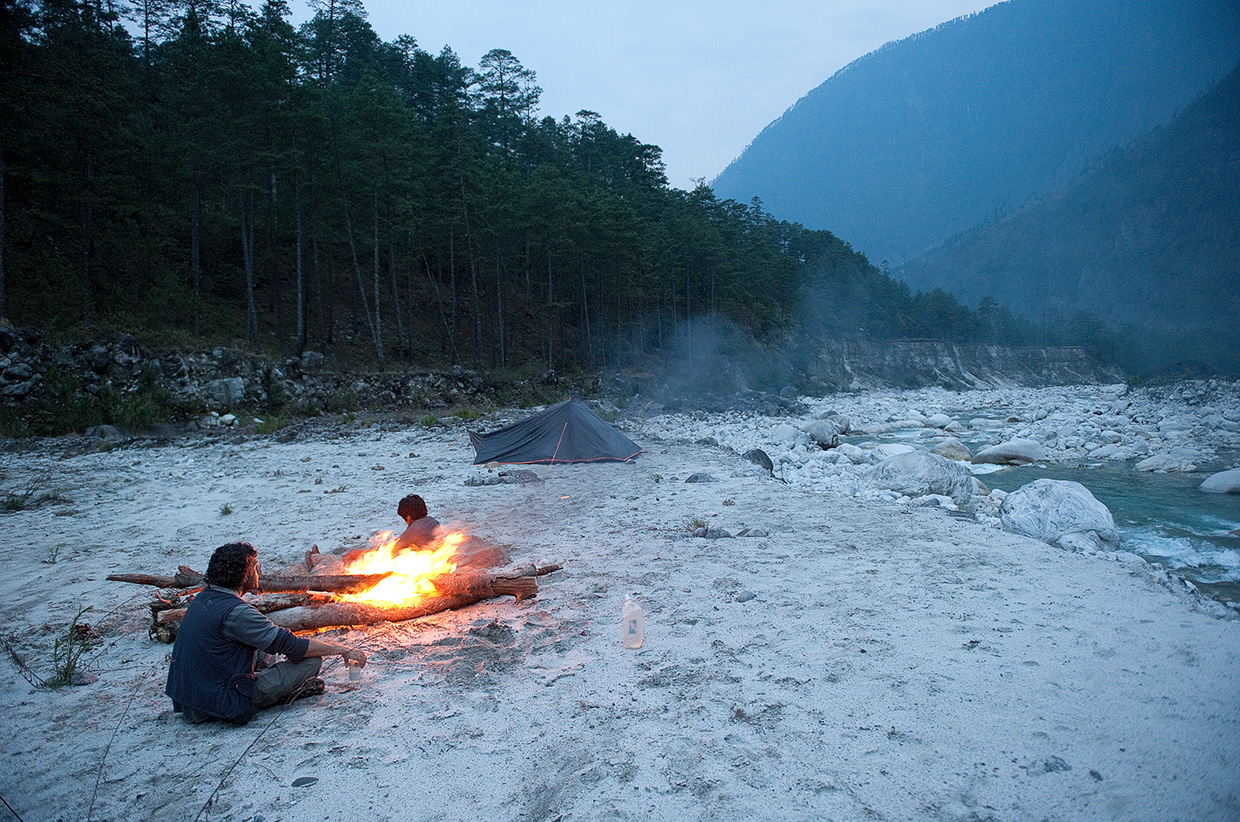
Ghalum valley - Eastern Himalayas - Photo © Amar Dev SinghGhalum valley - Eastern Himalayas - Photo © Amar Dev Singheastern-himalayas-08Camping by the river - Eastern Himalayas - Photo © Amar Dev Singh
We made our way back down the valley to the roadhead, satisfied with the knowledge that this section of the route could be done. Now to find out about the route up the Sar Di river which would be the descent route for the expedition. It took us two days to cover the 40km to the village of Dong as the early rains had washed away the road. We camped by some hot springs on the banks of the Lohit and put the word out on the bush telegraph that we were looking to hire the services of a local guide and porters. Just before dark three guys from the Meyor tribe showed up. Their leader Ajo, a quietly confident man, was an experienced hunter and knew the valley very well. He had bought two of his nephews along. They were just teenagers but Ajo assured us that they were very capable. We needn’t have worried as they turned out to be seasoned bushmen and could put the best of us to shame.
We paired our belongings down to a few bare essentials necessary for a two-day recce. The locals stood around as we repacked and shook their heads in disbelief at the amount of useless paraphernalia that we were carting along. All they packed for the trip was a blanket, a bush knife, matches, a cooking pot and a small bundle of food. These guys were hard as nails.
We set out before dawn and crossed the sparkling clear waters on a small suspension bridge at first light. The jungle began on the far side of the river and that’s where the path abruptly ended. We were now on a game trail that snaked it’s way up along the Sar Di river.
The trail climbed up and down along the precariously steep sides of the valley, which echoed with the roar of the rapids. Thick sub tropical jungle, thickets of bamboo, tangles of vines and dense undergrowth covered the hillsides. These jungles are teeming with wildlife; leopards, bears, monkeys and deer; Snow Leopard and Yak inhabit the higher reaches above the tree line.
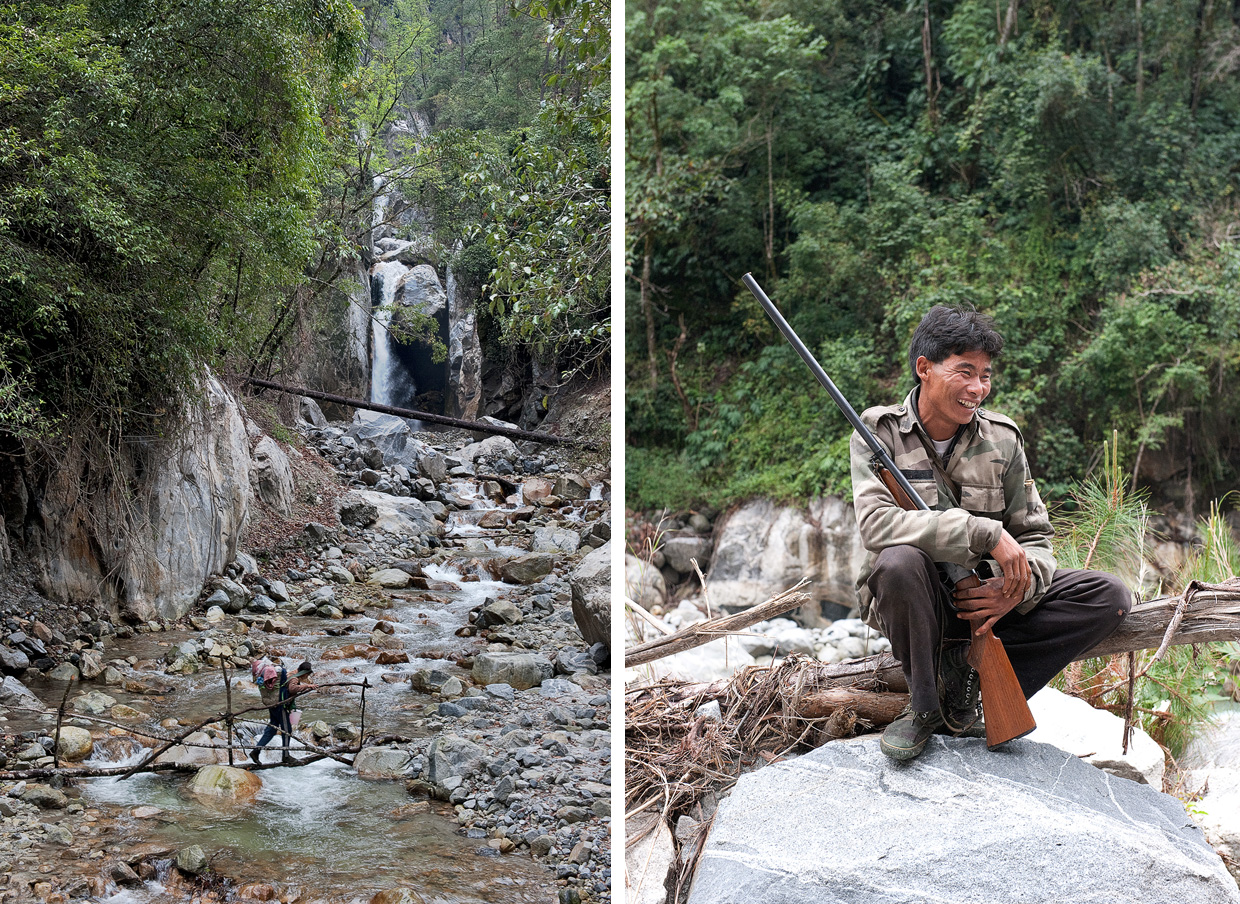
We had to keep within a few feet of each other otherwise we would loose our way in the dense undergrowth of the jungle. Ajo and his merry gang laughed and whistled their way while we stumbled behind them. We had to cross the river on a number of occasions and the bridges didn’t inspire any confidence. They consisted of a single bamboo pole to walk on with a flimsy handrail lashed together with vines. There would be little hope if you fell into the frigid waters with a loaded rucksack strapped onto your back.
As I was crossing one of these heinous constructions I noticed a fresh leopard turd balanced on the log. I smiled and took solace from the fact that the king of this jungle had to empty his bowels before making the precarious crossing.
We trekked for hours though the jungle, traversing steep slopes and crossing and recrossing the river. Ajo wove his way between boulders, up and down gullies, and across steep rocky terrain like he was strolling in his backyard. There was no real path anymore; he was just picking the line of least resistance. I am glad we had him with us, without him we would have been floundering around in the jungle.
It was starting to get late and we had been going all day. We had covered only around 16 km of challenging terrain. The valley was very steep and there weren’t many suitable campsites. Ajo guided us to a clearing by the river. This was as far as we planned to go on this recce. It had given us a good idea of the kind of terrain we would encounter when we would return to venture deeper into the valley.
The locals stood around as we repacked and shook their heads in disbelief at the amount of useless paraphernalia that we were carting along. All they packed for the trip was a blanket, a bush knife, matches, a cooking pot and a small bundle of food. These guys were hard as nails.
Ajo unsheathed his bushknife and got to work clearing the shrubs and undergrowth while his companions dropped their loads and disappeared into the forest to collect wood for the fire. They had been carrying heavy loads but didn’t show any sign of fatigue. We pitched our tents and laid out our sleeping bags while the others made a bivi in a cave under a large boulder. The fire was lit and we began preparing an evening meal of rice and vegetables. Once comfortable, we climbed a large boulder that gave us a good view up and down the valley. The sun was setting and the jungle was turning dark. Unnamed snow-clad mountains on the Burmese border glowed tantalisingly in the fading light. I smiled to myself as I sipped a hot cup of sweet tea for I knew the adventure had only just begun. I would be back next year to venture deeper into the depths of these remote valleys.


Amar Dev Singh is an expedition leader, project manager, photographer and writer based in Melbourne, Australia. He has over 20 years of experience organising expeditions and trips to remote and interesting parts of the world where he snaps stunning photographs that many of us only dream of. You can find him on his website, Facebook and Twitter.

Share

Saturday, June 14, 2014

Sri Lanka

Ramayana Trail in Sri Lanka

True ‘Gyan’ from Bharath Gyan
B R HARAN |   Sat, 01 Nov, 2008
On 19 January 2008 in New Delhi, the Sri Lanka Tourism Development Authority launched a new concept called   ‘Ramayana trail in Lanka’   to promote its   ‘Spiritual Tourism’   with famous cricketers   Arjuna Ranatunga   and   Arvinda Desilva   as brand ambassadors.
The SLTDA has identified 50 sites relating to the history of   Ramayana   and decided to promote them through tourism, which would be a part of the strife-torn Island Nation’s pursuit for progress. As the Ramayana   Ithihasa   connects both India and Sri Lanka and as India makes up to more than 20% of Sri Lanka’s tourist inflow, the SLTDA chose to launch the concept in New Delhi.
The highlight of the function was the candid & clairvoyant like statement from SLTDA’s Director General S Kalaiselvan that,   ‘the fifty sites identified in relation to Ramayana are not imaginary, but have existed since times immemorial’ . The Sri Lankan tourism department had appointed a research team for the ‘search & identification’ process, which was initiated by T Y Sunderesan of an organisation called   ‘Ashoka Vatika’   and only after ascertaining the ‘facts’ relevant to the great   Ithihasa,   the SLTDA formally announced its promotional plans.
Sita Eliya temple beside the stream
Inside the labyrinth of Ravana caves, Istripuram
 
Ashok Kainath, the Head of the research team has said that, their works have actually started four years back and that they could identify more than fifty, in fact 59 sites relating to Ramayana. The sites include, Ravana’s Palaces, Hanuman’s entry point called   ‘Nagadeepa’, ‘Donara’   where Rama first attacked Ravana , ‘Yudagannawa’   the main battle ground (now a wild life sanctuary) where ‘strangely’ no vegetation grows except grass. In the jungles on top of the Ramboda hills , a pond believed to have been formed by the tears of Sita has been found. The five places, where the   Sanjeevani hills   fell from Hanuman’s hand have also been identified. Similarly, the   Ashoka Vana , Ravana’s caves and the tunnels and many other sites, over which Temples have been built symbolising the concerned episode of Ramayana have all been spotted and marked for promotion. The SLTDA has decided to restore, renovate and maintain those sites.
It is really great that Sri Lanka, an officially declared Buddhist country has taken so much of pains through its Ministry of Culture, under which the SLTDA operates, to establish its faith on the Ithihasa Ramayana.   The Sri Lankan Parliament has the painting of King Vibeeshana, as he is considered by the people as a ‘fair’ king.   The organisation ‘Ashoka Vatika’, which has played a prominent role in this project by initiating the search & identification process, has recognised another Chennai based research organisation called ‘Bharath Gyan’ headed by Research Scholars D K Hari and his wife Hema Hari. T Y Sundaresan of Ashok Vatika has introduced them to the SLTDA, which in turn invited them to Sri Lanka for consultation and guidance.
D K Hari and Hema Hari made a ‘multimedia’ presentation on Ramayana trail in Lanka’ to a captive audience of around hundred people comprising Scholars, Buddhist Monks, Hindu Religious Leaders, Intellectuals, Historians, Poets, Journalists, Government Officials and many other elites. The function was organised at Galle Face Hotel in July 2008 and the ‘spellbound’ audience extended the session for more than three hours through the ‘Question & Answer’ session.    The delegates were so impressed that the SLTDA decided to take the help of Barathgyan to enhance the promotional activities of the ‘Lankan trail of Ramayana’ concept of spiritual tourism.
Incidentally the official logo of Hotel Galle Face is   ‘Dandu Monara Vimana’ . That is,   Dandu Monara   (Flying Peacock) Vimana   was used by Ravana to travel in and around Sri Lanka along with Mandothari. According to local legends in
Galle Face Hotel logo, Dandu Monara Vimana,  1864 Ravana and Mandodari in the Vimana
Lanka, Ravana was believed to have had many ‘airports’ out of which some five sites have been identified. Apart from   Pushpaka Vimana   (by which he abducted Sita from the   Dandakaranya ) and   Dandu Monara Vimana , Ravana also had a few other Vimanas and hence the number of airports used by him is justified. The now identified ‘airports’ are plain flat lands amidst hills, a fact, which ascertains the use of Vimana those days, which is corroborated by the book   ‘Vaimaanika Saastra by Maharishi Bharadwaj’   written in Sanskrit and then translated in English by Venerable Subbaraya Sastry of Mysore in the 1880s.
Subsequently another congregation was organised for the public last week (October 2008) and again D K Hari and Hema Hari made a presentation on the Lankan trail of Ramayana. To commemorate the event, the Sri Lankan branch of Chinmaya Mission has brought out a beautiful book titled ‘Ramayana in Lanka’ with a few articles of Revered Swamijis of Chinmaya Mission in addition to Barath Gyan’s well-researched essays for more than seventy pages including colourful paintings and photographs. D K Hari and Hema Hari have written these well documented essays at the specific request, and personal support of the President of Chinmaya Mission Sri Lanka S. Mahenthiran. The book gives a detailed picture of all the fifty sites identified by the Sri Lankan Tourism Development Authority along with different types of proposed tour itineraries.
 
It is a known fact that Ramayana has been considered as the   ‘Ithihasa’   of the Bharathvarsha   and the then Bharathvarsha comprised of the present day Sri Lanka, Pakistan, Afghanistan and even Iran. So, it is quite natural that Sri Lanka also considers Ramayana as its   Ithihasa.   In Sanskrit   ‘Ithihasa’   means   ‘It thus happened’   and so Ramayana must be a true history and the same is the case with Mahabaratha.
 
When the ‘Rama Sethu’ protection Movement was at its peak in India, D K Hari & Hema Hari, through their Bharath Gyan, came out with a brilliantly researched and well-documented presentation on ‘History of Ramayana’, which played a vital role in creating awareness among the people on the historicity of Rama, truth of Ramayana and existence of Rama Sethu, when the very facts were questioned and denied by none other than the Archaeological Suirvey of India, Union Culture Ministry, Union Shipping ministry, Central and State governments. Bharath Gyan, after immense research, has given the complete calendar of the Ramayana events right from the birth of Rama to his coronation including those events, which have happened in Lanka. The compact disc of that lively presentation was released by   Spiritual Guru Sri Sri Ravisankar of ‘Art of Living’ , who said that unless Ramayana had truly happened, it would not have attained the name   ‘Ithihasa’. Correct, ratrional and logical information on the historicity of Bhagwan Rama could be obtained from the website   www.historicalrama.org , which Bharath Gyan has dedicated to this world.
 
D K Hari & Hema Hari ariHarisay,   ‘Ramayana as a text is also geographically very correct. Every site on Rama’s route is still identifiable and has continuing traditions in the form of temples or other landmarks to commemorate Rama’s visit. No author could have travelled so far and wide just to concoct a story and even if so, it could not have had such a geographical credibility to become a local folklore across the subcontinent of India and Lanka’.
 
One cannot help comparing the two totally contradictory stands taken by the Indian and Sri Lankan governments. While the Indian government attempted (even now attempts) to deny the truth of Ramayana, the Sri Lankan government faithfully attempts to establish the truth of Ramayana. While a predominantly ‘Hindu’ country’s government questions the existence of Rama Sethu and other related sites, a predominantly ‘Buddhist’ country identifies and promotes the Ramayana-relevant sites in its territory.    It is sad, unfortunate and in a way painful that the Indian government has acted in such a sordid manner insulting the religious sentiments of milions of Hindus worldwide.
 
D K Hari, who has just returned from Sri Lanka after a memorable and successful visit, has this to say:   ‘The Buddhist Scripture ‘Mahavamsa’, which talks about the great lineage of Buddhist kings, has 49 references of Ramayana and the Buddhist Monks are also helping the Sri Lankan government in this project along with the Hindu institution such as Chinmaya Mission. It was indeed great to see all of them working together for the promotion of the Ramayana sites through the concept of ‘spiritual tourism’ and I am sure they would be successful. The book released by Chinmaya Mission has been received very well and the SLTDA has asked me to compile another detailed book, an enlarged version, on Lanka trail of Ramayana, in which we will be looking at the events from the Lanka perspective giving prominence to Ravana and Vibeeshana. After seeing our presentation of ‘date wise’ events of Ramayana, they have decided to present the ‘spiritual tourism’ concept as also a ‘historical tourism’ package. It is indeed a great honour for us and we feel proud for being associated with such a sacred project’.
Bharath Gyan’ doesn’t need an introduction at all, as it has become a very familiar player now in the intellectual arena with regards to cultural aspects and their scientific truths of Barathavarsh. It is almost five years since D K Hari and Hema
Hari started Bharath Gyan and the efforts, which they have put in these five years are so great that Bharath Gyan has acquired a niche on its own. But, before the conceptualisation and intiation of Bharath Gyan, both of them have undertaken monumental activities of extensive travel, vivid reading, unparalleled visits to museums, libraries, expositions, pageants and special cultural events the worldover. These activities have encouraged them to visualise a unique concept of collecting information and distributing them in such a manner that the generation next is able to recognise, understand and appreciate the glorious past of this great nation.
 
Hari & Hema say,   ‘Ours is the most ancient civilisation and the Vedic Heritage of our nation is beyond compare. Our ancient texts have a wealth of information, which need to be passed on to the next generation, which is slowly & steadily and unfortunately & sadly getting alienated from our cultural heritage and traditions. The present day youth must be made aware of the greatness of our heritage and they must be fed with the wealth of knowledge present in our ancient texts. What all have been told in our scriptures are being proved beyond doubt by modern science and such facts must be taken to the generation next. Bharath Gyan is one such attempt’.
Our ancestors, the Maharishis, Siddhars and Munivars have mastered anything and everything under the sun and the immense knowledge, which they have obtained through sheer grit, determination and years of penance, have been passed on to generation after generation for ages only orally. It is only a few thousand years since, a part of that vast knowledge have been compiled in the form of written texts. In fact, we are left with very little now and even that is ‘vast’ in today’s parlance!
 
The ancient system of education, the ‘Guru-Sishya Parampara’ has taken a heavy beating at the hands of the invaders, who have plundered this great nation. They have not only looted our material wealth, but also destroyed our wealth of knowledge. They have created divisions among the people and ruled them for over thouand years and unfortunately even after independence, we are continuing the systems, which they have established here, instead of going back to our glorious tradition. But then whatever said and done, we have to adopt ourselves to the modern methods to impart the wealth of information and knowledge available in our scriptures in abundance, to the generation next.
 
Bharath Gyan has taken the right step of collecting information on the scientific knowledge in our scriptures and the practical methods in our tradition and distribute them to the generation next through the modern method of ‘Multimedia Format’, so that, the targeted audience could easily and quickly grasp them for effective utilisation in future. Squarely focusing on our ancient civilisation and cultural heritage, Bharath Gyan works with a range of subjects as follows.
 
Tracing a civilisation:   Here Bharath Gyan has studied in deep the Bharathiya culture, analysed the   Puranas & Ithihasas , proved the   historicity of Rama and Krishna , dvelved into the ‘pan global’ similarities, researched the evolution of   Vedic civilisation along   Saraswathi   river and analysed the so-called   Aryan Inavasion theory, Alexander-Porus episode, Tamil cultural prosperity   and   Hindu society   and religions.
 
Seeking its knowledge source : Here Bharath Gyan searches for the source of knowledge going deep into the   Vedas   and their compilation by the   Veda Vyasas   and finally finds them by demystifying the Vedas and analysing the technique of transmission and ancient systems of education.
 
Knowing its knowledge   Here Bharath Gyan gives us a wealth of information regarding   Creation, Time, Calendar, Astronomy, Om (meaning & significance), Evolution, Ayurveda, Vichithra Janana (Unusual birth), Vimana (Ancient Flying Machine)Metallurgy, Chemistry (Rasayana), Geography (Bhusastra), Architecture, Mathematics, Warfare, Engineering   and Technology.
 
Understanding its wealth : Bharath Gyan focuses on water management and agricultural practices, the history of Ganges ( Bhagiratha Prayatna ), water grid, the jewels of India, Geology and Trade.
 
Learning from its governance : Here a clear comparison is made between the so-called ‘Modern Management’ (western) and our ancient systems and Bharath Gyan establishes the fact that our sages knew everything and that there are indeed new ways of identifying and implementing things based on times and its needs. It also studies Administration and Law. Bharath Gyan presents   ‘Rama Rajya   & its components’ through an analysis on the 56 questions asked by   Rama   when he taught   Baratha   on how to govern his empire during his absence.
 
 
Apart from the above subjects, Bharath Gyan has compiled data and is in the process of completing a few other topics such as Language, Pleasure and Harmony in connection with our ancient civilisation. The enormity of Bharath Gyan’s research and analysis could be understood from the fact that it has collected authentic and specific information on 64 different subjects concerning India’s civilisation to understand its cultural richness. Bharath Gyan has brought out the ‘science’ hidden in our ancient texts with a rational approach. It has put together the information inherent in our culture, data available with the traditional scholar community, native knowledge of the locals, authentic travelogues of the foreign visitors to our land, historical notes from the archives of other countries and research works of the modern scientific community.
 
When the objective is clear, achievement is certain! Bharath Gyan has clearly set its objective of focusing on the generation next and enriching them with knowledge on the ‘science’ of our ancient civilization, cultural heritage and tradition with a rational and modern outlook.   The official logo of Bharath Gyan itself is a wealth of information! By looking at its logo, one can see a ‘meditating person’, a ‘bell’ or even a ‘few numbers’! Every version has its own meaning behind it and the symbolic representation of ‘zero’ and ‘infinity’ (at the top and bottom of the ‘Bell’ respectively) conveying the message that this great land has got everything from zero to infinity . Ancient Maharishis knew from creation to infinity, which they had expressed in the language and understanding of their times. We need to re-understand it in accordance to our times and use it for our own needs now.
 
It would be more appropriate to conclude this essay with the words of D K Hari and Hema Hari:   ‘we present as is, the data and facts in a rational, logical and wholistic manner before the people and allow them to draw their own conclusions. Our main objective is to encourage people to ask their own questions and look for answers themselves. These data and facts are to help them reach towards their answers or undertake further exploration on their own. We, at Bharath Gyan, look at ourselves as catalysts by helping to bring together the inaccessible, unreadable by all and widely spread, but related data with scholars, researchers, common man and in old texts and records, together in a single platform. We go by the ancient Indian temper of, ourselves asking and triggering others to ask, questions that lead the way for exploring the universe of science, nature and knowledge. In our study, we have discovered that this has been the way our ancient knowledge grew and spread and we would like to bring back this temper amongst the Indians and rightfully we call our effort as Universal Questions, Indian Answers! Our view of the ‘I I’ of the ‘Incredible India’ slogan is ‘Inspiring Confidence in Indian Knowledge’ and ‘Initiating Applications and Inputs to Scientific Research’. That is our way of ensuring that the knowledge of the past is made available to the present to take to the future’. 
 WRITER   VIPUL KOUL         EDITED BY ASHOK KOUL
 B R HARAN

Visiting the Ghats of World's Spiritual capital "Varanasi"

Visiting the Ghats of World's Spiritual capital "Varanasi"

India TV news desk [ Updated 13 Jun 2014, 23:54:27 ]
Visiting the Ghats of World's Spiritual capital "Varanasi"
FONT SIZE
New Delhi: Varanasi, the first thing that comes to mind after hearing the name is beautiful morning beside river Ganga, the congested lanes, over populated city, the Ganga Aarti in the evening and the Ghats in city.

Justifying its name 'City of Ghats', Varanasi is famous for its numerous Ghats all over the world. People from around the world come here specially to experience the activities on the Ghats.

Varanasi has nearly 100 ghats, steps leading to the banks of River Ganga.

Many ghats are associated with legends or mythologies while many ghats are privately owned. The former Kashi Naresh owns Shivala or Kali ghat. Morning boat ride on the Ganges across the ghats is a popular visitors attraction.

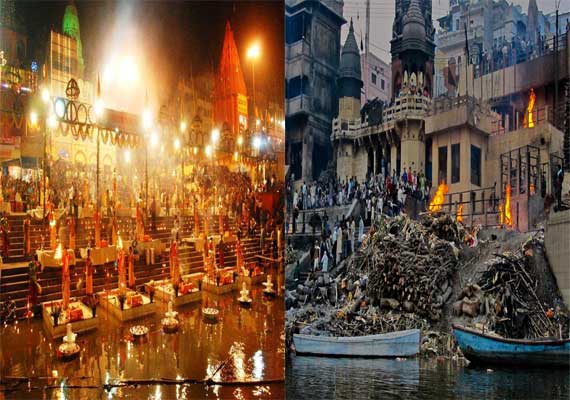
In Hindu traditions, cremation is one of the rites of passage and the Ghats of Varanasi are considered one of the auspicious locations for this ritual. At the time of the cremation or "last rites," a "Puja" (prayer) is performed. Hymns and mantras are recited to mark the ritual.

The Manikarnika and Harishchandra Ghats are dedicated to the cremation ritual. Annually, less than 2 in 1000 people who die in India, or 25,000 to 30,000 bodies are cremated on various Varanasi Ghats; about an average of 80 per day.

This practice has become controversial for the pollution it causes to the river. In 1980s, the Government of India funded a Clean Ganga initiative, to address cremation and other sources of pollution along the Ghats. In many cases, the cremation is done elsewhere and only the ashes are dispersed into the river near these Ghats.

Some of the populars Ghats in the city are:

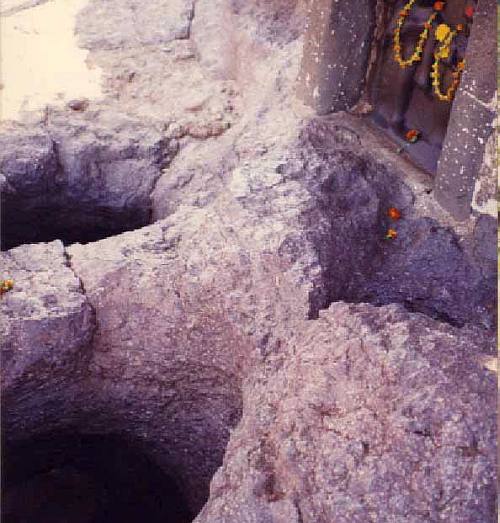
Manikarnika Ghat: Two legends are associated with Manikarnika Ghat. According to one, it is believed to be the place where Lord Vishnu dug a pit with his Chakra and filled it with his perspiration while performing various penances. While Lord Shiva was watching Lord Vishnu at that time, the latter's earring ("manikarnika") fell into the pit.

According to the second legend, in order to keep Lord Shiva from moving around with his devotees, his consort Goddess Parvati hid her earrings, and asked him to find them, saying that they had been lost on the banks of the Ganges. Goddess Parvati's idea behind the fib was that Lord Shiva would then stay around, searching forever for the lost earrings. In this legend, whenever a body gets cremated at the Manikarnika Ghat, Lord Shiva asks the soul whether it has seen the earrings.

According to ancient texts, the owner of Manikarnika Ghat bought King Harishchandra as a slave and made him work on the Manikarnika at Harishchandra Ghat. Hindu cremations customarily take place here, though a majority of dead bodies are taken for cremation to the Manikarnik Ghat. According to other sources that Manikarnik Ghat is named after Jhansi ki Rani Laxmibhai.

Maan-Mandir Ghat: Mana-Mandir Ghat: Maharaja Jai Singh II of Jaipur built this Ghat in 1770, as well as the Jantar Mantar equipped with ornate window casings along with those at Delhi, Jaipur, Ujjain, and Mathura. There is a fine stone balcony in the northern part of the ghat. Devotees pay homage here to the lingam of Someswar, the Lord of the Moon.

Lalita Ghat: The late King of Nepal built this Ghat in the northern region of Varanasi. It is the site of the Ganges Keshav Temple, a wooden temple built in typical Kathmandu style,The temple has an image of Pashupateshwar, a manifestation of Lord Shiva.

Local festivals including musical parties and games regularly take place at the beautiful Assi Ghat which is at the end of the continuous line of ghats. It is a favorite site of painters and photographers. It is here at the Assi Ghat that Swami Pranabananda, the founder of Bharat Sevasharam Sangh,attained 'Siddhi' (fulfilment/success) in his 'Tapasya' (endeavor) for Lord Shiva, under the auspices of Guru Gambhirananda of Gorakhpur.

Dashashwamedh Ghat: Dashashwamedh Ghat is located close to Vishwanath Temple, and is probably the most spectacular ghat. Two Hindu mythologies are associated with it: According to one, Lord Brahma created it to welcome Lord Shiva. According to another, Lord Brahma sacrificed ten horses in a yajna here.

A group of priests daily perform in the evening at this ghat "Agni Pooja" (Worship to Fire) wherein a dedication is made to Lord Shiva, River Ganges, Surya (Sun), Agni (Fire), and the whole universe.

Scindia Ghat: Scindia Ghat also known as Shinde Ghat borders Manikarnika to the north, with its Shiva temple lying partially submerged in the river as a result of excessive weight of the ghat’s construction about 150 years ago.

Above the ghat, several of Kashi’s most influential shrines are located within the tight maze of alleys of Siddha Kshetra (Field of Fulfillment). According to tradition, Agni, the Hindu God of Fire was born here. Hindu devotees propitiate at this place Vireshwara, the Lord of all heroes, for a son.

 vipul koul

Sunday, June 1, 2014

Vir Bhadreshwar Temple

Vir Bhadreshwar Temple

Chander M. Bhat
When Daksa, the Prajapati, performed a great sacrifice, he did not invite Siva…his own son-in-law. Sati, Siva’s wife and Daksa’s youngest daughter, went to attend the sacrifice much against the advice of her husband. Daksa ignored her and also reviled her husband Siva. Unable to stand the insult, she gave up her body using her yogic powers. When Siva got this news, he was infuriated. He created an ogre from his hair and commanded him to destroy Daksa’s sacrifice. The ogre was Bhadreshwar (Virabhadra), the soldier avatar of Lord Shiva. He was a partial manifestation of Rudra/Siva.
Iconographical works show Virabhadra in different ways. He is shown with two arms, four arms or eight arms. Objects shown in his hands are; sword, shield, bow, arrow, trident, skull-cup, goad, antelope, mace and hand-drum. He wears a garland of several heads and rides on a vetala or a vampire.
Vir Bhadreshwar is a super being created by the wrath of Shiva, when he stepped in to destroy the Yagna (sacrificial fire) of Daksha, after his daughter Dakshayani (Sati)…consort of Shiva self immolated in Yagna Kund. The origin of Bhadreshwar is related to the mythological story of Daksha Yagna. Lord Shiva created him by thrashing his matted lock in his deep anger and sorrow due to the self immolation of Devi Sati.
Devi Sati was the youngest daughter of Daksha, the king of all men. When she grew up she set her heart on Shiva, worshipping him. Daksha invited all the gods in the swayamvara of Sati except Shiva. Sati cast her garland into air, calling upon Shiva to receive the garland; and behold, he stood in midst of the court with the garland around his neck. Daksha had no choice but to get Sati married with Shiva. As the legend goes on, one day Daksha made arrangements for a great sacrifice, and invited all the gods except Shiva. Sati’s urge to go to her home due to the affection towards her parents overpowered the social etiquette for not going to an uninvited ceremony. Daksha insulted her in front of others. Unable to bear further trauma she ran into the sacrificial fire. Shiva came to know about the incident and with deep sorrow and anger, plucked a lock of hair and thrashed the same on the ground. Vir Bhadreshwar and Devi Bhadarkali were born. Vir Bhadreshwar was dark as the clouds, three burning eyes, and fiery hair; he wore a garland of skulls and carried terrible weapons. To provide him power arrived Bhadarkali, a wrathful incarnation of Devi.
Lord Shiva directed Vir Bhadreshwar to lead the army against Daksha and destroy the sacrifice and on the direction of Shiva, Vir Bhadreshwar appeared in the midst of Daksha’s assembly like a storm and broke the sacrificial vessels, polluted the offerings, insulted the priests and finally cut off Daksha’s head, trampled on Indra, broke the staff of Yama, scattered the gods on every side; then returned to Mount Kailash. After the destruction of Daksha’s sacrifice, the defeated gods sought Brahma and asked his advice. Brahma advised the gods to make their peace with Shiva. Brahma himself went with them to Mount Kailash and prayed to Lord Shiva to pardon Daksha. The compassionate Lord took pity on Daksha and restored his head with that of goat’s head. The Devas and Brahma requested Lord Shiva to the Yagna.
Lam a small village in Naushara Tehsil is situated about 20 km from Balavenue some 7 km towards Rajouri connected with a link road on the left side of Jammu Rajouri road. The metallic road moves though beautiful landscape and at some places through pine forests. En-route, about 11 km from Balavenue falls a village known as Quila Darhal. There is big fort on a hillock on the left side of this road in this village. 4 km ahead to this villages falls village Lam. There is a war memorial on the right of the road in the memory of these who laid down their lives fighting in Lam area during Indo-Pak war 1971. From village Lam one has to take right hand side road to reach Vir Bhadreshwar and en-route comes three villages known as Galla Durni, Challan and Thandikasi. This steep zig-zag road does not make journey boring as the road passes through beautiful pine forests. Vir Bhadreshwar temple is about 22 km from village Lam. Prior approval of the Deputy Commissioner, Rajouri is mandatory for visiting this temple as the temple is situated some 1 km from Line of Control in Naushara sector.
Vir Bhadreshwar while returning to Mount Kailash rested for some time at the time where present Vir Bhadreshwar temple, village Lam is situated. According to legend, Vir Bhadreshwar slept here for about fifteen days and woke up by the sounds of some bells tied to some goats which were pasturing in the jungle. Vir Bhadreshwar gave a soon to the shepherd and told him that anybody who offers a bell, the wishes will be fulfilled. From that day every pilgrim to this holy temple is offering a temple bell to fulfil him wish.
Vir Bhadreshwar or Pir Bhadreshwar is acronyms of same deity. The legend of this temple goes back to the days of Lord Shiva and Dakshayani (Sati). This temple is believed to have been built by King Kanishka in Samvat 141 to commemorate the victory of Vir Bhadreshwar, over king Daksha. According to Shiv Maha Puran, Vir Bhadreshwar is always worshipped before Lord Shiva.
During 1947-48 Jammu & Kashmir operations, the temple was completely desecrated by the invaders from Pakistan who had captured the temple area in 1948. The temple is situated near the present LOC in Naushara Sector. It is from this time the temple was renamed as Pir Bhadreshwar. The ancient Shiva Lingam was put in the courtyard by the Pakistani invaders and later said Shiv Lingam was installed in an old temple by the Indian Army after recapturing the area. After the signing of instrument of accession of Jammu & Kashmir, the Indian army launched an offensive to regain areas captured by Pakistan with effect from 27th October 1947 and Vir Bhadreshwar temple was recaptured on 20th October 1948 by the gallant soldiers of Indian Army.
The temple complex is spread over an area of about 6 kanals of land. Main sanctum sanatorium is situated on an elevated portion and one has to climb 12 stairs to reach the shrine. This temple is under construction and maximum portion of it has been completed. One can see thousands and thousands of temple bells hanging all over the complex, hanging from the walls, from the trees and where not. There is a belief that anybody who offers a temple bell in the complex of this temple gets his wish fulfilled. There is a Shiv Lingam and the icon of Vir Bhadreshwar inside the main sanctum sanatorium. Swami Shivananda, founder of ‘Divine Life Society’, has said in his book, ‘All about Hinduism’: “Lingam represents the formless Shiva…Shiv Lingam speaks to you in the unmistakable language of silence, I am one without a second. I am formless….Lingam is only the outward symbol of the formless being. Lord Shiva, who is the indivisible, all pervading, eternal, auspicious, ever pure, immortal essence of His vast universe, who is the undying soul seated in the chamber of your heart, who is your in dweller, innermost Self or Atman and who is identical with the Supreme Brahman”. On the right side of the main temple there are three small temples. The Shiv Lingam of the old temple which was desecrated by the invaders in the year 1947 has been installed in one of these temples. Holy Granth Sahib also forms the part of this old temple.
After having darshan one comes down with a heavy heart, longing lingering looks behind. The smooth transition from one site to this site; creates a unique experience of soul purification as clay of this place has touched the holy feet of Vir Bhadreshwar and graced by Lord Shiva. A visit to this place is a saga of memory for anyone who descends on it.

Sunday, May 18, 2014

Kashmiri Pandits celebrate NaMo victory in Jammu APMCC hopeful of good days ahead for Kashmir and Kashmiri Pandits

Jammu, May 16: Large number of Kashmiri Pandits under the banner of All Parties Migrants Coordination Committee (APMCC) took out a massive victory rally to celebrate the landslide victory of BJP and Narender Modi (NaMo) in the Lok Sabha elections here today.
Scores of APMCC activists alongwith other members of the community lead by King Bharati, APMCC National Spokesperson gathered outside the Press Club of Jammu shouting slogans in support of Narender Modi and burst crackers to give vent to their feelings.
Addressing the activists King Bharati said that the landslide victory of Narender Modi was an indication that good days were coming for India, particularly Kashmir and Kashmiri Pandits under the statesmanship of Narender Modi. He also congratulated Dr Jitender Singh and Jugal Kishore Sharma for their splendid victory in Jammu region.
Bharati said that he was hopeful that Modi would deliver what he has promised to the nation exactly as he had promised a landslide victory in the elections with the slogan “Achhey Din Aaaney Waley Hain”.
He recalled his meeting with Modi in Gujarat last year when APMCC team under the leadership of Vinod Pandit, Chairman APMCC met him at his residence where Modi had assured Kashmiri Pandits of good days once he comes to power at centre adding like Atal Bihari Vajpayee’s government Modi government will prove a boon for every Kashmiri irrespective of religion and it was expected that Kashmir problem will be resolved once for all.
Advocate Arun Kandroo, while congratulating Modi for his historic victory said that Kashmiri Pandits were hopeful that their miseries would come to an end under the Modi government as Modi believes in Karma rather than mere rhetoric.
He also thanked the electorate for their massive mandate to Modi which was the basic ingredient for a stable and strong government.
Prominent among those who participated in today’s victory celebrations include TK Zutshi, Executive Member APMCC, Vimarsh Koul (Executive Member APMCC),  Bansi Lal Reshi, Rajan Nakhasi APMCC Delhi Unit, Virender Pandit, Ravinder Pandit, Joint Secretary APMCC, Advocate Ramneesh Sharma, Soom Nath Saraf, Girdhari Lal Bhat, Rajiv Pandit, Hina Nakhasi and Usha Ji, Isha Bharati and  6 year old Ishu Bharati, the youngest

 member of APMC

Tuesday, May 6, 2014

Home » Vashikaran Yantras » Lona Chamari Mohini Mantra Sunday, September 22, 2013 Lona Chamari Mohini Mantra A lot of Shabar Mantra; including some which have been published on this site in the past invoke Lona Chamari. The name Chamari originates from the word Chamar; the Cobbler Caste of India. The mantra given here is a Lona Chamari Mohini Mantra; used for the attraction of females. Lona Chamarin is a much used phrase in Vashikaran and Mohini Mantras. Lona Chamari or Chamarin was said to be a most powerful Siddha practitioner of the Shabar Tantra in the early Middle Ages. Some sources state that Lona Chamarin was a Sorceress who possessed strong occult and magical powers. She is associated with the region Kamru Desh; an ancient name for some of the regions of the Indian state of Assam. This was one of major centers of Tantrik worship. This mantra is a Kanthasthya Siddhi Mantra; mastery is gained by full remembrance and the ability to chant the mantra clearly and without stumbling whenever required. The Prayog is done by holding a flower in the hand and then chanting the Mohini Mantra to bind the flower with the mantra. Then the flower is thrown in the direction of the women who the Sadhak seeks to enchant and bring under a spell of attraction. The spell is said to be so powerful that the women becomes hypnotised and enchanted by the Sadhak and becomes attracted to the Sadhak; like a Bee is to a flower. A most powerful Mohini Mantra Sadhana of Lona Chamari Lona Chamari Mohini Mantra Before commencing the attraction experiment the Sadhak has to make an offering of 1 Coconut and 5 dried Dates to Lona Chamarin. This offering can be kept in an open place and should face the East. However as mentioned in earlier articles this Sadhana is for the advanced Sadhaks and not for everyone. Read more: http://www.prophet666.com/2013/09/lona-chamari-mohini-mantra.html#ixzz30xoAvBX9 Under Creative Commons License: Attribution


Down Memory Lane - Bombay Of Yesteryear.


 avtar misri