Saturday, July 29, 2017

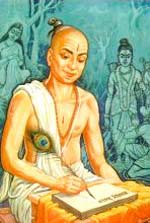
Goswami Tulsidas


Goswami Tulsidas

By

Sri Swami Sivananda

Tulsidas was born in Rajpur, in the district of Banda in Uttar Pradesh, in Samvat 1589 or 1532 A.D. He was a Sarayuparina Brahmin by birth and is regarded as an incarnation of Valmiki, the author of Ramayana written in Sanskrit. His father’s name was Atmaram Shukla Dube and his mother’s name Hulsi. Tulsidas did not cry at the time of his birth. He was born with all the thirty-two teeth intact. In childhood his name was Tulsiram or Ram Bola.
Tulsidas’s wife’s name was Buddhimati (Ratnavali). Tulsidas’s son’s name was Tarak. Tulsidas was passionately attached to his wife. He could not bear even a day’s separation from her. One day his wife went to her father’s house without informing her husband. Tulsidas stealthily went to see her at night at his father-in-law’s house. This produced a sense of shame in Buddhimati. She said to Tulsidas, "My body is but a network of flesh and bones. If you would develop for Lord Rama even half the love that you have for my filthy body, you would certainly cross the ocean of Samsara and attain immortality and eternal bliss". These words pierced the heart of Tulsidas like an arrow. He did not stay there even for a moment. He abandoned home and became an ascetic. He spent fourteen years in visiting the various sacred places of pilgrimage.
While returning from answering the calls of nature, Tulsidas used to throw the water that was left in his water-pot at the roots of a tree which a spirit was occupying. The spirit was very much pleased with Tulsidas. The spirit said, "O man! Get a boon from me". Tulsidas replied, "Let me have Darshan of Lord Rama". The spirit said, "Go to the Hanuman temple. There Hanuman comes in the guise of a leper to hear the Ramayan as the first hearer and leaves the place last of all. Get hold of him. He will help you". Accordingly, Tulsidas met Hanuman, and through His grace, had Darshan or vision of Lord Rama.
Tulsidas wrote twelve books. The most famous book is his Ramayan—Ram-charit-manas—in Hindi. He wrote this book under the directions of Hanuman. This Ramayan is read and worshipped with great reverence in every Hindu home in Northern India. It is an inspiring book. It contains sweet couplets in beautiful rhyme. Vinaya Patrika is another important book written by Tulsidas.
Some thieves came to Tulsidas’s Ashram to take away his goods. They saw a blue-complexioned guard, with bow and arrow in his hands, keeping watch at the gate. Wherever they moved, the guard followed them. They were frightened. In the morning they asked Tulsidas, "O venerable saint! We saw a young guard with bow and arrow in his hands at the gate of your residence. Who is this man?" Tulsidas remained silent and wept. He came to know that Lord Rama Himself had been taking the trouble to protect his goods. He at once distributed all his wealth among the poor.
Tulsidas lived in Ayodhya for some time. Then he shifted to Varanasi. One day a murderer came and cried, "For the love of Rama give me alms. I am a murderer". Tulsi called him to his house, gave him sacred food which had been offered to the Lord and declared that the murderer was purified. The Brahmins of Varanasi reproached Tulsidas and said, "How can the sin of a murderer be absolved? How could you eat with him? If the sacred bull of Siva—Nandi—would eat from the hands of the murderer, then only we would accept that he had been purified". Then the murderer was taken to the temple and the bull ate from his hands. The Brahmins were put to shame.
Tulsidas once went to Brindavan. He visited a temple. He saw the image of Lord Krishna. He said, "How shall I describe Thy beauty, O Lord! But Tulsi will bow his head only when You take up bow and arrow in Your hands". The Lord revealed Himself before Tulsidas in the form of Lord Rama with bow and arrows.
Tulsidas’s blessings brought the dead husband of a poor woman back to life. The Moghul emperor at Delhi came to know of the great miracle done by Tulsidas. He sent for Tulsidas. Tulsidas came to the emperor’s court. The emperor asked the saint to perform some miracle. Tulsidas replied, "I have no superhuman power. I know only the name of Rama". The emperor put Tulsi in prison and said, "I will release you only if you show me a miracle". Tulsi then prayed to Hanuman. Countless bands of powerful monkeys entered the royal court. The emperor got frightened and said, "O saint, forgive me. I know your greatness now". He at once released Tulsi from prison.
Tulsi left his mortal coil and entered the Abode of Immortality and Eternal Bliss in 1623 A.D. at the age of ninety-one at Asighat in Varanasi.

Swami Vivekananda in Kashmir....at swami amarnath je cave

As the grateful nation celebrated the year 2013 as the 150th birth anniversary year of Swami Vivekananda and on 12th January 2014, the grateful nation will celebrate 151th birth anniversary of this Prophet of Modern India. I take this opportunity to highlight some of the important events of his Kashmir visit. During his stay in Kashmir Swami Vivekananda was in a different world altogether. He was deeply touched by the beauty of Kashmir. Swami Vivekananda visited Kashmir twice and it was on 10th September 1897, when the lotus feet of this great saint touched the beautiful and pious land of Rishis, once called as Reshver. His first visit of Kashmir was short and was not so eventful although he visited some of the places of religious and historic importance. People from all spheres of life like Sadhus, Kashmiri Pandits, students, officials went to meet him. The second visit of Swami Vivekanand to Kashmir valley was more eventful. This time a party of Europians was accompanying him. Prominent among them was Sister Nivedita (Margret Noble). He stayed in Kashmir from about mid of June 1898 to the mid of September 1898. During this stay he visited the places of religious and historical importance like Shankaracharya Hill, Hari Parvat, Martand (Matan or Bhawan), Panderthan (Pandresthan, Place of Pandavas), temples of Avantipora, Bijbehara, Moghul Gardens of Nishat and Shalimar . But the focus of this article is his visits to shrines of Shri Amarnath Ji Cave and Mata Kheer Bhawani in Tulmulla. The visits of Shri Amarnath and Mata Kheer Bhawani proved to be very unique and the visions he had at both the places remained always with him. Such was the spiritual experience of Swami Vivekananda at these places that it is very difficult to put that into words but can only be felt from the actual words of Swami Vivekananda. It also reflects the essence of both these energy centres charged with God’s presence in the vale of Kashmir.


Swami Vivekananda had great fascination for God Shiva during his childhood. As he grew older his love for Shiva, the God of monks and yogis deepened. Now in the Himalayas, the abode of God Shiva, the thought of God Shiva was uppermost in the Swami Vivekananda’s mind. It was at Achabal in Anantnag on July 25, 1898 that Swami Vivekananda expressed his intention to visit Amarnath and Sister Nivedita was allowed to join him. On 27 July, 1898 they left for the pilgrimage. Enroute they camped at various places like Phahalgam, Chandanwari, Wavjan. On August 1st, after crossing Sheshnag, Mahagunus top they reached Panchtarni (Place of five streams). On August 2, they reached the Shri Amarnath Ji Cave. When Swami Vivekananda reached the cave he was full with emotion and devotion. Swami Vivekananda entered the shrine nude except his loin-cloth and prostrated before the God-Shiva in the form of Ice-Lingam. An exalting spiritual experience came to him of which he didn’t spoke much in detail but only said, “I thought the Ice-Lingam was Shiva Himself.” When he entered the cave and came face to face with the God-Shiva, Swami Vivekananda had never felt such spiritual exaltation in visiting a holy place as in Amarnath Ji. Afterwards he also said to Sister Nivedita that the God Shiva appeared before him and granted him the grace of Amarnath, means not to die till he himself a the consent. On the journey back Swami Vivekananda and party returned to Anantnag and from there they reached on August 8, by boat to Srinagar.


Following the pilgrimage to Shri Amarnath Ji, Swami Vivekananda’s love for the Divine Mother grew intense. At Srinagar he worshipped the four year daughter of his Muslim boatman ( Swami was staying in a houseboat at Srinagar) as “Goddess Uma”. When he left Kashmir, she, tiny one carried a tray of apples for him all the way to the tonga herself. On September 30, Swami Vivekananda left for Mata Kheer Bhawani at Tulmulla, leaving strict instructions to his party not to follow him. He stayed there almost for a week. He daily performed Havan there, and worshipped the Mother with offerings of Kheer. Every morning he worshipped a Brahmin Pandit’s little daughter as “Uma Kumari.” One day at Kheer Bhawani while worshipping, the thought of the ruination and desecration of the temple by the Muslim invaders left him distressed at heart. He thought that Mother has been manifesting Her presence here for untold years, “How could the people have permitted such sacrilege without offering resistance.


If I had been here then, I would never have allowed such a thing. I would have laid down my life to protect the Mother.” Thereupon he heard the voice of the Mother Goddess saying, “What if unbelievers should enter My temple and defile My image? What is that to you? Do you protect Me, or do I protect you? Another day, in course of his worship, another thought flashed through the Swami Vivekananda’s mind that he should try to build a new temple in the place of a present dilapidated one. He even thought of trying to raise funds for this. At once the Divine Mother said to him, “My child, If I so wish I can have innumerable temples and monastic centres. I can even this moment raise a seven-storied golden temple on this very spot.” Referring to these experiences after his return, he said to his disciples, “All my patriotism is gone. Everything is gone. Now it is only Mother! Mother! I have been very wrong. I am only a little child.” Since I heard that divine voice, I have ceased making any more plans. Let these things be as Mother wishes.” It is often said that the vision at Tulmulla made him realize, what he is and for what he is in this world? Ramakrishna Parmahansa his Guru had once prophesied during a discourse with his close disciples that when Vivekananda realize who he is, he will not like to live anymore in this world and would depart from it. On July 4, 1902 Swami Vivekananda at the age of 39 years, 5 months and 24 days left his mortal cage, to reunite with the Supreme Energy of this Cosmos, thereby fulfilling his own prophecy, ” I shall not live to be forty years old.”


(The writer is Assistant Professor of Physics at GDC- Bhaderwah).


By Rakesh Kumar Pandit

जयकारों के साथ रवाना होगी डिग्गी कल्याणजी की पैदल यात्रा


जयकारों के साथ रवाना होगी डिग्गी कल्याणजी की पैदल यात्रा
  • डिग्गीपुरी कल्याण लक्खी पदयात्रा समिति, जयपुर के तत्वावधान में डिग्गी कल्याणजी की लक्खी पैदल यात्रा 21 अगस्त को रवाना होगी।
जयपुर।
डिग्गीपुरी कल्याण लक्खी पदयात्रा समिति, जयपुर के तत्वावधान में डिग्गी कल्याणजी की लक्खी पैदल यात्रा 21 अगस्त को रवाना होगी। पदयात्रा को प्रातः 9 बजे बजे उच्च शिक्षा मंत्री कालीचरण सराफ केसरिया ध्वज दिखाकर चौड़ा रास्ता स्थित ताड़केश्वर महादेव मंदिर से रवाना करेंगे। इस मौके पर डिग्गी के ठाकुर रामप्रताप सिंह भी मौजूद रहेंगे। समिति के अध्यक्ष एवं यात्रा के संयोजक श्रीजी शर्मा ने बताया कि पैदल यात्रा जयकारों के साथ विभिन्न मार्गों से गुजरते हुए जाएगी।
ये भी पढ़िए- इन 5 जगहों पर रहें सावधान, यहां पार्टनर के साथ हो सकता है पंगा
पदयात्रा की व्यवस्थाओं के लिए कई संघ-संस्थाएं अपना सहयोग दे रहे हैं। इसके लिए पदाधिकारी एवं सदस्य जुटे हुए हैं। पदयात्रा मार्ग पर जगह-जगह भंडारों एवं जलपान के लिए टेंट लगाए जाएंगे।
diggi
पदयात्रियों की सुविधा के लिए मार्ग के चिकित्सा सुविधाएं भी उपलब्ध करवाई जाएंगी। पदयात्रा ताड़केश्वर मंदिर से रवाना होकर लवाजमे के साथ न्यू गेट तक जाएगी।
diggi
यहां से गुजरेगी पदयात्रा
पदयात्रा मोती डूंगरी गणेशजी होते हुए दुर्गापुरा, सांगानेर, मदरामपुरा, हरसुलिया, फागी, चौसला होते हुए  मंगलवार 25 अगस्त को डिग्गीपुरी पहुंचेगी।
diggi
वहां शाम 5 बजे शोभायात्रा निकाली जाएगी। मंदिर में ध्वज अर्पित करने के बाद रात्रि को सत्संग का आयोजन होगा। इस यात्रा में जयपुर के अलावा विभिन्न क्षेत्रों से आने वाली पदयात्राएं भी शामिल होंगी।

Sunday, July 16, 2017

Pandit Prem Nath Bazaz - a misunderstood and revolutionary Kashmiri Pandit


(L): Pandit Premnath Bazaz and his wife Badri.
(L): Pandit Premnath Bazaz and his wife Badri. (Photo courtesy: Bhushan Bazaz)
Like many Kashmiri Pandits, Sanjay Tickoo, a Srinagar businessman, is imprisoned by the history of his state, the ambivalent positions of its leaders, and his own paranoia of being a member of a minority community with a dominant past. Yet, in the mass exodus of the ’90s in which 34 Pandit families of his locality left Kashmir, his didn’t. In fact, he “still believes that by instinct, the Kashmiri Muslim is a secular person”. That Tickoo can say this is not simply magnanimity. Behind this outlook of his lies an almost forgotten history of a robust secular tradition. And over this tradition looms large the shadow of a man who symbolised it; almost perfectly one could say. That man was Prem Nath Bazaz, a committed progressive Kashmiri Pandit.
The story of Bazaz’s life is intimately entwined with the modern history of that secular tradition – at times referred to, a tad offhandedly, as ‘Kashmiriyat’ – and its vicissitudes. So, to tell his story is to also recall the history of that tradition, and its forgetting.
Sanjay Tickoo, president of the Kashmiri Pandit Sangharsh Samiti at his home in Srinagar. (Burhaan Kinu / HT Photo)
Kashmiri Pandits have a past that is as invisible as it is visible. An influential minority in the Dogra Hindu kingdom (they occupied all major jobs in the king’s administration and revenue departments), some of them were social reformers attacking orthodoxies in religion. They took active part in the politics of the day. And one of them even took the unconventional step of forging a common platform with Kashmiri Muslims to try to build a fair society.
Bazaz, a small-time government official and a writer, was the man who took that initiative to bring the Yuvak Sabha, a predominantly Kashmiri Pandit outfit in the princely state of Jammu and Kashmir of the ’30s, to a working relationship with the Muslim Conference, Kashmir’s first political party, after the 1931 anti-Dogra uprising in which Muslims protesting age-old social inequalities were massacred. (22 men died in the uprising.) Bazaz was the confidant and comrade of Sheikh Abdullah, Kashmir’s first mass leader, and was a champion of Kashmiris’ right to self-determination, a stand unthinkable for Kashmiri Pandits today, and for most of mainland India.
Clearly, this ‘Kashmiryat’ was as much about politics as it was about culture. Its ground was laid through the ’30s and ’40s when the first cracks in the Dogra kingdom were emerging as a result of the mobilisation of Kashmiri Muslims led by Sheikh Abdullah.
Pragmatic Kashmiri Pandits like Prem Nath Bazaz (along with other Pandits such as Kashyap Bandhu, Shamlal Saraf, Jia Lal Kilam) realised the end of Dogra rule was near and set about building a common platform with Abdullah and his movement, the Muslim Conference (the predecessor of the National Conference or the NC). By working with them, people like Bazaz also came to terms with their own history of past privileges and understood the urgency of Muslims’ need to ease out the monarchy.
Bhushan Bazaz, Prem Nath Bazaz’s son at his home in Delhi. After Sheikh Abdullah came to power in Kashmir in 1947, Bazaz was externed to Delhi . (Saumya Khandelwal / HT Photo)
Kashmiri Pandits and Kashmiri Muslims share no collective socio-political project now. Its potential was finished off by the Pandit exodus of the ’90s when, according to Kashmiri Muslims themselves, the “best of them left”. Pandits like Tickoo, not surprisingly, remember Bazaz only as the man who turned his back on his own community. Before a fact-finding commission set up after the anti-Dogra uprising in 1931, Bazaz had upheld the reality of Muslim grievances even when that would diminish the case and privileges of his own community. After Partition in 1947 he went on to back plebiscite and independence”.
Controversial from the start
For Kashmiri Muslims too, Bazaz’s positions then and now, are filtered by his eventual parting of ways with the NC and personal differences with Abdullah. They say he also influenced the changing of the name of Kashmir’s first mass party – from the Muslim Conference to the National Conference, a momentous event in Kashmir’s history. This change of denomination, Kashmiris say, had a fallout for which Bazaz cannot escape blame.
Mohammad Yousuf Taing, biographer of Sheikh Abdullah, says Bazaz was a great intellectual. He persuaded Sheikh Abdullah to honour Bazaz as a fellow of the Kashmir Academy of Art and Culture in the ’70s. (Burhaan Kinu / HT Photo)
Mehmood ur Rashid, columnist, Greater Kashmir, says the emergence of the Muslim Conference was part of a larger political awakening of Muslims in the subcontinent. “By dropping the word ‘Muslim’, the DNA of the movement was changed ’40s onwards. It’s as if the documents of the property were changed and these secular/Islamic binaries have remained at the core of Kashmir’s politics as a whole. It gives people the chance to raise the fiction of the rise in Kashmir now of Salafi Islam over Sufi Islam as if the former is bad Islam and the latter good. But the reality is that Sufis too had always questioned power. They were great diplomats, they just did it skillfully. There is more in common with both Islams than is generally known.” Bazaz, Rashid seems to suggest, should have known better than to influence Abdullah to impose a secular grid on a national liberation struggle at a time when it could have mobilised itself on the strength of the majority religion.
Without Bazaz, would Abdullah have adopted a different path? Mohammad Yousuf Taing, biographer of Abdullah, an NC man, who also knew Bazaz well, says one shouldn’t second-guess men of history. “You don’t know what is in people’s hearts. In history, you go by records,” says he, while steering the conversation to that part of the story where Bazaz was beaten up by fellow Pandits after he deposed in the fact-finding commission set up after the 1931 uprising to address public grievances.
“Bazaz said the Muslim grievances were correct. Some Pandits urinated in his mouth! He had to leave his home and move into another neighbourhood in Srinagar, at Amirakadal,” he adds. This displacement gave Bazaz a unique identity, bringing him into the vortex of the state’s politics. It gave him a new audience. And he came to be seen as a man of interest in the eyes of both Kashmir’s and India’s nationalists around the time of the buildup to India’s independence.
Jawaharlal Nehru addressing a meeting in Srinagar in 1947 with Sheikh Abdullah (L) by his side. (HT Photo)
NC old-timers, however, slip in that “Bazaz was writing letters to Nehru and Gandhi.” The suggestion is that he was a Congress informant, a perception that contradicted his public statements of conducting Kashmir and India’s respective freedom struggles “independent” of the other. The diaries maintained by his son Bhushan in Delhi, Bazaz, however, show how Bazaz saw this. Sometimes, he also refers to himself in the third person! He was clearly self-conscious of his role in history-making and saw himself criss-crossing both worlds -- he saw himself as the man who “cleared many misunderstandings” about Abdullah, that the anti-Dogra uprising was not a communal one, and that he had vouched for the secular credentials of Abdullah to Nehru.
“Nehru also offered father one of the two general secretaryships of the States People’s Conference that the former headed. He declined saying he had work in Kashmir,” says Bhushan.
“Sheikh Abdullah and Bazaz completely differed on the subject of Accession,” says Dr Farooq Abdullah, Sheikh’s son and a former chief minister of Jammu and Kashmir in Srinagar. (Burhaan Kinu / HT Photo)
The ‘idea’ of Bazaz
Like all years, this year too, Kashmir commemorated the 86th anniversary of Martyrs Day, on July 13, the date of the massacre of Kashmiris in the anti-Dogra uprising. Coincidentally, Bazaz’s 112th birthday also falls on the same date. Bazaz’s invisibility in official or popular memory is tied to an existential question that is relevant in Kashmir even today. It can be asked by one Muslim to another should they differ on the mode of the struggle, or simply while making sense of the conflict. It can be posed by a Pandit to a fellow Pandit not living in the Valley or by a Muslim to a Pandit, or vice-versa.
And that question is simply this: If you are one of us, why are you with them? Or, since you are one of them, can you really be one of us? Ideas of a catholic politics – one that is open to all, and open for negotiation – like Bazaz’s, are suspect at all times. People like him are always out of place.
Tickoo fleshes out what he understands by ‘us’ and ‘them.’: “It is not the Jamaat or Hurriyat that branded us Hindus/Indians in the Kashmiri Muslims’ eyes. It was the RSS. And its activities in the Valley. Television too.” Dr Sameer Kaul, a Pandit who is with the NC, says even in the time of Bazaz and Abdullah, Pandits “didn’t have the numbers but we had say….That has been lost over the years as Pandits responding to changes in the Valley clung to religion and allowed the tragedy of the exodus to shape their lives.”
Separatist leader Mirwaiz Umar Farooq (centre). Farooq maintains close relations with Bazaz’s family in Delhi. (Waseem Andrabi / HT Photo )
On the move
Bazaz wasn’t a man to be put off by roadblocks, personal or political. He joined organisations, left them, and put up others. A follower of the Communist-turned-Radical Humanist MN Roy after he left the NC in the ’40s, he built his politics and a milieu of like-minded people around his journals. Most got him into trouble. (Bazaz’s daily, Vitasta, started in 1932, was, in fact, Kashmir’s first newspaper.) Abdullah was unhappy with him for giving space to his opponents like Mirwaiz Yusuf Shah (the great-grand uncle of the present Mirwaiz, Umer Farooq) in Hamdard, the paper they jointly edited in the ’30s. When Abdullah was jailed by the Congress government in the ’50s, Bazaz, despite his fallout with the NC leader, published a booklet in his defence, Sheikh Abdullah-What is his crime?
Nehru replies to Bazaz’s letter: “You wrote to me about the accession of the state not being complete...It is complete.” (Saumya Khandelwal / HT Photo)
Flowing against the current – Bazaz simply didn’t know what that meant. In the ’60s, he was shooting off letters to Prime Minister Jawaharlal Nehru saying the “Accession of Kashmir to India was not complete”. His differences with Abdullah and his exile in Delhi – he was forbidden from entering Kashmir by the NC government for raising the issue of self-determination at periods inconvenient for the NC leader who himself vacillated on the issue – however changed Bazaz. He was “now willing” he wrote to Nehru, to work with Kashmiri Muslims to wean them to a position for Autonomy. But he kept raising the issue on Kashmir’s right to self-determination from time to time. On this point he would not budge.
The flip-flops of most Kashmiri leaders - Bazaz, Sheikh and the Mirwaiz included - is the story of a common Kashmiri under pressure to define his politics within and outside Kashmir, says academic Abir Bazaz of Haryana’s Ashoka University. “The pressure of politics forces a leader’s hand…. One wrong move and the movement suffers for years…or you can be made completely irrelevant. It can turn giants into dwarfs.”
Dual Identities
Prem Nath Bazaz till the last remained a student of history. Like Rughonath Vaishnavi, another pro-freedom Kashmiri Pandit, Bazaz read the political awakening of Kashmiri Muslims as part of the community’s assertion in the subcontinent. He saw this assertion as a matter of right and their affiliation with Pakistan, and even their consideration of Pakistan as a post-colonial possibility, as natural.
A Kashmiri who considered his regional identity to be on a par with his religious identity, Bazaz’s conception of a single society was one in which neither of the two communities would dominate the other, says Rashid. “The Kashmiri Pandit should not feel like an alien and the Kashmiri Muslim should not be a hegemon.”
It was from such a standpoint that Pakistan - or a Muslim-dominated discourse - did not seem an incompatible option to Bazaz, says Hurriyat Conference leader Mirwaiz Umer Farooq, who retains strong family ties with the Bazaz family even now. ‘Post-Plebiscite’, should Kashmir choose Pakistan, Bazaz never made clear if he would join it, but he stood for the right of Kashmiris to exercise that choice. “His views were that if Kashmir was to remain with India it should be out of choice not compulsion and that the democratic institutions should be allowed to run,” says the Mirwaiz. “India needs to ask itself whether it has increased that capability or shrunk it.”
Bazaz and Sheikh’s story shows that it was not inevitable that a Kashmiri Pandit would take an unambiguous pro-India position while a Kashmiri Muslim would take a pro-Pakistani one.
His achievement is that he represented the possibility of thinking a new politics across positions, points out Abir Bazaz. The question is: does Kashmir, in its most fraught period, need him now?
Thursday, July 13, 2017

Hindus have learnt to live with massacres, mayhem, abuse, humiliation and calmly-issued fake statements of condolences.

War On Hindus In a Land of Photocopied Condolence , By Tarun Vijay, BJP Leader & Ex. MP ( Published July 12, 2017)
----------------------------------------------------------------------------------------------------------

Hindus have learnt to live with massacres, mayhem, abuse, humiliation and calmly-issued fake statements of condolences.

Unfortunately, the extremist elements use Kashmiriyat word, otherwise a beautiful expression of our togetherness, as a burqa to hide their glee while sprinkling salt on Hindu wounds. Have you ever seen a Muslim sufi going to the Valley and appealing to Jihadis to shun violence? They remain safe in the all-Hindu concerts in golf clubs. Where was there Kashmiriyat when Amarnath Yatra was disrupted in 2008? Every year, Muslim leaders and Islamists issue threats to Amarnath Yatra and it has not been a smooth, safe Hindu yatra for long. Kashmiriyat has no meaning if it is separated from Hindustaniyat.

At a time when Hindus are the victims, we try not to mention words like "Muslim" and "Islam" and "Jihad" to preserve our secular fabric and to disallow any such ghastly incident to take away our resolve to make peace with everyone. If Muslims are the victims, it is upfronted, the lead point, the headline - with front page interviews of their sons, mothers and grandpas. If Hindus are victims, please don't even mention the word "H" and don't ever say that the attackers and killers were all Muslims.
 
amarnath victims family members pti
Family members mourn the victims of the Amarnath Yatra terror attack. (PTI)
I was sitting in my office when the Godhra massacre happened. I have kept all the newspapers from those days. There was just a line - some passengers in Sabarmati Express died due to a fire.

For the next three days, till Gujarat erupted, there was no mention in any media that the victims of Sabarmati Express were Hindus and the attackers were Muslims.

And then, every day, we saw pictures of "savage" Hindus with saffron headbands brandishing trishuls. In each case, it was prominently mentioned - Hindu fanatics, Hindu terrorists. The one face of that tailor begging for his life became an instant hit worldwide - an iconic image depicting brutal Hindus and Muslims at their mercy. No mercy-seeking pictures of Hindus travelling in the Sabarmati Express or driven out of their home and hearth from the Valley? Five lakh of them. Some people from Mars drove them out.

I have yet to see a single picture of a Mullah or a bearded Maulana in media caricatures equivalent to that of the tailor or anywhere close to it.
 
abvp activists protest amarnath attack pti
Protesters carry a huge tricolour at a vigil for the Amarnath Yatra terror attack victims in Delhi. (PTI)
Remember the Amarnath movement began in Jammu. I have never seen such a peaceful, mass movement against the secular Muslim leaders of the Valley who declared that not a single inch of land will be given to construct shelters for Amarnath yatris. They can't tolerate Hindu yatris, but love their money.

The law of the secular holy scripture for media is that even though we know the attackers were Muslims, that they were killing the Hindus in the name of Allah to prove that their dedication and devotion to Islam is complete, we must refrain from saying so and instead say "All Kashmiri Muslims love us, they are peaceful people, believe in democratic values and they uphold the lofty ideals of Kashmiriyat."

Wherever I have been in the Valley, I have found most Kashmiri Muslims like to lead a peaceful life under the tricolour. But they feel that patriotic Muslims are not safe because they can be attacked by terrorists at any time and Delhi's secular media never highlights the atrocities these Jihadis perpetrate on Kashmiri Muslims. Kashmir's media also plays up all the statements of the traitors, while not giving an inch to those who are patriotic.
 
tribute to amarnath pilgrims surat pti
Bodies of the Amarnath Yatra pilgrims killed in terror attack were brought to Gujarat on Tuesday. (PTI)
The lack of outrage in Srinagar's and Delhi's media over the lynching of senior police officer Mohammad Ayub is one example. It's better to be a traitor - at least liberal left media will focus on your views - than be a Tricolour Muslim who gets no coverage. Muslim voices, otherwise very vocal on incidents like Pahlu Khan, keep a studied silence on Amarnath massacres. Neither do they use their extraordinary communicative abilities to defend Ayub and offer sympathy for his family.

So kindly keep your Sufism and other great ideas of togetherness with you till all Indians feel safe in valley.

I am only concerned about my Hindustaniyat. And the Hindustaniyat of every Kashmiri. 

I want all Indians safe in every region of my nation. I am speaking for Hindus because in a Hindu majority nation, it has increasingly become unsafe to be a Hindu. From Kashmir to Karnataka to Kerala and the jungles of Chhattisgarh to the Northeast, it's only Hindus who are being killed, converted, humiliated - and their religion has become a matter of mockery. You see any principal mainstreamed newspaper - edited by foreign passport holder journalists who know more about Mexican problems than their neighbourhood - columns are given to those who have been notorious for their hatred for Hindus. The Hindu pain, sorrow, frustration and anguish is never allowed to reflect in their media, though their owners are very patriotic, religious and temple-building legends. Who get cosy with masters of political games and do daily puja (minimum one hour), wear the right-sized stones in their rings to ward off evil effects, and give huge, sometimes very astonishing donations to famous temples. But their Hindu-ness is limited to pleasing the Gods to get more contracts and more profits.
 
students tribute amarnath attack pti
Students in Surat pay tribute to the victims of the Amarnath Yatra terror attack. (PTI)
Condemnation of incidents like the Amarnath carnage mean less than ever before.The same sentiments were expressed when Tikalal Taploo, Lassa Kaul, PN Handoo, were killed and also when HL Khera, (General Manager, HMT, Srinagar) was abducted and later tortured to death by Muslims.

There used to be a towering Delhi leader, Madan Lal Khurana, who would call for a Delhi bandh every time such killings occurred. Delhi would comply spontaneously, willingly. I have seen even a paan-wala would not open shop and movie halls were closed when the bandh call was given in protest of Hindus killed in Kashmir by Islamist Jihadis. With the passage of time, Hindus understood, their lives will not be saved while netas continue living safely and hence, there is no use in heeding such bandh calls. We got used to seeing the daily killings of Hindus in Kashmir and continued working on our daily routine.

We have photocopies of harsh, very harsh, sometimes semi-harsh (as the situation may demand) expressions of condemnation for such actions as we saw in Amarnath. From our comfort zones, we issue huge sheets of our deep-felt sympathies laced with very prudently selected words like "dastardly", "cowardly", "despicable", and, finally, "unacceptable".

The condemnation letters are always ready, only the dates have to be changed. 

The Amarnath pilgrims' massacre proves once again that the Hindus of India are still paying heavy price for just being a Hindu.Hindus have learnt to live with massacres, mayhem, abuse, humiliation and calmly-issued fake statements of condolences.

Unfortunately, the extremist elements use Kashmiriyat word, otherwise a beautiful expression of our togetherness, as a burqa to hide their glee while sprinkling salt on Hindu wounds. Have you ever seen a Muslim sufi going to the Valley and appealing to Jihadis to shun violence? They remain safe in the all-Hindu concerts in golf clubs. Where was there Kashmiriyat when Amarnath Yatra was disrupted in 2008? Every year, Muslim leaders and Islamists issue threats to Amarnath Yatra and it has not been a smooth, safe Hindu yatra for long. Kashmiriyat has no meaning if it is separated from Hindustaniyat.

At a time when Hindus are the victims, we try not to mention words like "Muslim" and "Islam" and "Jihad" to preserve our secular fabric and to disallow any such ghastly incident to take away our resolve to make peace with everyone. If Muslims are the victims, it is upfronted, the lead point, the headline - with front page interviews of their sons, mothers and grandpas. If Hindus are victims, please don't even mention the word "H" and don't ever say that the attackers and killers were all Muslims.

Wednesday, July 12, 2017

History's 20 Most Brilliant Criminals!

There have been a lot many criminals on the world stage, but how many of these were the most brilliant. Here are some who defied any logic for their criminal activity. They surely were effective for some time until the law got their hands on them. Most of these people belonged to the western world, but we have a couple of  Indian gems amongst them who created ripples in their own way. It is not that these people were ugly, some of them being handsome like Al-Capone was.

BL Dhar

Who says that crime doesn’t pay? Rather than making use of their powers for good causes, these 20 criminal masterminds spent a lot of their time working out how to get away with some of the most perfect crimes in history!


alt
Leonardo Notarbartolo is believed to be the mastermind behind 2003's Antwerp Diamond Heist, which came to be known as 'the heist of the century.' He was the only thief to be caught and imprisoned, but was released after just a short stretch. The diamonds have never been recovered, and some believe that Leonardo allowed himself to get caught on purpose. If that's really the case, he's now rich and can never return to jail for this crime, since he's already served his sentence!

alt
The Godfather himself. He expertly ran New York's mob scene for quite a few years, yet this highly-elusive Italian-American gangster never saw the inside of a jail cell, in spite of the government's greatest efforts!

alt
Bernie needs no introduction, since he's one of the most notorious fraudsters in recent memory. His Ponzi scheme, through which he managed to swindle over $64 billion dollars, is the largest financial fraud in America's history.

alt
McMahon craftily swindled investors out of their hard-earned cash when he told them that he was constructing a skyscraper. However, when drafting the blueprints, he replaced all instances of 'feet' with 'inches.' Incredibly, he actually managed to get away with it too, since he claimed that he never actually said that it'd be 480 feet and not 480 inches! The 'world's littlest skyscraper' still stands today, in Wichita Falls, Texas.

alt
Now a public speaker, Anthony rose to fame in 2008 as the Craigslist Robber. Whilst planning to rob the Bank of America, Anthony began looking for construction workers on Craigslist. His ad instructed the workers to assemble close to the bank around the time of the heist. Anthony then robbed the bank and fled the scene disguised as a construction worker himself! He would have gotten away with it too, if it wasn't for a homeless man who witnessed the entire scene.

alt
Al Capone was a master of public relations, and was generally well-received by the citizens of Chicago. Even though his mob name was 'Scarface,' residents called him 'Robin Hood' and cheered whenever he made a public appearance. Such public perception was apparently due to his numerous donations and support of quite a few local charities.

alt
Albert Spaggiari was a notoriously clever French bank robber. When he eventually got caught, he managed to escape by confusing the judge with a fake piece of evidence, before jumping out of the window onto a planted motorbike. He was never seen again!

alt
Tom was a man of many talents. Throughout his turbulent life, he tried everything from being a lawman to an army scout. However, he is best-remembered as a cutthroat outlaw. Despite not being as famous as Billy the Kid or Jesse James, Tom made a name for himself in the violence department, and was eventually hung from a water-powered gallows.

alt
With a PhD in probability and statistics, Carl is one of the most educated criminals of all time! Over the course of 30 years, this criminal mastermind managed to rob over 50 banks. He was finally caught in 2002, after some local children came across his stash of weapons and equipment near a drainage ditch.

alt
Lustig's major claim to fame comes from him managing to successfully 'sell' the Eiffel Tower twice. Ironically enough, his last name actually means 'funny' in German.

alt
After breaking out of prison, and hiding out in Toys R Us for a few months, Jeffrey eventually became known as the Toys R Us Bandit. While in hiding, he posed as a faithful member of the local church, and even found himself a girlfriend from the congregation. After planning another robbery, however, the police caught on to him, and his girlfriend ended up turning him in.

alt
One of the most prominent Asian pirates of the 19th century, Ching commanded around 40,000 men in several hundred vessels. She was known to challenge entire empires, and is considered one of the powerful and legendary pirates in history.

alt
Canadian police describe Gerald as Canada's 'most sophisticated' criminal mastermind ever. He once parachuted into Vienna's Schönbrunn Palace and stole the Star of Empress Sisi, leaving a fake version behind him. After serving his time in jail, he has now embarked on a new career as a security consultant.

alt
Mithilesh Kumar Srivastava, a.k.a. Natwarlal, was a famous Indian con artist, who repeatedly 'sold' the House of Parliament and the Taj Mahal. By the time of his death, he was wanted in more than 100 cases of identity theft and forgery.

alt
Thanks to German privacy laws, the public have never found out their last name, but that's not all that German law protects them from! After robbing a massive department store, they accidentally dropped a single glove behind them. DNA testing led the police to this pair of identical twins, but German law requires each person to be individually convicted. Since they couldn't determine which twin the glove belonged to, the police were forced to let them both go free!

alt
The most notorious bank robber and safe cracker in the northeast during the 19th century, Adam Worth became known as the 'Napoleon of Crime.' When things started heating up for him in the States, he sailed over to England, where he disguised himself as a wealthy gentleman in order to evade the law. After many years, the police eventually caught up with him in Belgium.

alt
Wild was a very popular figure in London's 18th century underworld. His modus-operandi was to pose as a vigilante crime fighter, whilst actually being in on the crimes themselves! His public image eventually began to suffer, and he ended up being hung at the gallows.

alt
Frank is one of history's most famous imposters, and is the inspiration behind the movie, 'Catch Me If You Can.' Before turning 21, he had already assumed the identities of a lawyer, a doctor, and a pilot. He has escaped from police custody twice, one of which was from from a taxiing airplane! After helping the government identify forgeries for a number of years, he now runs his own financial fraud company.

alt
Using his twisted charm, this Californian songwriter managed to create his own cult, named the Manson Family, with which he intended to start a race war. After being imprisoned for numerous murders, he somehow managed to become a pop culture icon from behind bars!

alt
'The Pink Panthers' is the name Interpol gave to a group of Balkan criminals who carried out some of the craziest heists in history. Bizarrely, many people have described their crimes as "art." To get a clearer picture, imagine 'The Italian Job' or 'Ocean's Eleven' in real life!


__._,_.__BL Dhar